Author: Enterprise Solutions Architecture Practice at Vinova
Evaluating modern software architecture in 2026 shouldn’t feel like choosing between two frustrating extremes: handing your critical workflows to a cloud provider that can change its pricing overnight, or wading through the memecoins and marketing hype of crypto Twitter to find something real.
For a decade, that’s roughly the choice you had. Centralized web apps gave you speed and a polished interface, but you were entirely dependent on one company that could alter its API, suffer an outage, or terminate your account without much recourse. Early decentralized apps (DApps) promised to fix that, but they made you juggle a 24-word seed phrase to log in and wait a minute for a transaction to confirm. Neither option was actually good.
In 2026, DApps have grown up.
They’re not speculative tokens and they’re not a computer-science thought experiment anymore. Built properly, a DApp is just a coordination engine for situations where multiple parties need to agree on something and none of them fully trusts the others to hold the master key. Not a replacement for your database. A specific tool for a specific kind of problem.
This guide walks through how DApps actually work, what they’re good at, where they fall apart, and how to tell the difference before you spend a development budget finding out the hard way.
Table of Contents
The Short Version
- What changes technically: A normal app runs its logic on a server you (or your cloud provider) control. A DApp runs its logic on a network no single party controls, so the rules can’t be quietly changed after the fact.
- What this doesn’t mean in practice: Production DApps are never 100% on-chain. Storing your actual data on a public ledger is slow, expensive, and in most jurisdictions, illegal. Real implementations are hybrids: an immutable ledger handles consensus and settlement, ordinary cloud infrastructure handles everything else.
- The privacy catch: Writing anything personally identifiable to a public or shared ledger breaches data protection law almost everywhere, Singapore’s PDPA and the EU’s GDPR included. The workaround is straightforward once you know it: keep the actual records off-chain, put only a cryptographic fingerprint of them on-chain.
- The UX problem is basically solved: Seed phrases, browser popups, manual gas fees, all the stuff that made early DApps painful, has mostly been engineered away through passkey logins and invisible fee sponsorship. Users increasingly have no idea they’re touching a blockchain at all.
- When to skip it entirely: If your workflow lives inside one organization and nobody outside needs to independently verify it, a well-audited relational database will outperform a blockchain on every metric that matters, and cost you a fraction as much to run.
So What Is a DApp, Actually?
Strip away the jargon and a Decentralized Application (DApp) is just an app whose core logic runs on a network instead of a server you own. That’s the whole idea. Everything else is implementation detail.
How a Normal App Works (And Why That’s a Problem for Some Use Cases)
Your typical web app runs on a straightforward client-server setup: your browser talks to a server, the server talks to a database.
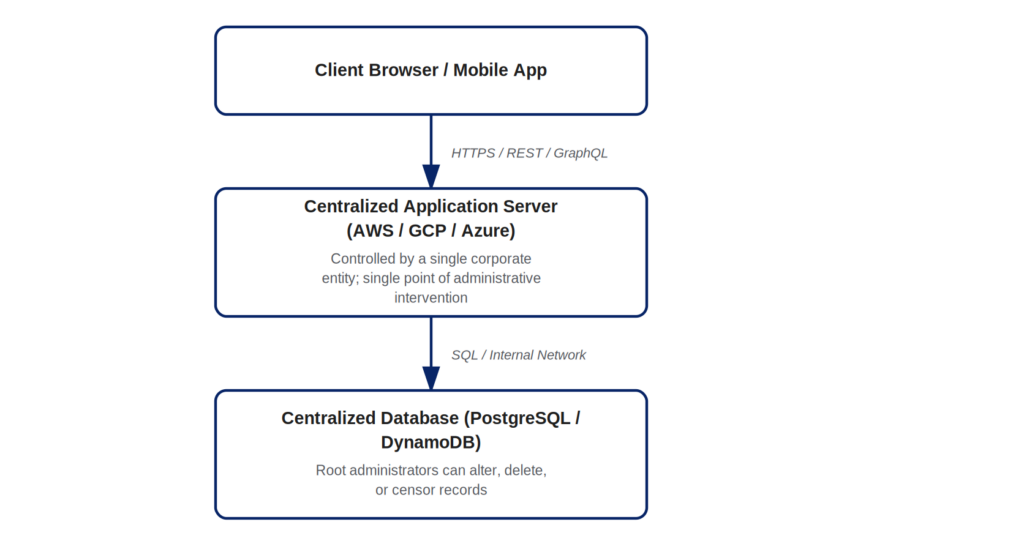
That works fine for almost everything you’ll ever build. But it breaks down in one specific situation: when the people who need to trust the data don’t trust each other, or don’t trust whoever’s running the server. Three ways that shows up in practice:
- Whoever holds the keys, holds the power. Anyone with root or database-admin access can quietly edit a row, backdate a log, or delete a transaction, and there’s often no way for an outsider to prove it happened.
- Rivals won’t run their business on your server. If you’re coordinating with competitors, say, in trade finance or shipping, none of them will route their transactions through a database that one of their rivals owns and controls.
- One outage takes everyone down. If the company hosting the app has a bad day, gets hacked, or shuts your account, you lose access. Full stop.
What Production DApps Actually Look Like: The Hybrid Model
Here’s the part most explainers skip: nobody builds a real DApp entirely on-chain. Putting every piece of your operational data on a public ledger isn’t just expensive, it’s often flatly illegal under privacy law.
So production systems split the difference. The ledger handles the part that needs to be tamper-proof and mutually verifiable. Everything else, your UI, your heavy compute, your actual customer data, sits on ordinary enterprise cloud infrastructure, the same AWS or Azure stack you’d use for any other app.
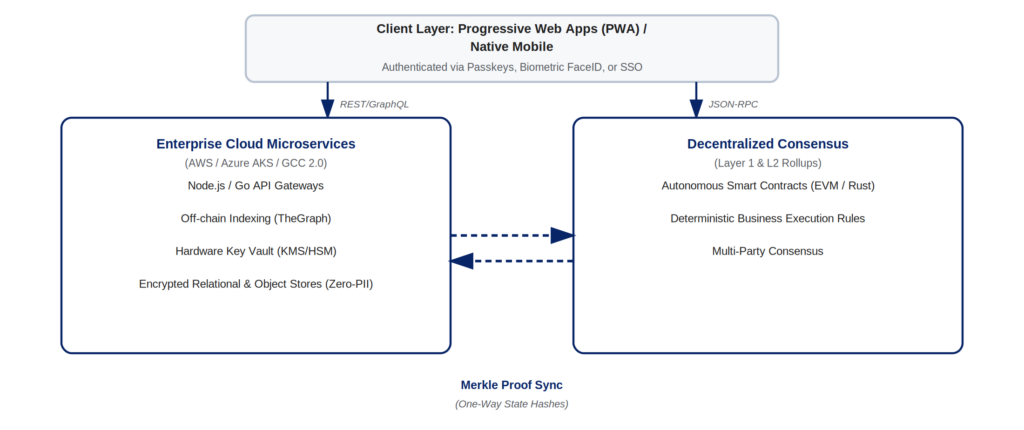
Two halves, one job each. The cloud side runs your business logic and keeps sensitive data locked down. The ledger side handles the multi-party settlement and dispute-proofing. They talk to each other through one-way cryptographic fingerprints, not raw data, so the sensitive stuff never actually crosses over.
What’s Actually Under the Hood
You don’t need to become a blockchain engineer to evaluate this space, but it helps to know roughly what’s being built. Five layers, working together:
| Layer | What Lives Here |
|---|---|
| 1. Settlement & Scaling | Ethereum L1, EVM Layer 2 Rollups (Arbitrum, Base, Optimism), Solana, Hyperledger Fabric |
| 2. Smart Contract Logic | Solidity, Rust (Anchor Framework), Go Chaincode, upgradeable proxy contracts |
| 3. Enterprise Cloud & Data Storage | Azure Kubernetes Service, AWS ECS, key vaults, encrypted databases holding the sensitive stuff |
| 4. Client Handshakes | Viem, Wagmi, Account Abstraction, embedded wallets, native mobile SDKs |
| 5. Testing & Release Pipeline | Automated fuzz testing, static security scanning, staged, gated deployment |
The Ledger Itself
Not every ledger is built for the same job, which is where a lot of first-time evaluations go wrong.
- Layer 1 networks like Ethereum, Solana, and permissioned ledgers provide the base security and final settlement. Think of this as the bedrock everything else sits on.
- Layer 2 rollups (Arbitrum One, Base, Optimism) bundle thousands of transactions together off the main network before checking in with Layer 1, which is what makes fees fractions of a cent instead of dollars.
- Permissioned networks (Hyperledger Fabric) are the enterprise-consortium answer: private channels so competitors can verify a shared truth without exposing their pricing or volumes to each other.
Smart Contracts: The Rules That Run Themselves
A smart contract is really just code that runs exactly the same way for everyone, every time, with no one able to quietly change the outcome after the fact. Written in Solidity for Ethereum-style networks or Rust for Solana, deployed once, and from then on it does exactly what it says on the tin, nothing more, nothing less. Because the code is publicly visible, anyone can check what it actually does before they trust it with anything.
How the Network Agrees on Anything
Without a central boss calling the shots, independent nodes still need to agree on what happened and when. A few different ways that gets solved:
- Proof of Stake: the standard model on Ethereum. Validators put up capital to earn the right to confirm blocks, and lose that capital if they cheat.
- Proof of History (Solana): a cryptographic clock that timestamps events in order, letting the network process transactions in parallel instead of one at a time. This is most of why Solana feels fast.
- Raft or similar (permissioned networks): enterprise consortium chains skip token economics entirely and just use classic distributed-systems consensus, which is faster and doesn’t need a native cryptocurrency.
Logging In Without the Headache
For years, the biggest reason DApps failed to catch on wasn’t the technology. It was onboarding. Users had to install a browser extension, write down 24 random words on paper, and buy cryptocurrency just to pay a transaction fee before they could do anything at all.
That’s mostly gone now. A newer standard called Account Abstraction lets apps offer normal login, FaceID, a passkey, your company SSO, while a smart contract wallet gets set up automatically behind the scenes, and the app itself quietly covers the transaction fee. The user never sees a seed phrase. Most never realize there’s a blockchain involved at all.
How Teams Actually Ship This Safely
One thing that’s genuinely different about shipping a DApp versus a normal app: once the core logic is live, you usually can’t just patch it. That changes how careful the release process has to be. A typical gated pipeline looks like this:
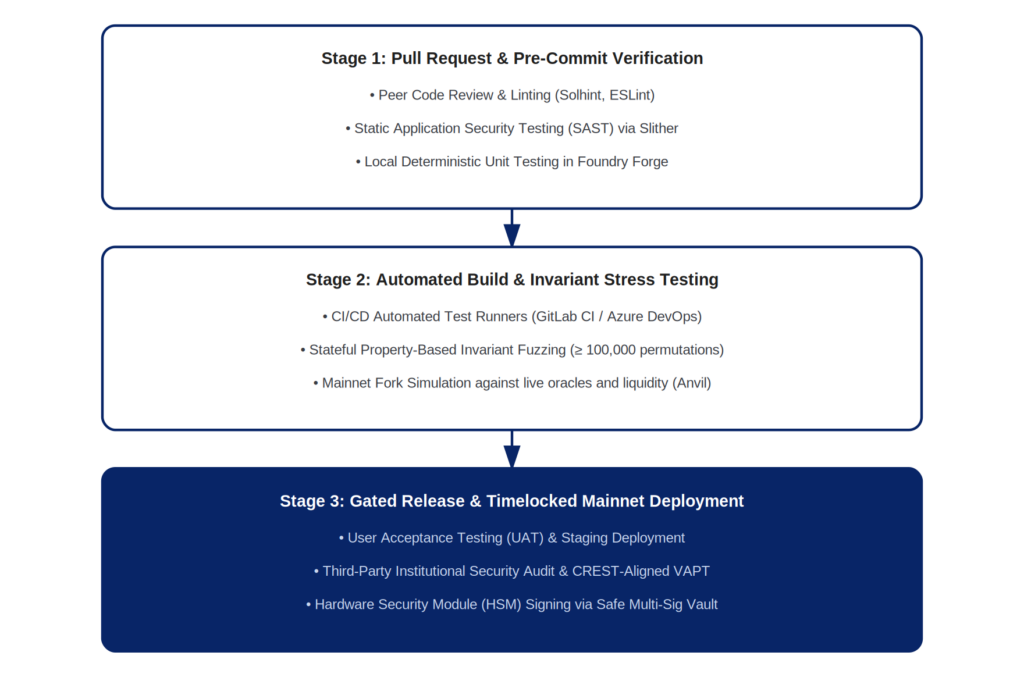
- Before anything merges, automated scans check for the classic mistakes, unhandled edge cases, obvious security holes, before a human even reviews the code.
- Before anything ships to staging, the test suite throws hundreds of thousands of randomized scenarios at the contract, trying to break it in ways a human tester wouldn’t think to try.
- Before anything touches the live network, an independent security team audits it, and the deployment itself requires sign-off from multiple people holding hardware security keys, not one developer with a laptop.
Five Kinds of Problems DApps Actually Solve
DApps aren’t one thing, they’re a shape that gets used for genuinely different jobs. Here’s where that shape shows up in the real world, and what it’s actually doing there.
1. Decentralized Finance (DeFi) & Purpose-Bound Money
The pitch: replace the bank in the middle with code that executes the same way for everyone, all the time, no branch hours.
In practice, this covers three things: automated market-making (swapping one asset for another with no human broker in the loop), lending protocols that adjust interest rates based on live supply and demand, and programmable disbursements, funds that release automatically once a condition is verifiably met, instead of waiting on someone to approve a wire transfer.
The catch isn’t small: a single arithmetic bug or a manipulated price feed can drain a protocol irreversibly, and there’s no customer support line to call afterward. Automated payouts also need real tax logic behind them, not just a wallet address, or you’ve built a compliance headache disguised as a feature.
Where we’ve seen this work: In banking and trade finance engagements, we’ve evaluated Purpose-Bound Money rails aligned with MAS Project Orchid, wrapping tokenized bank deposits in contract logic so that escrow releases and government disbursements fire automatically once an independent oracle confirms delivery. The actual win isn’t the blockchain part, it’s that reconciliation that used to take days now happens the moment the condition is met.
2. Cross-Border Trade & Multi-Carrier Logistics
Global trade still runs on a surprising amount of paper, or worse, paper pretending to be digital. A shipment can pass through a dozen parties, carriers, port authorities, customs brokers, financing banks, none of whom fully trust the others’ records.
DApps here replace that patchwork with a shared ledger everyone can verify but no single party controls: digital bills of lading that can’t be duplicated to commit financing fraud twice, permissioned channels so competitors can confirm a shipment happened without seeing each other’s freight rates, and customs clearances that trigger automatically off tamper-evident sensor data.
The hard part isn’t the cryptography, it’s the politics. You can’t force every shipping line on earth onto one public network; the architecture has to accommodate permissioned channels and open standards, not a single company’s preferred platform.
Where we’ve seen this work: Working with maritime logistics and port terminal operators, we’ve built platforms aligned with IMDA’s TradeTrust standard, keeping freight rates private between the parties who need to see them while committing just the document hashes to a shared ledger. The measurable outcome: customs verification that used to take days of back-and-forth now happens instantly, without anyone leaking commercial volumes to a competitor in the process.
3. Digital Ownership & Verifiable Access
This one’s less about finance and more about proof: proving you actually own something, or actually have access to something, without a company’s database being the only source of truth.
- Vehicle and asset histories that can’t be quietly edited after a service record is logged.
- Access passes, VIP status, event entry, that verify in milliseconds off a phone, no physical card involved.
- Loyalty programs that don’t depend on a separate ticketing platform staying in business.
Where this falls apart is user experience. If your customer has to manage a raw cryptographic key to redeem a loyalty reward, you’ve traded a minor inconvenience for a support nightmare, and probably some very annoyed VIPs.
Where we’ve seen this work: For global luxury automotive and mobility brands, we’ve built booking and ownership platforms wired directly into existing ERP and POS systems, so drivers verify reservations and track-day access from their phone in seconds, no physical pass, no phone call to a concierge desk, while the actual driver data stays behind enterprise-grade firewalls the whole time.
4. Statutory Identity & Tamper-Evident Registries
Certificates, licenses, patent filings, anything a government or institution issues that a third party later needs to verify is genuine. Paper and static PDFs are trivially forged. A centralized verification portal is a single point of failure.
- Instant verification of a certificate or filing, no phone call to the issuing office required.
- Revocation that updates in real time if a credential is later invalidated.
- Formats that work across borders instead of just one country’s system.
The one rule that can’t be broken here: never put the actual personal data on-chain. Names, ID numbers, and patent disclosures on an immutable public ledger is an instant, unfixable violation of privacy law, not a minor oversight.
Where we’ve seen this work: In technical work for statutory intellectual property and patent registries, we’ve built verification systems that never post the actual filing on-chain, only a cryptographic fingerprint of it. Third-party litigators and foreign patent offices can confirm a document is genuine in milliseconds, without ever touching the underlying registry database.
5. Physical Infrastructure Networks (DePIN) & Utilities
The newest category on this list, and arguably the strangest-sounding one: using token incentives to crowdsource physical hardware, energy meters, telecom nodes, environmental sensors, at a scale no single company could fund alone.
- Turning raw sensor readings into verifiable, aggregated proof.
- Issuing renewable energy certificates automatically once generation thresholds are actually hit, not self-reported.
- Settling energy trades directly between independent producers and consumers.
The technical trap here is volume. Sensors generate enormous amounts of raw data, and streaming all of it straight onto a ledger will bloat it into uselessness almost immediately. You batch first, then commit the summary.
Where we’ve seen this work: For national utilities and listed infrastructure providers, we’ve built platforms that capture telemetry and generation data in ordinary cloud infrastructure, then periodically commit a batched cryptographic summary to the ledger. That one change closed a real gap: double-counting in ESG disclosures, the kind of error that undermines an entire sustainability report, became mathematically impossible instead of merely policed against.
Trying to Figure Out If Your Use Case Actually Needs a DApp?
That’s genuinely a harder question than most vendors will admit, and half the value is someone telling you honestly when the answer is no. Book a free architecture consultation with our Singapore team and we’ll walk through your specific case, no commitment required.
What This Looks Like in Production Today
Abstract categories are one thing. Here’s what’s actually running, at real scale, right now:
| Platform | Category | What It’s Actually Doing | Why It Matters |
|---|---|---|---|
| Uniswap v4 | DeFi Trading | Processes tens of billions in monthly volume through automated liquidity pools, no broker-dealer in sight. | Proves complex market-making can run entirely on code, with zero human escrow agents. |
| Aave v3 | Lending | Runs automated collateralized lending with interest rates that adjust themselves and flash-loan mechanics. | Shows programmatic collateral management works at genuinely institutional scale. |
| IMDA TradeTrust | Trade Documents | An open framework connecting digital bills of lading across shipping carriers, banks, and customs authorities. | Proves competing companies can share a verified truth without sharing a database. |
| Arbitrum One / Base | Layer 2 Execution | Bundles thousands of transactions off-chain before checking in with Ethereum. | Cuts fees and latency by over 95%, making DApps cost-competitive with ordinary cloud APIs. |
| Farcaster / Lens | User-Owned Identity | Social and identity protocols where your profile and content live in your own wallet, not a company’s server. | No platform lock-in: developers can build independent apps on top of the same shared data. |
Where This Actually Gets Hard
Every architecture has trade-offs, and DApps have four that catch people out more than any others. Worth knowing these before you’re halfway through a build, not after.
1. Public Ledgers Aren’t Private by Default
A common and genuinely dangerous assumption: that a blockchain gives you privacy. It’s the opposite. Public ledgers are transparent by design, every balance, every transaction, every contract call is permanently visible to anyone running a block explorer.
Put a customer’s name, ID number, or medical record directly on an immutable ledger, and you’ve broken the law the moment it’s confirmed, not “created some risk,” broken it. Under Singapore’s PDPA and the EU’s GDPR, people have a legal right to have their data deleted. Once it’s written into an immutable block, there’s no deleting it without destroying the whole chain.
The fix, once you know it, is simple: never let personal data touch the ledger in the first place. This is the same Zero-PII pattern you’ll see in any production-grade DApp.
- Keep the actual customer records in an encrypted, ordinary database, not on-chain.
- Only ever commit a one-way cryptographic fingerprint of that data to the ledger.
- When a customer asks you to delete their data, destroy the off-chain record and its encryption key. The on-chain fingerprint becomes permanently meaningless, mathematically, not just by policy, while the audit trail stays intact.
2. Blockchains Are Just Slower Than Databases, Full Stop
A well-tuned relational database on decent hardware handles over 50,000 writes a second, with latency measured in fractions of a millisecond. A blockchain has to broadcast every transaction across a global network and get everyone to agree before it counts, which is a fundamentally slower process by design, not a bug someone forgot to fix.
Ethereum’s base layer tops out around 15 to 30 transactions per second, with a new block roughly every 12 seconds. During busy periods, fees spike hard enough to genuinely break your unit economics, and users watching a transaction sit in limbo tend to assume it’s broken.
The fix isn’t to fight the ledger’s nature, it’s to stop putting consumer-facing logic directly on Layer 1 at all. Modern DApps settle on Layer 2 rollups or fast parallel networks like Solana instead, dropping fees to fractions of a cent and confirmation times under 500 milliseconds. The rule of thumb: heavy, frequent traffic belongs in your cloud infrastructure; only the final settlement and the proof belong on-chain.
3. Nobody Wants to Manage a Seed Phrase
For years, this was the actual barrier, not the cryptography, the onboarding. Users were expected to install a browser extension, write 24 random words on paper and not lose them, and buy cryptocurrency just to pay a gas fee before doing anything useful at all.
Ask an employee or a customer to manage a raw private key and you’ve handed them a real risk: lose the key, or fall for a phishing link, and whatever it controlled is gone permanently. No support line fixes that.
This is close to solved now. Account Abstraction lets people log in with FaceID, a hardware passkey, or their existing company SSO. A smart contract wallet gets created automatically behind the scenes, and the app itself quietly covers the gas fee through a relayer. The end result feels like any other app. Most users never realize there’s a blockchain underneath at all.
4. Deployed Code Doesn’t Get a Second Draft
A normal app with a bug gets a hotfix within the hour. A deployed smart contract is, for all practical purposes, permanent. That’s the whole point of it, and it’s also the scariest part.
An unvetted contract with an arithmetic flaw or a logic hole can be drained irreversibly the moment someone finds it. And the obvious fix, making contracts upgradeable, introduces its own trap: if a developer adds a new variable in the wrong order during an update, the contract can start reading old balances or admin permissions from the wrong memory location entirely. Not a cosmetic bug. A very expensive one.
The way teams actually manage this:
- Reserve extra storage space in the original contract so future updates have somewhere safe to grow into, instead of shuffling existing data around.
- Run continuous automated testing that throws well over 100,000 randomized scenarios at the contract before it ever reaches staging.
- Require every upgrade to pass through a multi-signature vault with a mandatory 48- to 72-hour delay, so there’s always a visible window before a change goes live, not a single developer with deploy access at 2am.
When You Genuinely Don’t Need One
An honest architect will talk you out of a blockchain more often than they’ll recommend one. Forcing a distributed ledger onto a problem that’s fundamentally centralized just adds cost, complexity, and a slower app for no real benefit. A few scenarios where the answer is simply: don’t.
| If This Is Your Situation… | …Here’s What to Use Instead |
|---|---|
| Only your own employees use the system | No outside party to verify anything for; a distributed ledger just adds latency. Use PostgreSQL/Redis. |
| You’re logging high-frequency raw sensor data | Raw telemetry will bloat a chain almost immediately. Use a time-series database and batch the summary. |
| You’re constantly editing large records or media | Frequent edits and big files violate both gas economics and privacy law on-chain. Use S3/GCC 2.0 with a hash reference. |
| One party already has full legal authority | If a single trusted party can already override every decision, a consensus engine adds friction without adding trust. |
- Internal-only workflows: If an app only serves people inside your own organization, a distributed ledger adds zero value. A properly audited PostgreSQL database with encrypted logs gives you the same auditability, sub-millisecond writes, and roughly 60% lower running costs, not a minor saving, a genuinely different budget line.
- Raw, high-frequency telemetry: Millions of sensor pings or GPS coordinates written directly to a blockchain will bloat it fast and cost a fortune in fees. Stream that into a proper time-series database instead, and only commit a periodic summary hash to the ledger.
- Frequently-edited profiles or media: Large files and constantly-changing user profiles don’t belong on-chain, full stop, both because of gas costs and because PDPA doesn’t care that your architecture was convenient. Store the rich media in an encrypted object store and put only a hash on the ledger.
- A single legal arbiter already exists: If one entity legitimately has final say, an internal HR policy, for instance, a decentralized consensus engine doesn’t create genuine decentralization. It just adds friction to a decision someone already has full authority to make.
The Quick-Reference Version
If you just need a direct answer for a Monday morning meeting, here it is, no preamble:
Building something institutional, a tokenized fund, MAS Project Guardian-aligned?
Ethereum plus a Layer 2 like Arbitrum or Base. You need liquidity depth, established compliance token standards, and compatibility with institutional custodians.
Coordinating logistics or trade finance between companies that don’t fully trust each other?
Hyperledger Fabric. Competitors will never put pricing or volume data on a public network; private channels aren’t optional here, they’re the entire point.
Building a consumer app, a loyalty program, anything with real everyday users?
Solana. If someone hits a 12-second wait or an unexpected gas popup, they’ll just leave. You need sub-second execution and fees the user never has to think about.
Just managing internal data with no outside parties involved?
Skip the blockchain. PostgreSQL with proper audit logging does the same job for a fraction of the cost and complexity.
Four Questions Worth Asking Before You Commit Budget
Whoever’s proposing the build, internal team or outside vendor, should have a clear, specific answer to each of these. “We’ll figure it out” isn’t one.
| Ask This | Because |
|---|---|
| Does personal data ever touch the ledger? | It shouldn’t, ever. Confirm crypto-shredding is actually built in, not just promised. |
| Is the testing pipeline running real fuzz tests? | Hundreds of thousands of randomized scenarios, not a handful of unit tests someone wrote by hand. |
| Where do the private keys actually live? | Hardware security modules, not an environment variable someone can screenshot. |
| Can contracts be safely upgraded? | Proper proxy architecture with a mandatory delay and multi-party sign-off, not a single developer with deploy access. |
- Zero personal data on-chain, by design: Confirm nothing that identifies a real person, name, ID number, address, ever gets written to the ledger. Sensitive data belongs in an encrypted database, with only a one-way proof committed on-chain.
- Real, automated stress-testing: The pipeline should be throwing well over 100,000 randomized scenarios at the contract before it ever reaches mainnet, not relying on a developer’s intuition about what might break.
- Keys held properly, not casually: Anything signing transactions on your behalf should be doing it through a hardware security module, never a private key sitting in a config file or an environment variable.
- Upgrades that can’t happen by accident: Contracts should use a proper upgradeable-proxy pattern, governed by a multi-signature vault with a mandatory delay window, so no single person can push a change unnoticed.
Where This Goes Next
Three shifts worth having on your radar, even if none of them change what you’d build today:
1. You Won’t Know You’re Using One
The push toward invisible Web3 keeps accelerating. Between passkey logins, session keys, and automatic fee sponsorship, the end state is a DApp that feels exactly like any other app. Users increasingly won’t know, or need to know, that a blockchain is involved at all.
2. AI Agents Need Rails Too
Autonomous AI agents can’t exactly open a bank account or pass a KYC check the way a human does. Smart contracts give them something traditional banking rails can’t: a programmable, permissionless way to pay for compute, license data, or transact with other agents automatically, without a human approving each step.
3. Deeper Ties to National Infrastructure
Rather than staying in a crypto-native bubble, this keeps connecting to systems you already interact with:
- Sovereign digital identity, like Singapore’s Singpass, tying into verifiable credentials.
- Direct links to land registries and trade rails, TradeTrust being the clearest example already live.
- Tokenized deposits and central bank digital currencies, the kind of thing MAS is actively piloting under Project Guardian and Project Orchid.
Quick Answers to the Questions People Actually Ask
Are DApps faster than a normal app?
No, and it’s not close. A centralized app writing to a single database will always be faster for raw processing, there’s no network of strangers that needs to agree first. What you get with a DApp instead is fault tolerance, censorship resistance, and mutual trust between parties who don’t otherwise trust each other. Modern Layer 2 networks and Solana have closed the gap a lot, sub-second confirmations are normal now, but the honest answer is still no.
How do smart contracts actually enforce anything?
Because the code is public and runs the same way for everyone, no one, not even the company that deployed it, can quietly change the terms after the fact or reverse a transaction once it’s confirmed. An escrow release or a vote either happens exactly as written, or it doesn’t happen at all. There’s no manager who can make an exception.
Can a DApp be shut down?
Not by any single company, cloud provider, or government, as long as independent nodes keep running it. What can be blocked is the front door, a specific website domain or a centralized API provider, which is why serious projects host their actual interface on decentralized storage as a backup, not just a regular web server.
What do people actually build these in?
Solidity for anything Ethereum-compatible, Rust through the Anchor framework for Solana, Go or Java for permissioned networks like Hyperledger Fabric. The frontend is usually ordinary React or Next.js, talking to the blockchain through lightweight libraries like Viem or Wagmi, nothing exotic on that side at all.
Where This Leaves You
DApps aren’t a universal upgrade, and they’re not hype either. They’re a genuinely different tool that earns its keep in one specific situation: when multiple parties need to trust a shared outcome, and no single one of them should hold the only key.
If that’s not your situation, a well-built database will beat a blockchain on every axis that matters, and there’s no shame in that being the right answer. If it is your situation, the hard part isn’t the cryptography anymore, it’s getting the privacy architecture, the user experience, and the upgrade path right at the same time.
We’ve spent 16+ years building enterprise software, and the last several of those years applying that same discipline to distributed systems, currently 300+ delivered projects for 300+ clients, under ISO 9001 and ISO 27001 certification. We’re also a Financial Times Top 500 High-Growth Company for Asia-Pacific in 2026, and a Straits Times Fastest-Growing Company three years running.
If you’re trying to work out whether a DApp is the right call for what you’re building, or you already know it is and need someone to build it properly, that’s exactly the conversation our team has every week.
Vinova: Singapore’s blockchain and enterprise engineering partner since 2010. ISO 27001:2022 and ISO 9001:2015 certified.
300+ in-house engineers across Singapore and regional development centers. We build the hybrid, Zero-PII DApps this guide describes, so you don’t have to gamble your architecture on hype.
Financial Times Top 500 High-Growth Companies Asia-Pacific 2026. The Straits Times Singapore’s Fastest-Growing Companies 2024, 2025, and 2026.