Author: Enterprise Solutions Architecture Practice at Vinova
Category: Enterprise Systems Architecture & Distributed Computing | Market Focus: Singapore & Southeast Asia | Updated: 2026
Review Standard: Enterprise DevSecOps & MAS Regulatory Compliance Alignment
Evaluating blockchain development frameworks for an institutional system cannot be governed by single-stack dogmatism. Yet walk into an enterprise tech discovery session across Singapore, and you will routinely encounter agencies pitching a single hammer: a Solidity vendor insisting an EVM rollup solves every supply-chain confidentiality requirement, or a private-ledger consultant dismissing public networks entirely.
In production, architectural dogmatism generates severe technical debt. Selecting the wrong ledger topology doesn’t just mean rewriting smart contracts; it means failing a Monetary Authority of Singapore (MAS) regulatory review, exposing commercial counterparty metadata to market competitors, or locking your platform into an isolated data silo where institutional capital cannot settle.
Regional enterprises cannot afford exploratory trial and error. Drawing from Vinova’s 16+ years of software engineering leadership, 300+ delivered enterprise systems, and an institutional delivery track record across statutory agencies, critical utility providers, and leading public healthcare clusters, this blueprint provides technical leaders and architectural review boards (ARBs) with a calibrated framework to evaluate blockchain development frameworks, navigate engineering compromises, and deploy secure, compliant infrastructure.
Table of Contents
Key Takeaways:
- EVM & Layer 2 Rollups (Arbitrum/Base): The non-negotiable rail if your system requires institutional capital liquidity, secondary market trading, custody integration (Fireblocks), or MAS Project Guardian compliance. Slower base execution and potential state contention, but unbeatable financial composability.
- Hyperledger Fabric: The corporate fortress. Zero gas volatility, zero public ledger exposure, and native private data collections. Mandatory for competing consortia (maritime logistics, interbank clearing, utilities) who refuse to expose trade velocity or pricing metadata on public rails.
- Solana (via Anchor): The high-concurrency engine. Sub-second finality (~400ms) and micro-penny fees (~$0.0005) built for high-frequency consumer loyalty, retail payments, and micro-rebates where users refuse to wait on block confirmations or pay gas.
- Institutional Risk Realities: No software partner can hold an “MAS Web3 License.” What separates genuine compliance from compliance theater is ISO 27001-certified operational segregation, zero-PII on-chain architectures, and automated invariant fuzz testing before mainnet deployment.
Institutional Toolchains as Enterprise Risk Management
Distributed ledger technology has transitioned from experimental proof-of-concept sandboxes into mission-critical transactional infrastructure and institutional financial plumbing. Across Singapore and Southeast Asia, institutional initiatives operate under strict production requirements:
- Asset managers and private credit syndicates issue tokenized debt instruments and structured funds under MAS Project Guardian guidelines.
- Maritime logistics networks and port operators reconcile cross-border customs documentation and electronic bills of lading across decoupled enterprise clouds.
- National utilities and industrial conglomerates track verifiable renewable energy certificates (RECs) and manage carbon provenance with statutory auditability.
However, enterprise software architecture requires selecting blockchain development frameworks whose execution constraints match explicit compliance boundaries, data sovereignty mandates, and latency requirements:
- A multi-party supply chain or public-sector registry demands private communication channels, verifiable data integrity without public disclosure, and zero balance-sheet cryptocurrency exposure—the architectural domain of Hyperledger Fabric.
- An institutional tokenized fund or real-world asset (RWA) requires secondary-market liquidity, institutional custody integration (Fireblocks), and programmable transfer restrictions—mandating Ethereum and EVM Layer 2 rollups.
- A high-velocity retail payment railway, consumer micro-rebate engine, or merchant loyalty platform requires sub-second finality and predictable micro-penny fees—necessitating the parallelized runtime of Solana.
At Vinova, we treat blockchain software development tools and framework selection as an institutional risk mitigation exercise. Below is the blueprint our consulting squads deploy across enterprise and statutory-grade implementations.
Leading Blockchain Development Frameworks: EVM, Fabric, and Solana
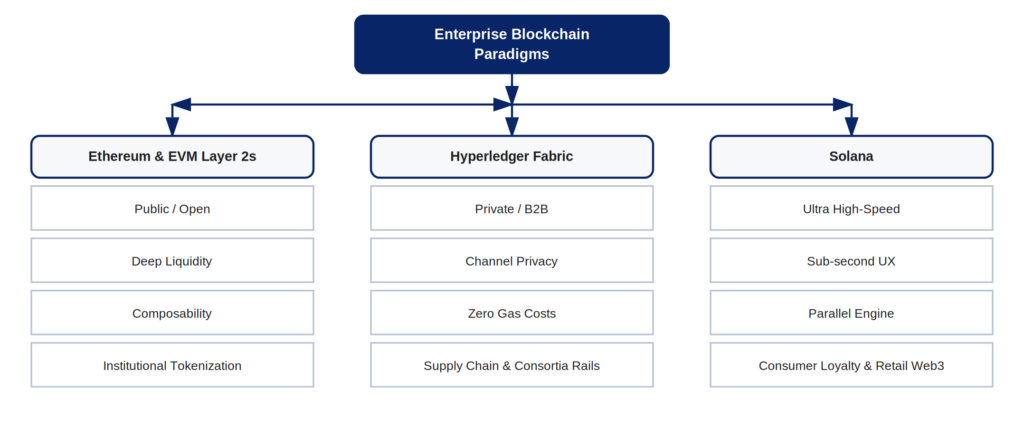
Modern enterprise Web3 systems fall into three distinct architectural models. A mature engineering partner must demonstrate verified production fluency across all three, selecting frameworks based entirely on functional constraints rather than single-stack advocacy.
1. Ethereum & EVM Layer 2s: The Bedrock of Institutional Capital
“The institutional liquidity rail. You don’t deploy here for raw database throughput; you deploy here because custody providers like Fireblocks support it out of the box and secondary markets require financial composability.”
— Lead Enterprise Architect, Vinova
When evaluating blockchain development frameworks for institutional liquidity and programmable settlement, Ethereum and its Layer 2 rollups remain the global benchmark. Ethereum serves as the sovereign settlement standard for programmable decentralized protocols and tokenized real-world assets (RWAs). Its execution environment, the Ethereum Virtual Machine (EVM), commands the deepest developer ecosystem, battle-tested cryptographic primitives, and institutional capital liquidity globally.
- Smart Contract Logic: Logic execution is authored in Solidity (the universal standard for EVM state transitions) and Vyper (a security-focused language with restricted control flows designed for formal auditability and mathematical transparency).
For the fundamentals of how this logic actually executes, see our smart contract development guide.
- Layer 2 Rollup Acceleration: To bypass base-layer throughput caps (~15 TPS) and unpredictable gas contention, modern enterprise architectures deploy to production-grade optimistic and zero-knowledge rollups, including Arbitrum One, Optimism, and Base. These environments inherit Ethereum Layer 1 economic finality while slashing transaction latency to sub-second confirmations.
- Core Enterprise Applications: Real-World Asset (RWA) tokenization, debt securities issuance, institutional liquidity vaults, and interoperable digital payment token (DPT) payment channels.
⚠ The Architectural Reality Check
Layer 2 rollups slash execution fees to pennies, but contracts with unoptimized storage layouts (SSTORE opcodes) still create volatile overhead under state contention. Furthermore, cross-chain relayer bridges between L1 and L2 introduce external off-chain attack surfaces that demand rigorous multi-sig governance, rate limiting, and timelock delays.
2. Hyperledger Fabric: Consortium Privacy for High-Stakes Rails
“The enterprise boardroom. Operationally demanding and completely devoid of public Web3 hype, but it is the only architecture corporate legal counsels and competitive consortia will sign off on for bilateral trade confidentiality.”
— Lead Enterprise Architect, Vinova
Among enterprise-permissioned blockchain development frameworks, Hyperledger Fabric remains the benchmark for consortia that require cryptographic auditability, zero public exposure, and zero balance-sheet cryptocurrency liability. Hosted under the Linux Foundation, it eliminates public mempools entirely.
- Architecture & Determinism: Fabric abandons non-deterministic PoW/PoS mempools in favor of an execute-order-validate transaction lifecycle. Business logic runs as isolated chaincode containers authored in compiled, enterprise-standard languages including Go (Golang) and Java.
- Private Data Collections & Channels: Fabric enables bilateral and multilateral transactional confidentiality through dedicated channels and Private Data Collections (PDCs). Counterparties can validate state transitions on a shared ledger without disclosing pricing matrices, client identifiers, or transaction volumes to competing peer nodes.
- Core Enterprise Applications: Cross-border maritime trade documentation, interbank clearing syndicates, statutory intellectual property registries, and verifiable operational tracking across critical public utilities.
⚠ The Architectural Reality Check
Operational orchestration overhead is severe. Managing mutual TLS (mTLS) certificate authorities, coordinating Raft consensus across isolated enterprise clouds, and executing multi-organization chaincode lifecycle approvals demands heavy Kubernetes and DevSecOps engineering. If your organization lacks dedicated platform engineering, operational maintenance will escalate rapidly.
3. Solana: Parallelized Execution for High-Throughput Consumer Services
“Parallelized execution at scale. It delivers sub-second Web2 response times and makes gas invisible to the user, provided your engineering team understands rigid memory layouts and compute budgets.”
— Lead Enterprise Architect, Vinova
For organizations evaluating blockchain development frameworks optimized for ultra-high concurrency, Solana was engineered to eliminate distributed database state contention without resorting to fragmented sharding or off-chain state channels. By combining Proof-of-Stake with Proof-of-History (PoH) and the parallelized Sealevel transaction runtime, Solana delivers high throughput on a single global state.
- Tooling & Engineering Frameworks: Solana on-chain programs are authored in Rust and structured via the Anchor Framework, which provides declarative account validation, standardized binary serialization (Borsh), and automated IDL generation.
- Deterministic Performance: Processing thousands of transactions per second with ~400-millisecond slot times and predictable, sub-cent transaction costs (~$0.0005), Solana eliminates execution bottlenecks for consumer-facing systems.
- Core Enterprise Applications: High-frequency retail payments, nationwide merchant loyalty programs, mobile-first Web3 applications, and institutional foreign exchange (FX) settlement.
⚠ The Architectural Reality Check
Strict compute unit limits (200,000 CU default) and manual account serialization in Anchor mean unoptimized instructions fail at the runtime boundary without descriptive stack traces. Furthermore, because transactions declare all account read/write locks in advance, high-concurrency writes to a single global account will induce local fee market contention and throughput degradation.
Comparative Enterprise Architecture Matrix & Decision Heuristics
To assist Architectural Review Boards (ARBs) in benchmarking these blockchain development frameworks, the comparative matrix below outlines core protocol mechanics and operational boundaries:
| Architectural Dimension | Ethereum & Arbitrum (EVM) | Hyperledger Fabric | Solana |
|---|---|---|---|
| Network Governance | Public / Permissionless (or L2 Rollup) | Private / Permissioned Consortium | Public / Permissionless |
| Consensus Mechanism | Proof-of-Stake (PoS) | Pluggable (e.g., Raft, BFT) | Proof-of-History (PoH) + PoS |
| Smart Contract Logic | Solidity, Vyper | Go (Golang), Java | Rust (via Anchor Framework) |
| Transaction Economics | Dynamic gas (negligible on L2s) | Zero token fees (internal compute) | Deterministic micro-fees (~$0.0005) |
| Throughput & Finality | ~15–100+ TPS (L1/L2); ~12s finality | High (bounded by hardware); instant finality | 2,500–5,000+ TPS; ~400ms finality |
| Data Privacy & Access | Pseudonymous; ZK-proofs for privacy | Native private data channels & collections | Pseudonymous; transparent state access |
| Target Singapore Use Case | MAS Project Guardian RWAs, Tokenized Funds | Cross-Border Maritime Logistics, Critical Utilities | High-Volume Retail FinTech, Loyalty Rails |
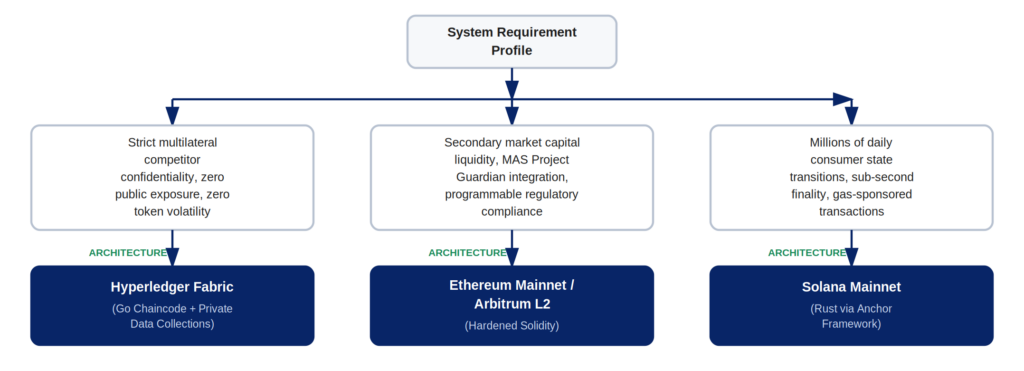
Architectural Selection Heuristic (If-This-Then-That Logic)
When technical steering committees evaluate network topology across leading blockchain frameworks, we provide this deterministic decision rubric:
Strategic Architecture Lessons & Production Vignettes
Drawing from Vinova’s engagements delivering large-scale digital platforms for institutional clients and statutory bodies, our solutions architects highlight three strategic lessons when selecting network topology:
Lesson 1: Network Effects Drive Capital Liquidity (The EVM Paradigm)
If your enterprise product requires secondary market trading, institutional custody integration (Fireblocks, Copper), or composability with existing financial rails, launching within EVM-compatible blockchain development frameworks is mandatory. Building an isolated proprietary chain where no capital resides introduces fatal liquidity friction.
Production Vignette – Institutional Asset Tokenization: For an institutional asset tokenization engagement structured around MAS Project Guardian compliance standards, a financial services client required secondary-market transfer restrictions between accredited institutional investors. Our solutions squad engineered an EVM-based architecture on Arbitrum, incorporating custom compliance whitelisting, off-chain KYC oracle verifications, and automated freeze/pause controls directly into the smart contract lifecycle. By remaining EVM-native, the client retained plug-and-play interoperability with institutional custodians while enforcing Singapore regulatory boundaries on every transaction.
Lesson 2: Confidentiality Dictates Consortium Adoption (The Hyperledger Paradigm)
Enterprise consortia across competitive sectors (shipping carriers, commercial banks, energy distributors) will flatly refuse to deploy onto public rails where transaction metadata or trade velocity can be scraped. Granular channel privacy within permissioned blockchain frameworks is not an optional feature; it is an onboarding condition.
Production Vignette – Cross-Border Maritime Logistics: In an architectural discovery for a regional maritime logistics consortium, multiple competing port operators, shipping lines, and trade finance banks required a shared provenance ledger for electronic bills of lading without exposing commercial tariffs or freight volumes to market rivals. Our squad architected a Hyperledger Fabric implementation utilizing Private Data Collections (PDCs) and segregated channels. Bilateral tariff and cargo documentation remained cryptographically isolated strictly between transacting parties, while zero-knowledge transaction commitments were committed to the ordering service to guarantee immutable provenance across all consortium peers.
This kind of multi-party provenance tracking extends well beyond bills of lading. See our piece on blockchain applications across the wider supply chain for more.
Lesson 3: User Experience Governs Consumer Retention (The Solana Paradigm)
In consumer applications, users will not tolerate 15-second block latencies, wallet authorization pop-ups for minor state changes, or fluctuating transaction fees. High-throughput parallel engines allow enterprises to sponsor user gas and provide invisible Web3 infrastructure.
Production Vignette – High-Velocity Consumer Loyalty Engine: For a high-frequency consumer loyalty and micro-rebate network handling tens of thousands of daily state updates across regional retail merchants, base-layer latency and erratic transaction fees presented an existential threat to user adoption. Vinova’s engineering squad authored native Solana programs utilizing the Anchor Framework paired with custom gas-sponsorship (paymaster) relayers. This architecture delivered sub-second token redemptions with zero user-facing gas overhead, providing a frictionless Web2 consumer experience backed by decentralized auditability.
Not Sure Which Architecture Fits Your System?
Vinova maintains dedicated, in-house squads across Solidity, Rust, and Go, so our architecture recommendation is based on your compliance and throughput requirements, not which stack we happen to sell.
Modern Blockchain Software Development Tools and Engineering Environments
Deploying mission-critical systems across these blockchain development frameworks requires a disciplined engineering toolchain to serve as an enterprise’s first line of operational defense. Smart contracts execute in unforgiving, adversarial runtime environments. Once compiled and deployed to an immutable ledger, logic cannot be patched with an out-of-band hotfix.
| Engineering Domain | Vinova Toolchain |
|---|---|
| EVM Development | Foundry (forge, cast, anvil) — Rust-based testing; Hardhat — complex deployment orchestration |
| Solana Ecosystem | Anchor Framework — IDL, serialization, safety; Solana CLI & Local Validator test environments |
| Enterprise Rails | Hyperledger Fabric SDK (Go, Node.js); multi-peer consortium local Docker networks |
| Client & Frontend | Viem & Wagmi — type-safe, high-speed EVM client; Ethers.js v6 & Solana Web3.js; React, Next.js, Flutter mobile applications |
The Languages of On-Chain Execution: Solidity, Rust, and Go
Solidity: The standard for EVM state transition logic. Vinova engineers author hardened, gas-optimized Solidity code utilizing OpenZeppelin production baselines, enforcing reentrancy guards, packed storage layout slots, and role-based access architectures (AccessControlDefaultAdminRules).
Rust: Employs zero-cost abstractions, deterministic memory safety, and strict compile-time borrow checking. We pair Rust with the Anchor Framework to author auditable Solana programs that enforce strict account ownership boundaries and protect against unauthorized instruction spoofing.
Go (Golang): The standard of enterprise cloud infrastructure. We utilize Go to author modular, high-performance chaincode for Hyperledger Fabric, ensuring native concurrency and seamless integration with enterprise message buses (Apache Kafka) and relational databases.
Modern Blockchain Software Development Tools: Retiring Deprecated Stacks
The Web3 developer ecosystem has matured significantly. Legacy tools like Truffle and Ganache were formally sunsetted and deprecated by Consensys in 2023; maintaining them in 2026 pipelines represents a severe technical liability. Vinova engineers with modern, high-performance blockchain software development tools:
- Foundry (forge, cast, anvil): Our primary development and testing suite for EVM networks. Authored in Rust, Foundry executes test suites orders of magnitude faster than JavaScript-based environments, executing property-based fuzzing and deterministic mainnet state forking via Anvil.
- Hardhat: Maintained in our pipelines for multi-chain deployment orchestration, complex continuous integration (CI) automation, and cross-system integration verification.
- Anchor Framework: The production standard for Solana engineering, managing account byte allocation, Interface Definition Languages (IDLs), and instruction constraint verification.
- Viem & Wagmi: Lightweight, type-safe client libraries replacing bulky legacy Web3 packages, drastically improving frontend bundle performance and ensuring secure wallet handshakes within enterprise Next.js and React portals.
Multi-Stage Verification: Invariant Fuzzing and Mainnet Forking
To safeguard enterprise clients against economic exploits, reentrancy vectors, and state corruption, Vinova enforces a three-tier pre-audit pipeline:
- Deterministic State Simulation: Executing test cycles against live-forked mainnet state using Anvil and local Solana validators, verifying transaction execution against real liquidity pools, oracles, and custody contracts without exposing logic to public testnets.
- Automated Fuzzing & Invariant Testing: Running hundreds of thousands of randomized inputs through Foundry test runners to systematically discover edge cases, integer boundary violations, and unauthorized state transitions across different blockchain frameworks.
- Static Analysis & Formal Linting: Embedding automated analysis engines (including Slither) directly into our CI/CD pipelines to flag common vulnerability patterns before any code is submitted for third-party institutional audits.
For the full five-phase audit pipeline this feeds into, see how we build secure, institutional-grade smart contracts.
Vinova’s Enterprise Blockchain Technology Stack
Vinova delivers end-to-end engineering—from technical feasibility studies and system architecture down to chaincode deployment, enterprise integration, and mobile frontends.
- Smart Contract Languages
- Solidity (EVM Networks)
- Rust (Solana Program Runtime)
- Go / Golang (Hyperledger Fabric Chaincode)
- Engineering Frameworks & Toolchains
- Foundry (Forge, Anvil, Cast)
- Hardhat Suite
- Anchor Framework (Solana)
- Production Ledger Environments
- Ethereum Mainnet & EVM Layer 2s (Arbitrum One, Base)
- Solana Mainnet
- Hyperledger Fabric (Private / Consortium Deployments)
- Integration, Security & Enterprise Infrastructure
- Client Toolkits: Viem, Wagmi, Ethers.js (v6), Solana Web3.js
- Application Layer: React, Next.js, Flutter, NestJS, Go Microservices
- Decentralized Storage & Oracles: IPFS, Chainlink
- Enterprise Cloud & SecOps: AWS, Docker, Kubernetes, AWS KMS / HSM
Objective Advisory: Eliminating Single-Framework Bias
Many boutique development agencies specialize in a single paradigm—a Solidity-only shop will reflexively advocate for an EVM rollup, even when a client’s business model requires the strict private channels of Hyperledger Fabric or the sub-second finality of Solana.
Because Vinova maintains dedicated, in-house squads across Solidity, Rust, and Go, our advisory across different blockchain development frameworks remains strictly objective. We assess your transactional throughput, data privacy obligations, and compliance requirements first, selecting the framework that serves your strategic roadmap.
If you want to see how other providers stack up on this same objectivity question, our comparison of blockchain development companies in Singapore is a useful reference point.
The 4-Layer Enterprise Security Moat
In enterprise Web3, code security cannot exist in isolation from operational infrastructure. Validated across rigorous security frameworks for Singapore statutory boards and national critical infrastructure providers, Vinova enforces a 4-Layer Enterprise Security Moat across every dedicated development engagement:
This moat applies the same principles our cybersecurity practice runs on client-side infrastructure generally, not just smart contract deployments.
| Layer | Focus | Controls |
|---|---|---|
| Layer 1: Governance & Compliance | The Foundation | Dual ISO 9001 & ISO 27001 ISMS; mandatory security vetting & NDAs; PDPA alignment & periodic audits |
| Layer 2: Physical Security | The Fortress | Biometric & keycard segregation; dedicated, locked project rooms; zero shared co-working space |
| Layer 3: Network Security | The Moat | Air-gapped dev zones & firewalls; blocked personal webmail/clouds; segregated VLANs per enterprise |
| Layer 4: Endpoint Security | The Guards | Full-disk encryption; disabled USB ports & Bluetooth; continuous vulnerability scanning |
Layer 1 – Governance & Compliance (The Foundation): Governed under dual ISO 9001:2015 (Quality Management) and ISO 27001 (Information Security) certifications. All team members undergo background checks, mandatory security awareness training, and sign individual, legally binding Non-Disclosure Agreements (NDAs).
Layer 2 – Physical Security (The Fortress): Dedicated, segregated project suites. Engineering teams work in private, keycard- and biometric-controlled zones rather than unverified shared co-working spaces.
Layer 3 – Network Security (The Moat): Dedicated network VLANs, enterprise firewalls, and restricted egress rules. Personal webmail, unauthorized USBs, and unmonitored personal cloud storage are strictly blocked to prevent private key exposure or intellectual property exfiltration.
Layer 4 – Endpoint Security (The Guards): Enterprise-managed endpoints featuring full-disk encryption, centralized patch management, disabled peripheral transfers (USB/Bluetooth), and real-time vulnerability monitoring.
Solving Singapore’s Core Enterprise Delivery Challenges
Singapore enterprises face three compounding hurdles when scaling blockchain systems: severe domestic talent shortages, high local burn rates, and demanding regulatory compliance. Vinova’s operating structure directly solves these challenges.
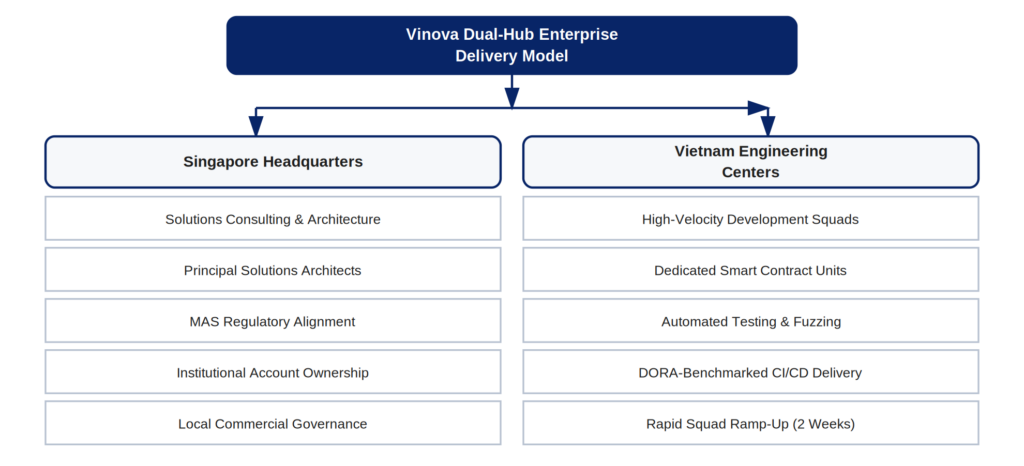
The Dual-Hub Model: Central Singapore Governance with Regional Scale
Securing senior blockchain engineers locally in Singapore is cost-intensive and protracted, with typical hiring cycles extending 3 to 6 months due to high demand from multinational financial institutions and Employment Pass (EP) quotas.
If you’re weighing building this team in-house against a partner model, our complete guide to hiring blockchain developers walks through the trade-offs in more depth.
Singapore Solution Architecture & Governance: Headquartered locally in Singapore, Vinova provides face-to-face technical discovery, high-level system architecture, and local contractual accountability governed by Singapore law.
High-Velocity Engineering Centers: Backed by 4 regional offices and over 200 engineers across Vietnam (Hanoi, Ho Chi Minh City, Da Nang) — part of Vinova’s 300+ engineer bench across Singapore and the region — Vinova deploys dedicated engineering squads within two weeks, bypassing domestic recruitment cycles.
Sustainable Capital Efficiency: By pairing Singapore architectural oversight with regional delivery scale, enterprises achieve 55% to 65% cost optimization relative to domestic onshore contracting, significantly extending technical runway.
Institutional Compliance: MAS Alignment and Zero-PII On-Chain Architectures
Deploying decentralized technology in Singapore requires strict compliance with statutory regulators:
MAS Regulatory Literacy: When engineering tokenized assets or payment mechanisms across blockchain frameworks, we embed regulatory safeguards directly into contract logic—including role-based access restrictions, address whitelisting, KYC/AML oracle checks, and emergency pause controls.
PDPA (Personal Data Protection Act) Compliance: Writing Personally Identifiable Information (PII) directly to an immutable ledger is a direct violation of Singapore privacy law. Vinova engineers hybrid off-chain data architectures: sensitive records reside in ISO 27001-governed encrypted data stores, while only cryptographic commitments, zero-knowledge proofs, or hashes are anchored on-chain.
Agile Playbook & DORA Engineering Benchmarks
Vinova’s delivery methodology blends Design Thinking with a disciplined Agile Playbook:
Sprint-Based Transparency: Two-week sprint cadences with scheduled milestone demonstrations, enabling enterprise stakeholders to review working testnet builds continuously.
DORA Metric Benchmarks: Our DevSecOps pipelines measure deployment frequency, change lead time, mean time to recovery (MTTR), and change failure rate—ensuring institutional reliability from initial discovery through to production rollout.
Comparative Delivery Analysis: In-House Build vs. Big-4 Consultancy vs. Vinova Dual-Hub
When enterprise steering committees evaluate how to operationalize an initiative across modern blockchain development frameworks, they typically weigh three execution paths: attempting to staff an internal engineering team, hiring a Big-4 management consultancy, or partnering with a dedicated dual-hub specialist.
Whichever path you choose, the same regulatory and contractual pitfalls apply when hiring in Singapore. Our breakdown of the biggest hiring traps covers what to check before signing.
| Evaluation Dimension | In-House Engineering Build | Tier-1 / Big-4 Management Consultancy | Vinova Dual-Hub Enterprise Model |
|---|---|---|---|
| Sourcing Speed & Ramp-Up | Protracted: 3–6 month recruitment loops; severe local developer scarcity; EP quota constraints. | Moderate: 4–8 weeks; long onboarding administrative overhead before technical kickoff. | Rapid: deployment within 2 weeks from a verified bench of 200+ software engineers. |
| Capital Expenditure & Rates | Very high: S$14,000–S$22,000+/mo per senior developer plus CPF, recruiter fees, and retention equity. | Prohibitive: S$350–S$600+/hour blended rates; high cost of partner billing with thin delivery margins. | Optimized: 55%–65% cost optimization via regional delivery scale with Singapore solutions oversight. |
| Execution Depth vs. Subcontracting | Direct control, but exposed to severe key-person attrition and on-chain security knowledge gaps. | Often strategic/advisory only; technical implementation is frequently subcontracted to unverified 3rd parties. | Direct in-house engineering squads managed under ISO 9001/27001 governance without third-party subcontracting. |
| Architectural Objectivity | Often limited to the pre-existing language background of the first technical hire (single-stack bias). | Varies; often pushes pre-packaged vendor alliances (e.g., enterprise software partnerships) regardless of fit. | Multi-philosophy fluency across Solidity, Rust, and Go—delivering objective architectural fit. |
| Security & Compliance Controls | Variable: DevSecOps setups often lack specialized smart contract fuzzing, formal auditing, or PDPA safeguards. | Strong enterprise governance, but often detached from low-level smart contract execution and threat vectors. | 4-layer defense moat, automated Foundry invariant fuzzing, dual ISO certifications, and zero-PII ledger designs. |
| Governance & Commercial Recourse | Full internal control, but absorbs 100% of operational failure and security audit liabilities. | Contractual assurance under Singapore law, but complex liability caps and bureaucratic governance. | Singapore-headquartered entity providing same-timezone alignment and direct legal recourse under Singapore law. |
How to Choose Your Architecture (The Fast Version)
Still evaluating network trade-offs for your steering committee? Here is the unvarnished engineering rule of thumb:
Evaluating an MAS Project Guardian tokenized fund or secondary debt market?
Select Ethereum Mainnet + Arbitrum One L2. You need Fireblocks custody compatibility, institutional liquidity depth, and ERC-3643 regulatory whitelisting.
Building a shared provenance network between competing maritime carriers, banks, or utilities?
Select Hyperledger Fabric. Competing enterprises will never put commercial trade metadata on a public rail. Private Data Collections and deterministic ordering are non-negotiable.
Deploying a nationwide consumer loyalty engine, micro-rebate rail, or retail payment flow?
Select Solana (via Anchor). If your end users experience a 12-second block latency or an unexpected gas pop-up, retention will collapse. You need sub-second execution and gas-sponsorship relayers.
Conclusion & Architectural Discovery
Enterprise blockchain adoption across Singapore and Southeast Asia demands a disciplined balance of cryptographic security, high-velocity engineering, and strict regulatory compliance. Selecting between decentralized, permissioned, or parallelized blockchain development frameworks is fundamentally an exercise in risk mitigation and business alignment. Succeeding in this ecosystem requires an experienced technology partner who understands both decentralized protocols and enterprise systems architecture.
At Vinova, we de-risk decentralized innovation through three foundational pillars:
- Full-Spectrum Technical Currency: Modern 2026 engineering toolchains (Foundry, Anchor, Viem) across Ethereum/L2s, Hyperledger Fabric, and Solana.
- Institutional Security Posture: A 4-layer defense architecture, dual ISO 9001/27001 governance, and a proven track record delivering mission-critical digital systems for national statutory bodies, energy conglomerates, and major public healthcare institutions — recognized as a Financial Times Top 500 High-Growth Company (Asia-Pacific, 2026) and a Straits Times Fastest-Growing Company (2024, 2025, 2026).
- The Dual-Hub Delivery Advantage: Centralized Singapore solutions architecture paired with the scale and cost agility of 200+ engineers across our regional development centers.
Whether you are designing an institutional asset tokenization framework, launching a high-throughput consumer Web3 application, or architecting a permissioned supply chain syndicate, Vinova delivers the architectural rigor and delivery power to execute your roadmap.
Ready to evaluate your blockchain architecture?
Backed by 16+ years of enterprise delivery and ISO 27001-certified governance, Vinova’s solutions architects will assess your throughput, privacy, and compliance requirements against all three paradigms — no single-stack bias. Schedule a Technical Discovery Session with Vinova Singapore to review your smart contract specifications and systems integration plan.
Vinova: Singapore’s blockchain and enterprise engineering partner since 2010. ISO 27001:2022 and ISO 9001:2015 certified.
300+ in-house engineers across Singapore, Hanoi, Da Nang, and Ho Chi Minh City — with dedicated squads across Solidity, Rust, and Go, so your architecture is chosen on merit, not stack bias.
Financial Times Top 500 High-Growth Companies Asia-Pacific 2026. The Straits Times Singapore’s Fastest-Growing Companies 2024, 2025, and 2026.
Schedule a Technical Discovery Session with Vinova’s Singapore Team →