For financial services CIOs, legacy modernization is no longer an infrastructure upgrade. It’s risk-weighted portfolio management and operational survival. As digital-native fintechs ship features in days, established Tier-1 and Tier-2 institutions stay constrained by batch cycles, siloed COBOL core ledgers, and rising maintenance overhead.
Yet banking operates under zero-tolerance conditions. A ten-minute database lock can halt national interbank clearing. An un-hedged compliance gap can trigger multi-million-dollar sanctions. Move too slowly and you risk irrelevance; move recklessly and you risk systemic failure.
The question was never if to modernize. It’s where to begin.
Table of Contents
1. The Executive Dilemma
CIOs sit in a persistent political squeeze: CCOs demand fintech-like release velocity, CROs and regulators demand zero unmanaged downtime, and CFOs demand predictable amortization after cloud migrations that routinely trigger unexpected cost inflation.
Bank boards have every right to be skeptical. Nearly 9 out of 10 large enterprise software programs fail outright or face severe distress. McKinsey, in collaboration with the University of Oxford, studied over 5,400 large IT projects and found they overrun budgets by an average of 45% while delivering 56% less value than projected. In banking specifically, monolithic core replacements routinely overrun budgets by 50–100%, with 18–36 month timeline slippages.
Field observation: In our architectural audits of core banking systems across Singapore and Southeast Asia, we routinely find nested stored procedures and undocumented batch job logic that account for up to 30% of critical daily clearing exceptions, almost never captured in architectural documentation. Any “big bang” cutover guarantees production disruption on day one. Cloud modernization in banking is an exercise in structural decoupling, not an all-or-nothing leap.
2. The Lift-and-Shift Trap
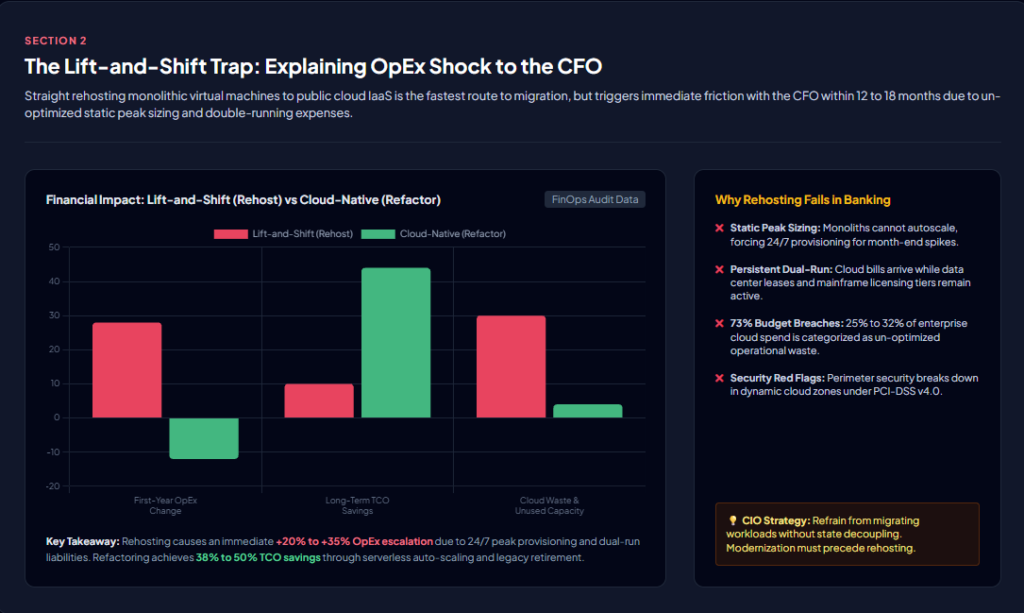
The fastest route to the cloud is frequently the costliest mistake. Under board pressure to show migration momentum, institutions often start with a straight rehost: moving monolithic VMs directly into public cloud IaaS. Within 12–18 months, this triggers real friction with the CFO.
| Approach | Path | Result |
| Lift-and-shift (rehost) | Static peak sizing → persistent dual-run | +20% to +35% OpEx escalation |
| Cloud-native (refactor) | Dynamic elasticity → decommissioning | 38% to 50% TCO savings |
Rehosted VMs can’t shed the oversized, peak-provisioned capacity needed for month-end settlement spikes, and institutions rarely retire legacy infrastructure. They end up paying for the cloud *and* the data center lease simultaneously. Refactored, cloud-native workloads reach 38–50% long-term TCO savings; un-refactored rehosts average only 8–12% in year one, an advantage quickly erased by egress costs and storage misconfiguration.
3. The Coexistence Reality
A common misconception among boards is that modernization means migrating 100% of digital assets to public cloud. For Tier-1 and Tier-2 institutions, a total data center exit is an impractical, high-risk posture. Hybrid coexistence isn’t a compromise. It’s the correct target architecture.
| Workload Tier | Target Model | Why |
| Customer engagement & channels | Public cloud (serverless) | Elastic scaling for traffic spikes, rapid CI/CD |
| Fraud, AML & analytics | Public cloud (high-performance compute) | Scalable GPU clusters for real-time inference |
| Payment switching & clearing | Sovereign cloud / on-prem edge | Sub-millisecond latency, data residency |
| Core deposit & general ledger | Private cloud / mainframe core | Decoupled via APIs, insulated until economics justify extraction |
Regulators are actively policing hyperscaler concentration. The EU’s DORA requires an audited register of ICT third-party dependencies, with fines of up to 1.0% of daily worldwide turnover for critical providers. Singapore’s MAS Notice FSM-N21 enforces a 4-hour Recovery Time Objective for critical systems, with severe incidents reportable within 1 hour. Regulators increasingly expect exit plans backed by operational proof, not paper plans.
Drawing on over sixteen years of engineering experience across 300+ mission-critical projects for regulated enterprises and statutory bodies across Singapore and Southeast Asia (client names stay confidential, the same discretion you’d want applied to your own systems), we implement a layered security framework spanning governance (ISO 27001, vetted personnel), physical infrastructure, network security (zero-trust, microsegmentation), and cryptography (FIPS 140-2/3 HSM key rotation), keeping hybrid data exchanges isolated and audit-logged from day one.
4. Hollowing the Core
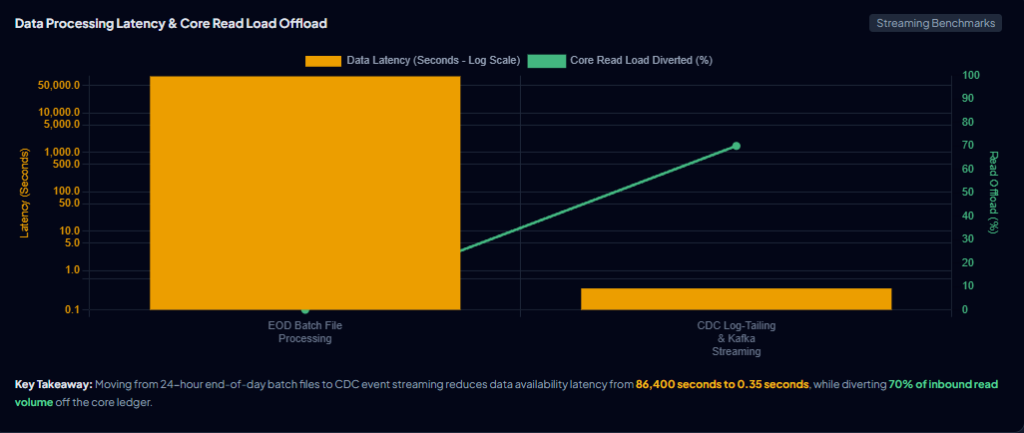
The single most dangerous decision a CIO can make is greenlighting a big-bang replacement of the core ledger. Top-performing institutions instead build an architectural blast wall: they hollow out the core by decoupling read inquiries from the system of record, using Change Data Capture (CDC) to tap database transaction logs directly rather than querying operational tables, avoiding the lock contention and MIPS overhead that query polling creates.
Done well, this lets millions of mobile banking customers query balances in real time without adding a dollar to daytime mainframe processing bills, and diverts up to 70% of inbound read volume away from the legacy core into eventually-consistent cloud read replicas, while the core ledger keeps its strict ACID consistency untouched. Our data engineering squads configure and manage this directly alongside client teams — started-task CDC extractors, Kafka clusters, schema registries — materializing transactional state at the cloud edge with sub-second latency and mainframe CPU overhead typically under 2–3%.
5. The Executive Prioritisation Matrix
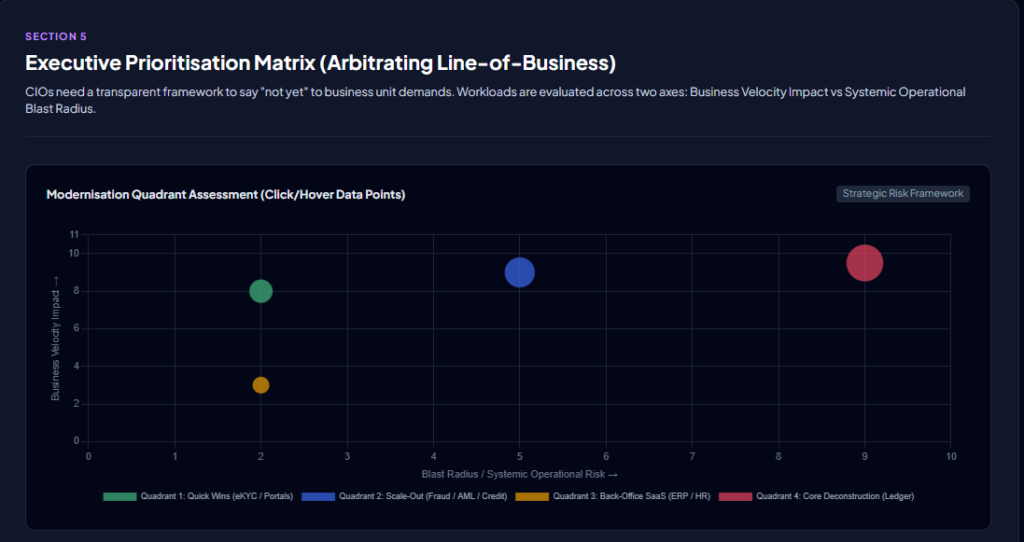
CIOs need a defensible framework to say “not yet” to low-value or high-risk asks. Every initiative sits on two axes: business impact and systemic blast radius.
| Low Blast Radius | High Blast Radius | |
| High Impact | Quick Wins: eKYC, customer-facing frontends | Scale-Out: real-time fraud & AML, credit decisioning |
| Low Impact | Back-Office SaaS: HR, procurement | Core Deconstruction: clearing & settlement engines |
Quick Wins prove ROI within 6–12 months without touching the ledger. Core Deconstruction gets addressed last, extracted domain by domain over 3–5 years with the Strangler Fig pattern, running parallel reconciliations until the legacy subsystem can be safely retired.
6. Talent, and Why Org Design Beats Technology
Modernization programs fail more often from organizational friction than technical limits; Conway’s Law holds that architecture mirrors communication structure. The engineers who built and maintain foundational banking platforms have a median age of 55–60 and are retiring fast, while newer cohorts carry almost no COBOL, Assembler, or JCL expertise. The real risk isn’t the language. It’s the undocumented institutional knowledge (cross-border fee waivers, legacy sweep calculations) embedded in code nobody can safely touch once its author retires.
Leading institutions counter this with Platform Engineering teams running an Internal Developer Platform with pre-approved “Golden Paths”: standardized, guardrail-embedded service templates that let delivery teams ship compliant services in hours instead of months. We embed the same discipline directly with client teams: shift-left automated testing, declarative Infrastructure as Code across AWS/Azure/GCP, and DevSecOps guardrails (SAST/DAST, Open Policy Agent) built into CI/CD rather than a quarterly Architecture Review Board.
7. FinOps as an Executive Discipline
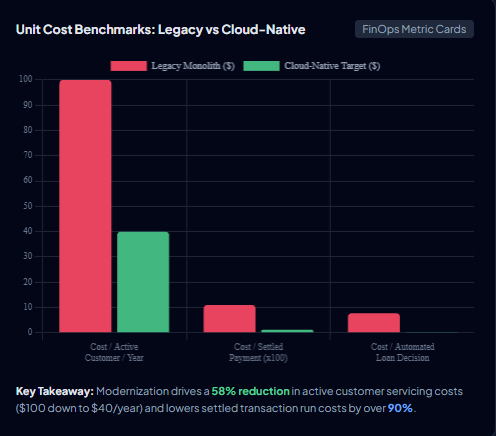
To eliminate post-migration OpEx surprises, CIOs need to partner with the CFO on unit economics before migrating production workloads, correlating cloud spend with business volume rather than managing to an aggregate monthly bill.
| Metric | Legacy Benchmark | Cloud-Native Target | Impact |
| Cost per active retail account | $80–$120 / year | $30–$50 / year | 58% reduction in servicing overhead |
| Cost per settled payment | $0.08–$0.15 | $0.005–$0.02 | Enables profitable micro-transactions |
| Cost per automated loan decision | $3.50–$12.00 | $0.15–$0.45 | Lower customer acquisition cost |
We work alongside financial controllers to embed automated resource-tagging and real-time unit-cost dashboards, giving the CIO and CFO one audited view that tracks marginal transaction cost against infrastructure spend.
8. Three Lessons From the Field
TSB Bank (April 2018). TSB attempted a full weekend cutover of 5.2 million customer accounts onto a new core platform. The target architecture collapsed under live production concurrency: customers locked out for weeks, cross-account data leaks, fraud attacks surging 70x baseline. Full stability wasn’t restored for eight months. The FCA and PRA jointly fined TSB £48.65 million, and total remediation reached £330 million. The CEO resigned. The lesson: a big-bang cutover on a core ledger is a board-level risk, not an engineering detail.
Capital One. Capital One spent roughly eight years exiting its data centers entirely, becoming the first major US bank to run 100% on public cloud by late 2020. It refactored into event-driven microservices rather than lift-and-shift, and open-sourced its own cloud governance tooling (Cloud Custodian) to manage the fleet. A 2019 breach via a misconfigured WAF exposed the risk of over-permissioned cloud identities; the industry response (IMDSv2, now widely adopted) became a standard the whole sector benefited from. Production change lead time dropped from months to minutes.
DBS Bank. In 2014, DBS set out to become “the D in GANDALF,” measuring itself against Google, Amazon, Netflix, and peers. It flipped from 85% outsourced to 85% in-house engineering, replaced project-based funding with persistent platform funding, and modernized through containerization and a resilient API mesh rather than a core rip-and-replace, expanding digital banking across India and Indonesia with minimal physical footprint.
Frequently Asked Questions
Are Tier-1 banks moving away from the public cloud?
No. Some are repatriating predictable, steady-state workloads to optimize baseline spend, but the dominant strategy across financial services remains a disciplined hybrid, multi-cloud approach, with continued acceleration into public cloud for customer-facing channels, analytics, and ML.
What’s the single biggest risk in core banking modernization?
A big-bang replacement of the primary transaction ledger. Monolithic cores hold decades of undocumented rules and batch dependencies; cutover failures cause outages, regulatory sanctions, and customer churn. The Strangler Fig pattern and Change Data Capture are how you avoid it.
How should a CIO justify modernization ROI to the board?
Skip abstract “agility” arguments. Present it as a risk-weighted program measured in FinOps unit economics: lower cost per settled payment, lower cost per active digital customer, and reduced exposure to a shrinking pool of legacy mainframe talent.
Cloud modernisation in financial services is an operating model transformation, not an infrastructure migration. Rejecting un-refactored lift-and-shift, hollowing out the legacy core through event-driven integration, and prioritizing workloads through a risk-assessed framework is how CIOs eliminate technical stagnation while protecting institutional stability.
Headquartered in Singapore with a 16+ year engineering track record and 300+ mission-critical digital systems delivered, Vinova partners with Tier-1 and Tier-2 financial institutions, fintechs, and government-linked enterprises to architect, decouple, and scale resilient cloud ecosystems.
| Request a Confidential 30-Day Core Dependency & MAS TRM Architecture Audit Our principal systems architects deliver three boardroom-ready outputs: a Legacy Dependency & CDC Feasibility Assessment, a Regulatory Resilience & Concentration Risk Register mapped against MAS FSM-N21 and DORA Article 28, and an Executive FinOps Unit-Cost Baseline: the hard economic metrics needed to secure CFO and board approval. 👉 Schedule an Executive Consultation with Vinova’s Enterprise Cloud Practice, or reach out directly to hello@vinova.sg to initiate your architectural review. |