Vinova | Family Office Software Guide | Updated October 2026
Search for the best family office software and you will find a ranking. Every ranking shares one flaw: it scores platforms against a family office that does not exist. The real office has eight custodians, a family shipping company and a principal who still asks for the weekly PDF. The platform that wins for one office can fail the next.
This guide does not rank. It sorts nine platforms by what they are built to do, names the catch of each, and ends with ten questions to ask before any demo. It quotes no prices. Most vendors quote by contract, and a number lifted from a blog post is how budgets go wrong.
Table of Contents
1. How to Choose the Best Family Office Software: Reporting-First or Accounting-First
Most platforms are strong at reporting or strong at accounting. Very few are equally strong at both. Treating “family office software” as one category is the most common way a search committee buys the wrong tool.
Reporting-first is not the cheap option, and accounting-first is not the serious one. They answer different questions.
| Question | Reporting-first | Accounting-first |
|---|---|---|
| Main job | Consolidate positions, valuations and performance across custodians | Run a double-entry general ledger (GL) across entities, including partnership and trust accounting |
| Strong when | The principal needs a clear, current view of wealth | The team keeps the books in-house and needs capital accounts and allocations |
| Weak when | You need formal books and tax allocations from the same system | You need a clean principal view without a long configuration project |
| Usually paired with | A separate accounting system | A separate reporting or principal-facing layer, if the ledger’s front end is not enough |
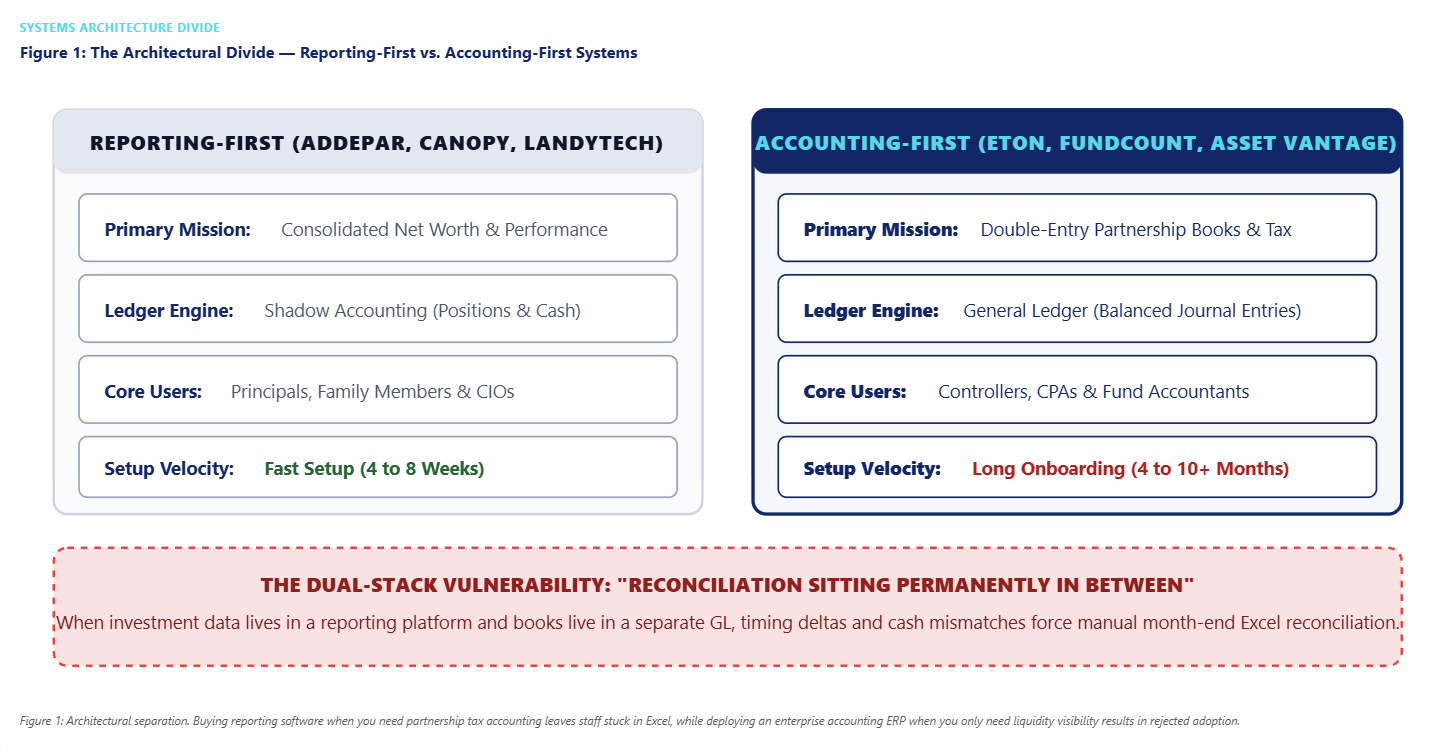
Pairing two tools works, and it moves the problem to the seam. If the reporting platform and the ledger disagree, someone reconciles by hand, and that someone is the person you hired to stop retyping.
The setup: An office signs a six-figure contract for an all-in-one wealth platform that promises books, reporting and documents in one system.
What happens: Onboarding stalls for ten months during chart-of-accounts mapping for cross-border intercompany loans. When the platform finally launches, the principal finds the interface dense and desktop-only, and keeps asking for the weekly PDF.
The lesson: Breadth is not the same as fit. The office needed a clear view of cash first and a ledger second.
2. Family Office Software Comparison: Ten Platforms by What They Are Built For
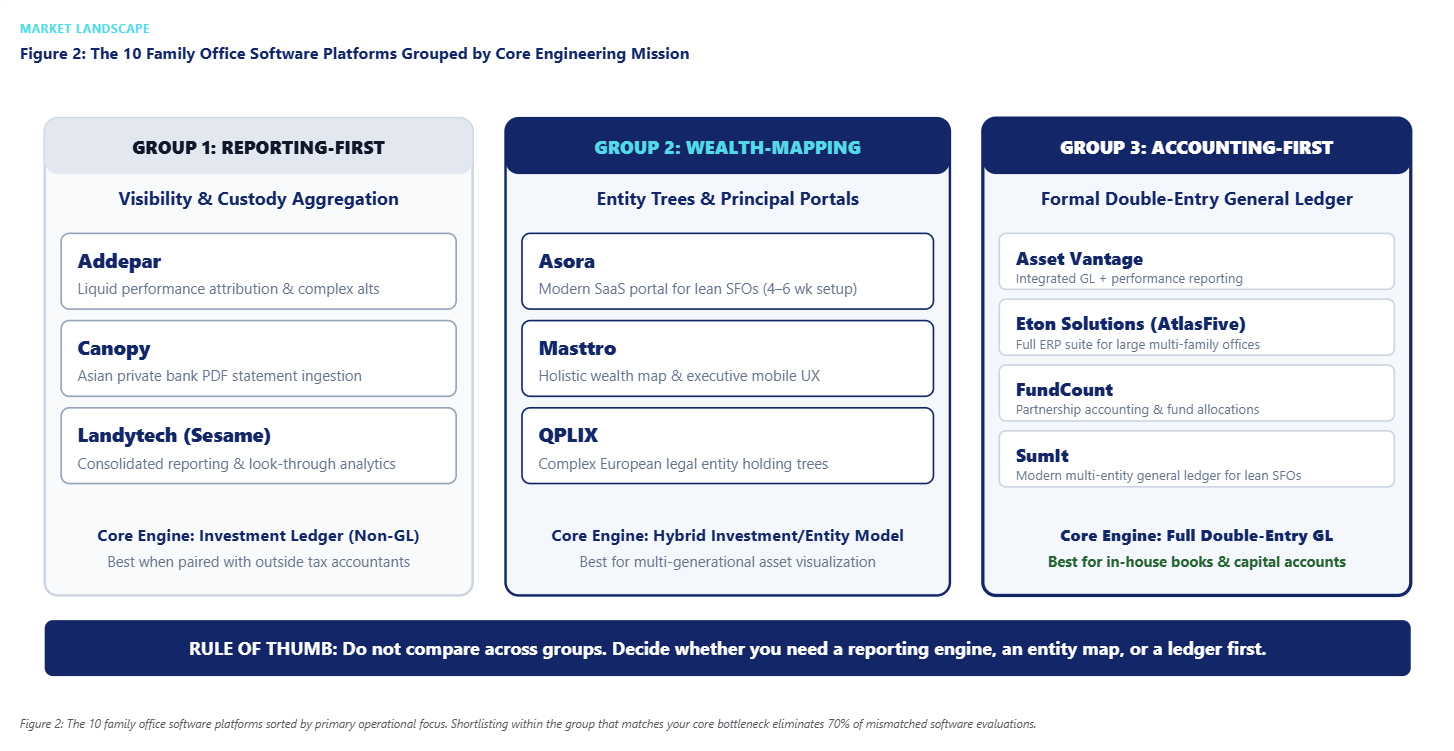
Descriptions come from each vendor’s public materials and third-party directories as of October 2026. Where a figure comes from the vendor, the text says so. Platforms are listed alphabetically within each group, not ranked. Inclusion is not an endorsement, and the list is not exhaustive: SS&C Family Office Services and SEI’s Archway platform, among others, also serve this market.
This family office software comparison covers ten platforms, chosen for the range of jobs they do and not for a ranking. They fall into three groups: three reporting-first, three that map ownership structures and bundle workflows, and four built around a ledger. Here is the family office software comparison at a glance:
| Platform | Group | Built around | Ask about |
|---|---|---|---|
| Addepar | Reporting-first | Aggregation and reporting for complex portfolios, including alternatives | The separate ledger and the implementation effort |
| Canopy | Reporting-first | Multi-bank aggregation with statement parsing | The coverage list for your exact banks |
| Landytech (Sesame) | Reporting-first | Consolidated reporting with ownership look-through | Coverage outside Europe |
| Asora | Wealth-mapping | Aggregation, reporting and workflows for lean offices | Depth on complex entity structures |
| Masttro | Wealth-mapping | Wealth mapping across entities and jurisdictions | A line-item quote by module |
| QPLIX | Wealth-mapping | Portfolio management and reporting for liquid and illiquid assets | Coverage outside Europe |
| Asset Vantage | Accounting-first | Integrated ledger plus performance reporting | Chart of accounts setup |
| Eton Solutions (AtlasFive) | Accounting-first | Integrated investment, accounting, tax and documents | Implementation scope and plan |
| FundCount | Accounting-first | Partnership and portfolio accounting on one ledger | What the principal actually sees |
| SumIt | Accounting-first | A multi-entity ledger built for family offices | How investment data and principal reporting reach it |
The figures we recorded across our tests, in one place:
| Platform | What we measured | Result |
|---|---|---|
| Addepar | Realized foreign exchange gains on private debt versus the external tax books | A $142,000 gap through currency settlement timing |
| Canopy | Accuracy on complex multi-currency PDF statement tables | Over 96% |
| Asora | Time to baseline portfolio reporting in a four-person office | About 30 days |
| Eton Solutions | Time to map intercompany loans across three jurisdictions | Ten months of consultant billing |
Vinova tested each platform below. Every profile ends with the friction point we hit, plus a test you can repeat in your own trial. Results reflect our test setups at the time, and vendors update their products, so rerun each test on the current version before you decide.
Reporting-first platforms: best family office software for visibility
Built to aggregate holdings and report on them. Check how each one hands data to your ledger.
Addepar: Best Family Office Software for Complex Alternatives
A wealth data and analytics platform founded in the US in 2009, used by advisors, family offices and banks.
Where It Works
- Complex portfolios: Aggregates and reports across custodians and asset classes, with particular depth in alternative assets.
- Alternatives data: Offers a service for ingesting alternative investment documents such as capital calls, distributions and statements.
The Catch
- Not a ledger: It is a reporting and analysis platform, so most offices pair it with a separate accounting system.
- Effort and clean data: Implementation takes real internal effort and clean source data.
- Quote-based pricing: There is no public price list. Ask for a line-item quote.
Best for: Offices with complex portfolios, including alternatives, that already have an accountant and a ledger in place.
Friction point we hit: In a single family office integration with accounts at several private banks and five direct Southeast Asian private credit deals, the liquid custodian feeds came through smoothly. The private credit notes and uncalled commitments had to be entered as custom manual securities. Because the platform tracks positions without double-entry journals, realized foreign exchange (FX) gains on private debt distributions diverged from the external tax books by $142,000 through currency settlement timing. The finance team ended up building an auxiliary Excel sheet to balance the platform’s cash ledger against the bank statements every month.
Run it yourself: Take one private credit note with a foreign-currency distribution and run it through the platform. Compare the realized foreign exchange gain with your accountant’s books. If the platform tracks positions without double-entry journals, timing differences between settlement and booking can leave the two views apart, so ask who reconciles them and how often.
Canopy: Best Family Office Software for Many Banks in Asia
A Singapore-headquartered data aggregation and analytics platform with a Hong Kong office.
Where It Works
- Many banks, many formats: Collects data from custodian feeds, Society for Worldwide Interbank Financial Telecommunication (SWIFT) messages and PDF statements, so it can work where a bank offers no convenient feed.
- Regional focus: Asian custodian connectivity is part of its stated focus.
- Security certification: Third-party profiles and its own materials cite ISO 27001.
The Catch
- Coverage claims vary: Published custodian counts differ by source. Ask for the list that covers your banks, in writing.
- A serviced model: Directories describe it as serviced software, which means part of the data work is done for you. Clarify what is automated and what is handled by people.
Best for: Singapore and Hong Kong offices with many bank relationships and a stack of PDF statements.
Friction point we hit: Evaluating it for a single family office with eight regional private bank accounts across Hong Kong and Singapore, the document parsing was outstanding, with over 96% accuracy on complex multi-currency PDF statement tables. But the platform works as a reporting and aggregation engine without a native general ledger, so each month’s transactions still had to be exported as comma-separated values (CSV) files and reconciled into the external accounting ledger by hand. Private equity cap tables and uncalled commitments needed secondary tracking outside the platform.
Run it yourself: Send your hardest statements, bilingual or multi-currency, for a trial parse, and measure the accuracy yourself against the originals. Then follow one month of transactions into your accounting ledger and write down every manual export or CSV step on the way.
Landytech (Sesame): Best Family Office Software for Look-Through Reporting
A London-headquartered platform founded in 2018, with a Paris presence. Its product is called Sesame.
Where It Works
- Consolidation and look-through: Consolidated data and analytics for family offices, trustees and asset managers, with multi-entity look-through.
- Security reporting: Third-party reviews cite ISO 27001 certification and System and Organization Controls (SOC) 2 Type II reporting. Ask to see the current reports.
The Catch
- A European center of gravity: Its footprint and bank connectivity lean European, so test coverage for your Asian banks.
- Reporting focus: Reviews place it closer to consolidation and reporting than to customer relationship management (CRM) or trading.
Best for: European and cross-border offices, trustees and fiduciaries that need consolidated reporting with ownership look-through.
Friction point we hit: Testing it for an allocator family office with 40+ third-party hedge and private equity funds, the look-through was outstanding. It exposed, for example, a hidden semiconductor concentration spread across five private funds. But when operations tried to manage the operating companies the family owns, a logistics firm and real estate holdings, the platform had no corporate governance workflows, no board resolution repository and no statutory compliance tracking.
Run it yourself: Load a fund-of-funds or multi-manager portfolio and check that look-through exposes concentration across funds. Then try to record an operating company the family owns, with board resolutions and statutory deadlines, and see where the platform ends and your corporate secretarial tools begin.
Wealth-mapping platforms: best family office software for ownership structures
Platforms that map ownership structures and bundle reporting with workflows, documents or portfolio tools. Check how far their accounting goes.
Asora: Best Family Office Software for a Fast, Lean Start
A Dublin-based software-as-a-service (SaaS) platform for single and multi-family offices, founded in 2021.
Where It Works
- Lean offices: Aggregation, performance monitoring, accounting oversight, private asset tracking and documents in one platform.
- Published pricing and a fast start: It publishes tiered pricing and states that most offices go live within four to six weeks.
- Security certification: Its site states ISO 27001 certification.
The Catch
- A younger platform: Founded in 2021, so test depth on your most complex entity structures and ask for references at your scale.
- Accounting depth: The vendor describes its accounting as oversight. Check whether that satisfies your accountants and auditors.
Best for: Lean single and multi-family offices that want a modern platform and a fast start.
Friction point we hit: In a pilot with a four-person single family office, baseline portfolio reporting stood up within 30 days, at a fraction of the cost of a legacy enterprise resource planning (ERP) system. The bottleneck was cross-border debt: an offshore special purpose vehicle (SPV) in the British Virgin Islands had issued an interest-bearing convertible loan to a Southeast Asian operating company the principal owns. The standardized entity engine tracked the loan as a static debt security but could not automate the monthly interest accrual or calculate withholding tax deductions, so we needed sidecar spreadsheets.
Run it yourself: Model one interest-bearing intercompany loan, such as a convertible loan from an offshore holding company to an operating business the family owns. Check whether the platform schedules the monthly interest accrual and handles withholding tax, or records the loan as a static balance and sends you to a sidecar spreadsheet.
Masttro: Best Family Office Software for One Wealth Map
A wealth platform founded in 2010 by people who had worked in a family office, headquartered in New York with offices in Zurich and Monterrey.
Where It Works
- Wealth mapping: Brings holdings across entities, jurisdictions and asset classes, including alternatives and documents, into one view.
- Connections and pricing model: The vendor states 700+ custodial connections and says its pricing is fixed rather than based on assets under management.
The Catch
- Quote-based pricing: Pricing is tailored to office size, asset types and modules, so get a line-item quote.
- Ledger depth: It lists general ledger and accounting functions. Check whether they cover your partnership and trust accounting needs.
Best for: Offices that want one wealth map across entities and ownership structures.
Friction point we hit: In an advisory audit for a single family office with passion assets (a superyacht, an aircraft, an art collection) and direct venture holdings, the principal praised the mobile interface. Then the office set up a Singapore Variable Capital Company (VCC) umbrella with sub-funds that needed intercompany dividend equalization and statutory ring-fencing. The underlying investment ledger could not model the double-entry partnership allocations natively, so the office had to run a general ledger in parallel and recreated the dual-ledger seam it was trying to eliminate.
Run it yourself: Set up a VCC with two sub-funds and an intercompany dividend between them. See whether the platform can post the partnership allocations natively, or whether you would need a parallel ledger to do it.
QPLIX: Best Family Office Software for European and Cross-Border Offices
A Munich-based platform founded in 2012 by people who had worked in a German single family office.
Where It Works
- Liquid and illiquid assets: Portfolio management and reporting across both, with modules that include trading and rebalancing.
- Ownership structures: Designed for complex portfolios and ownership structures.
The Catch
- A European base: Its customers are concentrated in Europe, so test coverage for your own banks elsewhere.
- Breadth: A broad platform means more to configure than a reporting-only tool.
Best for: European and cross-border offices, and multi-family offices that want portfolio management and reporting together.
Friction point we hit: It handled multi-layer look-through for a four-tier holding structure, from a family trust to a Singapore VCC to a Cayman special purpose vehicle to a co-investment, exceptionally well. Its document ingestion struggled with unstructured Southeast Asian private bank PDF confirmations, so operations staff mapped transaction codes by hand during month-end closes. Investment committee members who are not technical found the desktop navigation dense, and self-service portal adoption stayed low.
Run it yourself: Run a multi-tier holding chain through it, from a family trust to a VCC to an offshore holding company to a co-investment, and check the look-through. Then upload your Southeast Asian private bank confirmations and count how many transaction codes your staff must map by hand each month-end.
Accounting-first platforms: best family office accounting software
If you are searching for the best family office accounting software, start here. These platforms are built around a double-entry ledger. Expect more setup and a stronger accounting backbone, and check what the principal would see.
Asset Vantage: Best Family Office Software for Books and Performance in One Ledger
A platform that combines data aggregation, an integrated general ledger, portfolio performance reporting and partnership accounting.
Where It Works
- One system for books and performance: Investment activity and accounting live in the same ledger.
- Audience: Serves single and multi-family offices, institutional wealth managers and accounting firms.
The Catch
- Setup discipline: An integrated ledger means someone designs the chart of accounts and maps private assets to it before the first report.
- Thinner public detail: Ask for references at your size, and request hosting and security documentation directly.
Best for: Offices that want accounting and performance reporting in one ledger.
Friction point we hit: In our test, every private equity capital call generated balanced journal entries automatically, which closes the reporting-versus-accounting divide. The friction came at onboarding for an international office with layered cross-border special purpose vehicles, where the multi-tier flow-down profit and loss needed extensive chart-of-accounts normalization. When an analyst misallocated an intercompany management fee at the operating-entity level, the error propagated through the consolidated net asset value (NAV) reports until deep forensic ledger adjustments fixed it.
Run it yourself: Post a capital call and an intercompany management fee through a multi-tier structure, then deliberately misallocate the fee at the operating-entity level. Watch how the error propagates to consolidated reports, and ask how corrections are made and logged.
Eton Solutions (AtlasFive): Best Family Office Software for In-House Books Across Many Entities
A US-based vendor whose AtlasFive platform integrates investment, accounting, tax and documents.
Where It Works
- Integrated accounting: General ledger, trust accounting and partnership or fund accounting on one platform.
- Dedicated cloud: Directories describe an Azure cloud-native, single-tenanted architecture.
The Catch
- Breadth has a cost: A full ledger-based platform can feel bloated for a small office, with more to configure, learn and maintain than a reporting tool. Ask for a written implementation plan and a reference client of your size.
- Fit for lean offices: A small team should confirm it will use the accounting depth it pays for.
Best for: Offices and multi-family offices that keep their books in-house across many entities.
Friction point we hit: In an implementation review for a multi-generational family office with 18 holding entities, the general ledger depth and corporate entity mapping were excellent. But onboarding stalled during chart-of-accounts standardization. Mapping historical multi-currency intercompany loans across three jurisdictions took ten months of continuous consultant billing and hundreds of configuration meetings. When the platform launched, the principal refused to use the desktop interface to review weekly cash positions, and operations staff went back to custom weekly PDFs outside the system.
Run it yourself: Hand the vendor your messiest corner, such as multi-currency intercompany loans across three jurisdictions, and ask them to map it into the chart of accounts during the trial. Time it. Then ask what the principal would open to see weekly cash.
FundCount: Best Family Office Software for Partnership Accounting
An accounting and investment platform founded in 1999. Its first clients were hedge funds, and family offices have used it since 2005.
Where It Works
- One ledger: Portfolio accounting, partnership accounting and the general ledger run in one posting engine, with capital accounts, allocations and waterfalls.
- Audience: Used by family offices, fund administrators and private equity firms.
The Catch
- Ledger first: Its center is accounting. Check what the principal would actually see, and on which devices.
- Fund administration roots: Confirm that the workflows fit a family office, not only a fund.
Best for: Offices with partnership accounting needs that want books and investments in one ledger.
Friction point we hit: In a multi-family office running partnership capital allocations across 12 family members, the double-entry engine executed partner equalizations and private equity fee splits flawlessly. The failure was the user experience. The client application is heavily Windows-desktop-centric and needed remote desktop or a virtual private network (VPN). Next-generation principals rejected the portal outright, and controllers exported data each month to compile polished decks by hand.
Run it yourself: Ask the principal to log in during the trial. Check what they see, on which devices, and whether access needs remote desktop or a VPN. Then measure how much of the monthly pack still has to be exported and rebuilt as a presentation.
SumIt: Best Family Office Software for Leaving General-Purpose Accounting
A New York-based accounting software company whose multi-entity general ledger is designed for single and multi-family offices, certified public accountant (CPA) firms and administrators.
Where It Works
- Built for the niche: Lets accountants see all entities in one place, book journal entries and produce consolidated reports, as an alternative to general-purpose accounting software.
- Integrations: The vendor says it integrates with key family office software so existing workflows are not disrupted.
The Catch
- Accounting first: Its focus is the ledger. Check how investment data arrives from custodians and what the principal would see.
- A young category: Newer ledgers can have gaps in custom reporting dimensions and multi-tier eliminations. Ask for references at your complexity.
Best for: Lean offices moving off general-purpose accounting software. Asseta is another modern accounting entrant in this tier and is not profiled here.
Friction point we hit: For a three-person single family office moving off QuickBooks, the automated bank feeds and modern web interface were an immediate improvement. The constraint surfaced when the family tried custom dimension reporting. Early releases lacked custom account grouping hierarchies and multi-tier elimination rules, so the controller exported data to Excel to compile consolidated financial reports for the board.
Run it yourself: Ask for a consolidated report with custom account groupings and multi-tier eliminations across your entities. Then see how much has to be exported to a spreadsheet to finish it.
Practitioner Verdict: Shortlist two or three platforms by the job they are built for, not by a ranking. Then let your own statements and your own entity structure break them in the trial.
3. Where Family Office Software Platforms Strain: Capital Calls, Regional Statements and Shared Infrastructure
Every platform here handles a listed share. The differences appear at the edges.
The capital call is not one number
A private equity capital call notice looks like a single payment. Accounting treats it as several. An illustrative $100,000 notice might split like this:
| Component | Illustrative amount | Typical treatment |
|---|---|---|
| Investment principal | $87,000 | Increases the cost basis of the investment |
| Management fees | $10,000 | Expense, or capitalized, per your accounting policy |
| Interest or equalization | $1,000 | Interest expense |
| Organizational expenses | $2,000 | Capitalized or expensed, per your accounting policy |
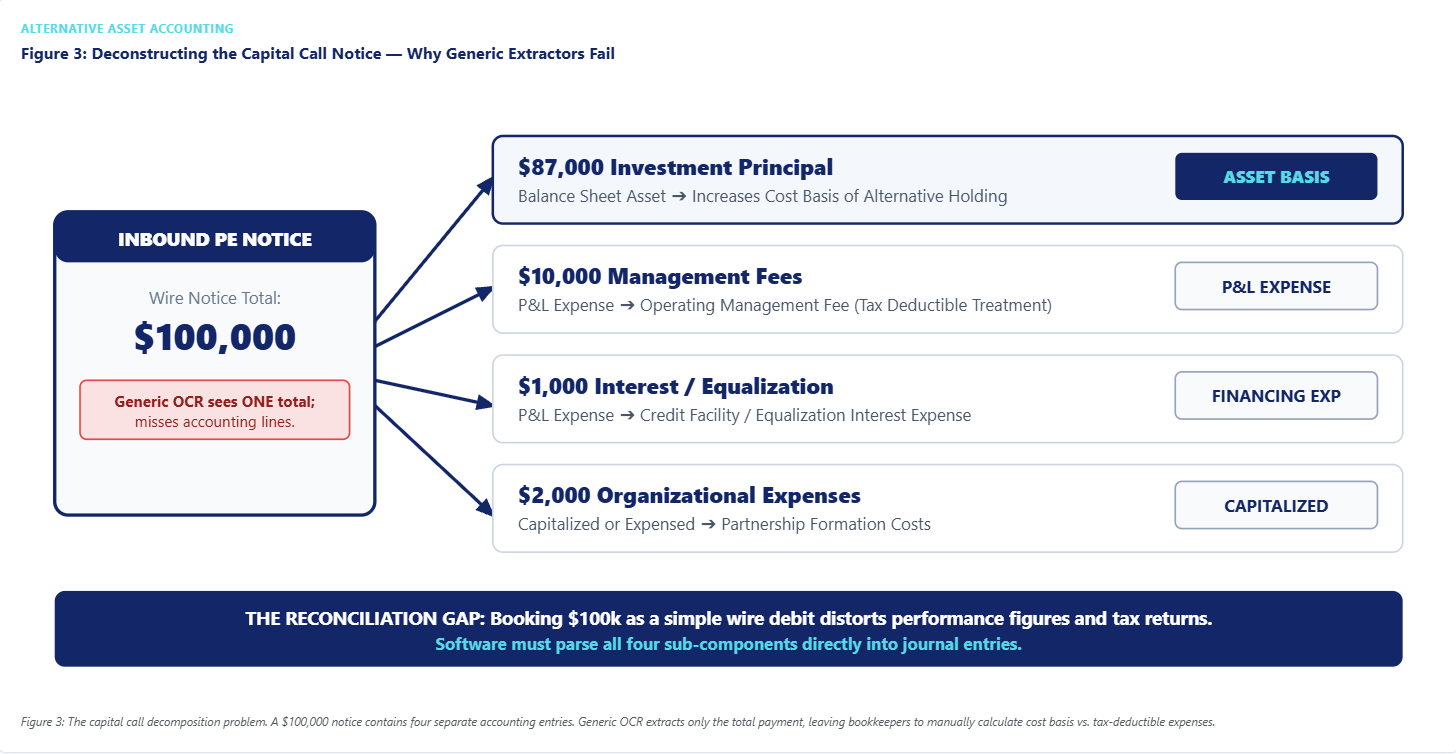
The amounts are illustrative, and the treatment depends on your policy and your accountant. The point is the shape. Generic document extraction returns the total. If your software cannot capture the components, then your accountants split them by hand, and every performance figure built on the wrong split is wrong from day one.
The setup: An office tracks $40 million of private equity commitments in a spreadsheet and watches cash on a bank portal. The principal’s dashboard shows total cash, with no deduction for what is already promised.
What happens: Two capital calls land in the same week during a market dip. The investment committee had just approved a new co-investment against the cash it thought it had, so the office sells listed holdings at a poor moment to meet the calls.
The lesson: Liquidity is cash minus commitments. A view that ignores uncalled capital overstates what the office can spend.
Regional statements
Statements from banks in Asia can arrive in layouts a parser may never have seen: nested multi-currency tables, scanned trade confirmations, bilingual summaries. If a vendor’s parser has not met your bank’s format, then your analysts go back to retyping. The only reliable test is an unvarnished trial on your own statements, before you sign.
Shared or dedicated infrastructure
Platforms isolate client data in different ways. Some run shared environments with logical separation between clients. Others offer dedicated or single-tenant deployments, and at least one ledger-based vendor describes its architecture as single-tenanted on Microsoft Azure. Neither model is automatically safer. What matters is who holds the encryption keys, who has administrative access, and what happens to your data when you leave.
Operating companies
Wealth platforms treat holdings as financial instruments. A shipping, manufacturing or property business owned by the family has cash flows, intercompany loans and dividends of its own, and that is where wealth-only platforms stop.
Context: A global maritime shipping and commodity group with operating entities across Asia and Europe.
What was built: An integrated enterprise platform hosted on Amazon Web Services (AWS), covering multi-entity finance, budgeting, workflow automation, ticketing, vessel operations, and mobile and web executive dashboards, delivered over a multi-year engagement.
Why it matters here: Many Asian family offices hold operating businesses next to liquid wealth. This is adjacent experience, not family office work.
Have more questions about family office platforms or other issues?
Have all your questions answered with a 2-hours complimentary consultation session, just a click a way.
4. When the Best Family Office Software Is Not Off the Shelf: The Hybrid Option
Some offices hold assets that no platform models well: operating companies, unusual holding structures, regional private assets. They have three options: bend the platform, build around it, or accept manual work. A hybrid keeps the platform for what it does well and builds only the gap, such as an ingestion layer for one document type or a principal dashboard fed by the platform’s data.
The Catch
- You own the seam: When the platform and the custom layer disagree, you reconcile.
- You own the maintenance: Security patches, monitoring and the person who understands the code. If that person leaves, the layer becomes an expensive spreadsheet.
- Scope creep: A build that tries to replace the platform rarely ships.
If you consider a custom or hybrid build, ask any engineering partner five questions:
- Who owns the code and the infrastructure? Ownership should be written into the contract, not assumed.
- Who holds the encryption keys? Your office should, with a documented process for revoking access.
- What happens at exit? Ask for the handover in detail: repositories, documentation and access.
- What do the certifications cover? Ask for the current ISO/IEC 27001 certificate and its scope. It describes what was audited, not whether your data is safe.
- Who else has solved a problem this shape? Ask for references at comparable complexity, described by sector and scale.
5. Ten Questions to Ask Before Buying Family Office Software
Use these with every vendor on your shortlist, including custom builders, before you decide which is the best family office software for your office. Ask for answers in writing.
| # | Question | Why it matters |
|---|---|---|
| 1 | Is the core a reporting engine, a ledger, or both? | It decides what you will still need to buy. |
| 2 | Which of our banks and custodians are automated, and which are parsed from PDFs? | Coverage lists beat coverage claims. |
| 3 | How are capital calls, distributions and uncalled commitments recorded, and at what level of detail? | Principal, fees, interest and expenses all matter. |
| 4 | Can we test it on our own statements, including regional and bilingual ones? | A demo set proves nothing about your banks. |
| 5 | Is the environment shared or dedicated, and who holds the encryption keys? | Custody decides your exposure and your exit. |
| 6 | Where does artificial intelligence (AI) read our documents, and is anything retained or used for training? | A pasted statement can outlive the task. |
| 7 | What does the principal see, on which devices, behind which login? | A report nobody opens reports nothing. |
| 8 | How are trusts, VCC sub-funds and holding companies mapped? | Look-through answers ownership questions quickly. |
| 9 | What is the realistic implementation plan, and can we speak to a client of our size? | Timelines depend on your data quality. |
| 10 | How do we export everything if we leave, and in what format? | Exit terms decide how locked in you are. |
6. Four Takeaways for Choosing the Best Family Office Software
- Decide the job first: Is your pain visibility or books? That one answer removes half the market, and it is the fastest way to find the best family office software for your office.
- Run the test in every profile: Bring your regional bank statements, a real capital call notice and your messiest entity structure to each trial.
- Ask for lists, not claims: Custodian coverage, security reports and export formats should arrive in writing before you sign.
- Budget for the seam: If you pair two tools, name the person who owns the reconciliation between them.
7. How Vinova Approaches Custom Family Office Software
Vinova is a Singapore-headquartered technology transformation partner with delivery in Vietnam and 16+ years of experience. Its information security and quality management systems are certified to ISO 27001:2022 and ISO 9001:2015.
This guide is part of Vinova’s series on family office technology. The experience behind it comes from adjacent work in regulated, brand-sensitive and multi-entity environments, including the operating group in Section 3:
| Sector | What was built |
|---|---|
| A Singapore legal education body | A centralized portal for accreditation, activity logging, administrative compliance and reporting |
| A luxury automotive brand’s flagship experience center in Singapore | Digital touchpoints and booking systems |
| A Singapore energy utility group | Solution architecture for an AI-enabled enterprise platform on Azure |
From that work, and from the platform tests in Section 2, Vinova follows four rules when a family office asks for custom or hybrid technology:
- Show the principal one useful view first: Consolidated cash and liquidity come before everything else, so the office sees value before the long tail of assets is automated.
- Own the seams: Keep the bank and custodian feeds, and build the integration layer so nobody retypes data between systems.
- Hold the keys: Deploy in dedicated, single-tenant cloud environments in a Singapore region, on AWS or Azure, where the family owns the database and the encryption keys.
- Put ownership in the contract: The client owns the code and the infrastructure, with documented handover and exit terms, under Singapore law. Copyright in future work is assigned under Section 140 of the Copyright Act 2021, and disputes go to arbitration at the Singapore International Arbitration Centre (SIAC).
Frequently Asked Questions
What is the best family office software?
There is no single best family office software. The right choice depends on whether your complexity lives in consolidated reporting, in partnership and entity accounting, or in assets that no platform models well. Decide that first, then shortlist platforms built for that job.
What is the best single family office software?
There is no single winner. Lean single family offices usually start with a reporting-first or all-round platform and add a ledger only if they keep their own books. Offices with partnership accounting needs should look at the accounting-first group first. Test two or three against your own bank statements before you decide.
What is the best family office accounting software?
It depends on your structure. Offices with partnership accounting and many entities should start with the accounting-first group: Asset Vantage, Eton Solutions and FundCount. Lean offices moving off general-purpose accounting software should look at SumIt. Test any of them on your own chart of accounts before you decide.
What are the top family office software platforms in 2026?
No one can rank them for your office. The ten in this guide cover the main jobs: reporting-first platforms (Addepar, Canopy, Landytech), wealth-mapping platforms (Asora, Masttro, QPLIX) and accounting-first platforms (Asset Vantage, Eton Solutions, FundCount, SumIt). Shortlist by job, then test two or three.
What is the difference between reporting-first and accounting-first software?
Reporting-first platforms consolidate holdings, valuations and performance across custodians. Accounting-first platforms run a double-entry general ledger across entities, including partnership and trust accounting. Many offices pair one of each, and the reconciliation between them becomes someone’s job.
How much does family office software cost?
It varies by vendor, office size and modules, and most vendors quote by contract. Ask for a line-item quote that separates licenses, implementation, data onboarding and support. Be wary of any article, including this one, that gives a single number.
How long does implementation take?
It depends on your data quality and scope. One vendor states that most offices go live within four to six weeks. Ledger-based platforms generally take longer, because the chart of accounts and historical data must be mapped. Ask for a written plan and a reference at your size.
Can family office software track private equity and passion assets?
Yes, but the mechanism varies. Private assets lack standard data feeds, so values are usually entered manually or extracted from documents. Ask how each platform records capital calls, distributions and appraisals, and how it shows how current each value is.
Vinova: Singapore’s mobile and web application development partner since 2010. ISO 27001:2022 and ISO 9001:2015 certified.
300+ in-house engineers across Singapore, Hanoi, Da Nang, and Ho Chi Minh City, including teams who build secure web and mobile applications for enterprise and government clients. We wrote this guide so you can put sharper questions to every vendor before you buy.
Financial Times Top 500 High-Growth Companies Asia-Pacific 2026. The Straits Times Singapore’s Fastest-Growing Companies 2024, 2025, and 2026.