In 2025, the AI development ecosystem is defined by a rapid push for enterprise scale. Is your current framework an architectural asset or a liability slowing your deployment velocity?
The core decision rests on the “Big Three”: TensorFlow, PyTorch, and Scikit-learn. These are distinct computing philosophies, not just code libraries. Choosing the wrong one creates unnecessary infrastructure costs and delays critical innovation—AI development in the USA by Vinova bridges this gap by delivering enterprise-grade architectures that align model selection, MLOps, and scalability from day one.
Learn how to select the foundation that powers your real innovation.
Table of Contents
Key Takeaways:
- TensorFlow is the industrial standard for production-scale deep learning and mobile/edge deployments using TensorFlow Lite.
- PyTorch, the GenAI engine using dynamic graphs, offers training times up to 31% faster in some benchmarks, favored by researchers.
- Scikit-learn is the foundation for classical ML on tabular data, offering audit-ready explainability for regulated sectors.
- Vinova’s hybrid stack leverages expertise from 300+ successful projects and adheres to ISO 27001 and HIPAA readiness for US enterprises.
Introduction – Why the Right Tools Matter in AI Development
In 2025, the AI development landscape is vast, but for enterprise applications, the gravitational center remains the “Big Three”: TensorFlow, PyTorch, and Scikit-learn. These are not merely code libraries; they are distinct philosophies of computing. Choosing between them is a foundational architectural decision that influences hiring, infrastructure costs, and deployment velocity.
TensorFlow: The Industrial Heavyweight
Developed by Google Brain, TensorFlow (TF) remains the standard for massive-scale production environments. Its design philosophy prioritizes deployability and pipeline integrity.
- The Static Graph Legacy: Historically, TensorFlow utilized a “static computation graph” (defining the entire neural network structure before running data through it). While this steeper learning curve has been smoothed by the integration of Keras (a high-level API), the underlying architecture still favors optimization. This allows the compiler to fuse operations and manage memory more efficiently than dynamic alternatives, making TF often superior for high-throughput, low-latency environments.
- End-to-End MLOps with TFX: The true differentiator for enterprise is TensorFlow Extended (TFX). This is not just a model trainer; it is a production platform. TFX modules handle data validation (detecting schema skew), model analysis (checking fairness across demographic slices), and serving. For a bank processing millions of transactions, TFX ensures that the model deployed on Friday behaves exactly like the model verified on Thursday.
- Mobile and Edge Dominance: Through TensorFlow Lite, the framework offers the most mature path for deploying models on edge devices (Android, iOS, IoT). For Vinova’s mobile-first clients, this capability is critical. It allows complex inference to happen locally on a user’s device, preserving privacy and reducing cloud costs.
PyTorch: The Researcher’s Choice and the GenAI Engine
Originally developed by Meta AI (Facebook), PyTorch has conquered the research world and is aggressively expanding into the enterprise.
- Dynamic Computation Graphs: PyTorch uses “eager execution,” meaning the computation graph is built on the fly as the code runs. This makes it feel like standard Python. If a developer wants to change the network structure mid-loop based on data conditions, they can. This flexibility is why PyTorch is the native language of Generative AI. Most Large Language Models (LLMs), including the architectures behind GPT-4 and Llama 3, are researched and trained primarily in PyTorch.
- Debugging and Prototyping: Because it executes line-by-line, debugging PyTorch is intuitive. Developers can use standard Python debuggers to inspect variable states instantly. This reduces the “Time to Prototype,” allowing Vinova’s R&D teams to iterate on novel architectures faster than they could with TensorFlow.
- The Production Gap is Closing: Historically, PyTorch struggled with deployment. However, tools like TorchServe and the ONNX (Open Neural Network Exchange) format now allow PyTorch models to be serialized and run on high-performance inference engines, narrowing the gap with TensorFlow.
Scikit-learn: The Unsung Hero of Business Logic
While Deep Learning gets the headlines, Scikit-learn powers the majority of day-to-day business intelligence.
- Classical Machine Learning: Not every problem requires a neural network. For tasks like customer churn prediction, credit scoring, or inventory forecasting—where data is structured (tabular) and interpretability is key—Scikit-learn is often superior. It implements classical algorithms like Random Forests, Support Vector Machines (SVM), and Gradient Boosting with high efficiency.
- Explainability: In regulated industries, “black box” models are liability magnets. A Scikit-learn Decision Tree provides a clear, audit-ready path of logic explaining why a loan was denied. This transparency is often a legal requirement in US financial and healthcare sectors.
Strategic Selection Matrix
For US enterprises, the choice is rarely binary. It is about fitting the tool to the specific layer of the stack.
| Feature | TensorFlow | PyTorch | Scikit-learn |
| Primary Use Case | Production-scale Deep Learning, Mobile/Edge Deployment | Research, GenAI, LLMs, Complex/Dynamic Architectures | Classical ML, Tabular Data, Data Preprocessing |
| Execution Mode | Static/Graph (Optimized for Scale) | Dynamic/Eager (Optimized for Flexibility) | CPU-based (Optimized for Simplicity) |
| Deployment | Excellent (TFX, TF Serving, TF Lite) | Good (TorchServe, ONNX) | Simple (Pickle, Joblib, ONNX) |
| Learning Curve | Steeper (requires understanding graph concepts) | Moderate (Pythonic, intuitive) | Low (Simple, consistent API) |
Vinova’s engineering teams frequently employ a hybrid architecture. For instance, a healthcare application might use PyTorch to train a cutting-edge diagnostic model (leveraging the latest research), convert it via ONNX for deployment, while simultaneously using Scikit-learn to handle patient data preprocessing and risk stratification. This approach avoids vendor lock-in and ensures that every component of the application is powered by the best-in-class tool for that specific task.
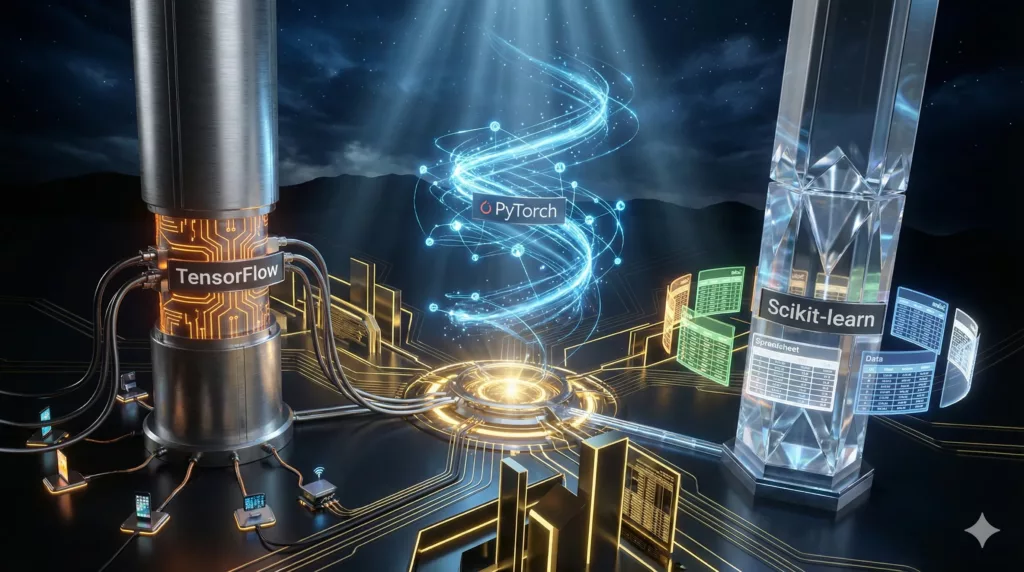
Overview of Top AI Frameworks: TensorFlow, PyTorch, Scikit-learn
The modern ecosystem of Artificial Intelligence is built upon a foundation of open-source frameworks that abstract the complex mathematics of calculus, linear algebra, and probability theory. While a plethora of libraries exists, three giants have come to dominate the landscape: TensorFlow, PyTorch, and Scikit-learn. Each of these frameworks embodies a distinct philosophy regarding development capability, deployment ease, and target audience. Understanding the nuanced differences between them is crucial for enterprise architects and Chief Technology Officers (CTOs) when defining a long-term technology strategy.
TensorFlow: The Industrial Titan
Google released TensorFlow (TF) in 2015. It quickly became the standard for production-grade deep learning. Its architecture is built for one thing: scale. It runs on everything from massive data center clusters to low-power edge devices.
Architectural Philosophy: Static vs. Dynamic Execution
TensorFlow’s core strength is the static computation graph. You define the entire neural network structure before any data flows through it. This allows the compiler to optimize the graph aggressively. It fuses operations and manages memory efficiently. This is critical for large-scale deployment where performance per watt is the primary metric.
TensorFlow 2.x introduced Eager Execution. This allows line-by-line execution, similar to standard Python. It solves the “black box” debugging problem of earlier versions.
The “Best of Both Worlds” Strategy:
- Debug Dynamically: Use eager execution during research to inspect code line-by-line.
- Deploy Statically: Use the @tf.function decorator to compile your functions into optimized static graphs for production.
The Ecosystem Advantage
TensorFlow is not just a library; it is an end-to-end platform.
- TensorFlow Serving: This handles the lifecycle of your models. You can update and version models without downtime. It is designed for high-performance production environments.
- TensorFlow Extended (TFX): This pipeline manages data validation, preprocessing, and model analysis. It ensures that the data you train on matches the data you see in the real world.
- JAX Integration: Recent updates integrate JAX. This library allows high-performance numerical computing. It lets TF users leverage hardware acceleration for complex scientific tasks.
Mobile and Edge: The LiteRT Evolution
For app developers, TensorFlow Lite (TFLite)—now evolving into LiteRT—is the critical component.
- On-Device Inference: You do not need a constant cloud connection. TFLite enables models to run directly on iOS and Android devices.
- Latency & Privacy: Processing data locally reduces lag. It also keeps user data on the device, addressing privacy concerns immediately.
Use Cases and Performance
TensorFlow wins when scale and rigidity matter. It is the default choice for image recognition and reinforcement learning in autonomous systems.
Benchmarks consistently show that while TF has a steeper learning curve, it offers superior inference speed. For enterprise systems that require stability and massive distribution, TensorFlow remains the reliable workhorse.
PyTorch: The Researcher’s Choice and Production Contender
Facebook’s AI Research lab (FAIR) released PyTorch in 2016. It rapidly overtook TensorFlow in academic citations and conference implementations. Its primary appeal lies in its simplicity and “Pythonic” design, which aligns with the mental model of most data scientists.
Architectural Philosophy: Imperative Programming
PyTorch utilizes dynamic computation graphs, also known as Define-by-Run. The graph is built on the fly as the code executes, line by line.
- Intuitive Control: Developers use standard Python control flow statements—loops, if-else conditions, and print statements—directly within the model definition.
- Dynamic Flexibility: This architecture is ideal for complex tasks where the graph structure changes based on input data, such as dynamic neural networks (Tree-LSTMs) or advanced NLP workflows.
The Bridge to Production
Historically a research tool, PyTorch has aggressively closed the production gap with TensorFlow.
- TorchScript: This tool serializes PyTorch models into an intermediate representation. It allows models to run in a C++ runtime environment, independent of the Python interpreter. This bridges the gap between research flexibility and high-performance production.
- TorchServe: Developed with AWS, this tool provides a scalable way to serve models, mirroring the capabilities of TensorFlow Serving.
- Hugging Face Integration: PyTorch is the primary framework for the Hugging Face Transformers library. It is the de facto standard for Generative AI and Large Language Models (LLMs).
Performance Metrics
In direct comparisons, PyTorch often demonstrates faster training times—up to 31% faster in some benchmarks. This is due to efficient memory management and reduced overhead during iterative training.
While it typically consumes more RAM than TensorFlow’s optimized static graphs, its superior Developer Experience (DX) and ease of debugging make it the preferred choice for startups and teams prioritizing agility.
Scikit-learn: The Foundation of Classical Machine Learning
Deep Learning gets the headlines, but “Classical” Machine Learning drives most business analytics. Scikit-learn (sklearn) is the premier library for these practical tasks.
Focus and Functionality
TensorFlow and PyTorch handle complex neural networks. Scikit-learn focuses on traditional, effective algorithms.
- Regression: Predicts continuous values. Use this for sales forecasting or estimating housing prices.
- Classification: Categorizes data into distinct classes. Examples include detecting spam emails or scoring credit risk.
- Clustering: Groups unlabeled data based on similarity. Marketing teams use this for customer segmentation.
- Dimensionality Reduction: Simplifies complex datasets. Techniques like PCA help visualize high-dimensional data without losing key information.
Simplicity and Accessibility
Scikit-learn is famous for its consistent design. The code structure remains identical regardless of the algorithm.
Whether you use a Support Vector Machine (SVM) or a Random Forest, you use the same commands: model.fit() to train and model.predict() to generate results. This consistency lowers the barrier to entry for analysts.
Enterprise Application
Deep neural networks are often unnecessary for standard business data. They require expensive hardware and long training times.
A Scikit-learn Random Forest model often delivers sufficient accuracy for tabular data (spreadsheets and SQL records) at a fraction of the cost. It also offers greater interpretability. You can explain why the model made a decision. Furthermore, Scikit-learn integrates perfectly with NumPy and Pandas, making it the standard tool for data preprocessing even in complex AI pipelines.
Comparative Analysis: Choosing the Right Framework
The selection between these frameworks often dictates the architecture and velocity of the final solution. The following table synthesizes the key trade-offs based on the research findings.
| Feature | TensorFlow | PyTorch | Scikit-learn |
| Primary Use Case | Large-scale Deep Learning, Production Deployment, Mobile | Research, Prototyping, GenAI, NLP, Complex Architectures | Classical ML, Data Analysis, Small/Medium Structured Data |
| Graph Architecture | Static & Dynamic (Eager Execution); Graph Compilation | Dynamic (Define-by-Run); Imperative | N/A (Algorithmic implementation) |
| Learning Curve | Steep; complex API abstraction and boilerplate | Gentle; Pythonic and intuitive debugging | Very Easiest; consistent, simple API |
| Performance | High optimization for inference; Mobile/Edge focus | Fast training; Flexible development cycle | CPU-bound; constrained by RAM |
| Deployment | Excellent (TFX, Serving, Lite) | Improving (TorchScript, TorchServe) | Simple (Pickle/Joblib), not for mobile |
| Industry Adoption | Enterprise, Mobile Apps, IoT, Embedded Systems | Academia, GenAI Startups, Research Labs | Universal Data Science, Financial Modeling |
Table 1: Comparative Analysis of Top AI Frameworks
Insights on Framework Convergence
A critical second-order insight derived from the current landscape is the increasing convergence of TensorFlow and PyTorch. As TensorFlow adopts dynamic features to improve usability (TF 2.x) and PyTorch adopts static compilation for performance (TorchScript), the functional gap is narrowing.
However, the cultural gap remains significant:
- TensorFlow is viewed as the “industrial engineer’s” tool—rigid, robust, and scalable.
- PyTorch is the “scientist’s” tool—flexible, expressive, and experimental.
For a comprehensive solution provider like Vinova, which services both established enterprises (Abbott, Samsung) and agile startups, mastery of all three ecosystems is essential.
- Scikit-learn: Utilized for rapid data analysis and predictive modeling on structured data.
- PyTorch: Deployed for cutting-edge generative AI and NLP tasks.
- TensorFlow: Leveraged for robust, cross-platform mobile deployments.
Vinova’s Custom AI Tech Stack for US Companies
In the competitive US technology market, knowledge of AI frameworks is not enough. Success depends on architecture. Vinova leverages over 15 years of experience and a portfolio of 300+ successful projects to build a “hybrid” stack tailored to US enterprises. This approach avoids monolithic structures in favor of a modular, best-of-breed system.
The “Innovation Services” Layer: AI & Machine Learning
Vinova treats AI as a foundational element of software, not an optional add-on.
Generative AI and LLMs The stack integrates advanced Generative AI capabilities. It supports a broad range of models, including proprietary options like GPT (OpenAI), Gemini (Google), and Claude (Anthropic), as well as open-source models like LLaMA and Stable Diffusion. This diversity allows US clients to balance performance with strict data privacy requirements.
Orchestration with RAG To manage these models, Vinova utilizes LangChain. This framework creates context-aware applications capable of reasoning. It pairs with Vector Databases like Pinecone to enable Retrieval-Augmented Generation (RAG).
This architecture retrieves specific, private business data to answer queries. It solves the “hallucination” problem common in generic LLMs and ensures answers rely on your actual data.
Deep Learning and Computer Vision For complex pattern matching, the stack employs TensorFlow, PyTorch, and Hugging Face transformers. This handles high-dimensional, unstructured data. Applications include automated defect detection in manufacturing and medical imaging diagnostics in healthcare.
The Mobile-First Integration Strategy
Vinova builds on a strong mobile engineering foundation, having delivered over 90 Flutter applications. The stack integrates AI capabilities directly into mobile environments.
Cross-Platform Frameworks Flutter and React Native allow for a single codebase that runs natively on both iOS and Android. This reduces time-to-market and Total Cost of Ownership (TCO).
- Flutter Integration: Flutter interfaces directly with C++ libraries and on-device AI engines like TensorFlow Lite via the Foreign Function Interface (FFI). This enables “Edge AI,” running models directly on the user’s device for speed and privacy.
- React Native: This framework leverages the massive JavaScript ecosystem, simplifying integration with web-based AI APIs.
Offline-First Architecture For variable connectivity environments like field service or rural healthcare, the stack uses an “Offline-First” strategy. Embedded databases like SQLite and Realm store data locally.
The application functions with zero latency. When connectivity returns, data automatically synchronizes with the cloud. This ensures no critical field data is lost before processing.
Data Engineering and Backend Infrastructure
AI requires reliable data. The backend supports high-throughput processing.
Backend Technologies
- Python (Django/Flask): The standard for AI logic, used to invoke ML models directly or process data.
- Node.js: Handles high-concurrency I/O operations for real-time apps.
- Legacy Modernization: Support for .NET and Java (Spring MVC) allows modern AI features to integrate with established enterprise systems.
Database Systems The stack supports diverse data models:
- Relational (SQL): For transactional records requiring ACID compliance.
- NoSQL: For unstructured data like logs and sensor streams.
- SingleStore: A high-performance distributed SQL database designed for real-time analytics and massive concurrency.
Compliance and Security (DevSecOps)
US markets demand strict regulatory adherence. Vinova wraps the entire stack in a DevSecOps philosophy.
- Certifications: The company holds ISO 9001 (Quality Management) and ISO 27001 (Information Security Management) certifications.
- US Compliance: Applications are built ready for HIPAA and SOC 2 attestation. This ensures patient data handling meets federal standards for healthcare clients like Abbott.
- Security Testing: Automated security checks and penetration testing detect vulnerabilities before they impact users.
The Value of the “One-Stop” Solution
Vinova controls the entire stack, from the pixel on the screen to the AI inference engine and the secure cloud database. This end-to-end capability eliminates the friction and integration errors common in multi-vendor projects. It provides a single point of accountability for driving innovation.
Integrating AI Tools with Cloud Platforms
AI does not exist in a vacuum. It lives and scales in the cloud. Scalability—the ability to train on terabytes of data and serve millions of predictions—depends entirely on robust infrastructure. You must treat cloud infrastructure and AI development as a single discipline.
The Cloud-Native Ecosystem
Leverage the “Big Three”—AWS, Azure, and Google Cloud—to optimize performance and cost.
IaaS for Training Training deep learning models requires immense power. Use cloud infrastructure to provision high-performance GPUs on demand. This transforms capital expenditure (CapEx) into operational expenditure (OpEx).
- Auto-Scaling: Do not maintain expensive on-premise hardware that sits idle. Spin up hundreds of instances for heavy jobs, like retraining a recommendation engine on Black Friday data. Spin them down immediately after.
- Containerization: Use Docker and Kubernetes (EKS or GKE). Containerizing models ensures they run identically on a developer’s laptop and the production server. This eliminates deployment errors.
PaaS for AI Tap into higher-level services to reduce maintenance overhead.
- Generative AI: Tools like Amazon Bedrock allow you to build and scale applications using foundation models via a simple API. You do not need to manage the underlying infrastructure.
- Enterprise Integration: For teams using the Microsoft ecosystem, integrate AI directly into Azure. This surfaces insights naturally within tools like Dynamics 365, connecting ERP and CRM data seamlessly.
The Migration Strategy
You cannot run modern predictive analytics on fragmented, offline servers. Cloud migration is the critical first step.
Data Assessment and Cleansing Perform a “deep dive” needs analysis before migration. Clean and structure your data. Handle missing values and remove duplicates. This step often represents 80% of the project work.
Secure Transfer and Modernization Encrypt data both in transit and at rest. Adhere to ISO 27001 standards, especially for regulated sectors like Finance and Healthcare.
Do not just “lift and shift.” Refactor legacy applications to be cloud-native. Break monolithic apps into microservices. Expose specific functions, like risk assessment modules, as APIs that AI can enhance.
Integrating AI into Workflows (MLOps)
MLOps unifies development and operations. It ensures reliability.
Continuous Deployment (CI/CD) Automate the retraining pipeline. If your data changes—for example, new product lines are added—the system must trigger a retraining cycle. It validates the new model against baseline metrics and deploys it to production without human intervention.
Model Monitoring AI models suffer from “drift.” They lose accuracy as real-world data diverges from training distributions. Implement monitoring tools to track performance metrics like latency and accuracy. Alert administrators instantly when quality drops.
Hybrid and Edge Cloud Integration
Pure cloud is not always the answer. Latency and privacy often demand a hybrid approach.
Edge Inference Run models directly on IoT devices or mobile phones using frameworks like TensorFlow Lite. This provides instant feedback for wearables or medical sensors.
The Cloud Training Loop Sync edge data to the cloud using an “Offline-First” strategy. Use the infinite storage and compute capacity of the cloud to analyze long-term trends and retrain the global model.
Case Example – AI Integration for Predictive Analytics
We must examine execution to understand impact. While giants like Netflix illustrate the potential of data, specific implementations reveal the mechanics. Analyzing projects like Engine Mobile and GOfix shows how predictive analytics shifts business logic from “Reactive” to “Proactive.”
Accelerating Drug Discovery: Engine Mobile
The pharmaceutical industry faces a massive bottleneck. Identifying viable drug candidates is slow, expensive, and prone to failure.
The Solution Engine Mobile applies an engineering mindset to biology. The team uses Machine Learning to power experimentation. By applying deep learning algorithms—likely leveraging frameworks like PyTorch or TensorFlow—to massive datasets, the system predicts compound efficacy before physical testing begins.
The Impact This creates a high-velocity feedback loop. Researchers visualize data and insights instantly. The system transforms drug discovery from a process of trial-and-error into one driven by predictive precision.
Intelligent Resource Allocation: GOfix and LiveIn
In the on-demand economy, efficiency equals logistics. Manual assignment leads to long wait times and customer churn.
Smart Allocation System The core innovation is a system that auto-allocates providers to service orders. It replaces manual dispatch with predictive logic.
- Provider Location: Analyzes real-time geospatial data to find the nearest available technician.
- Job Complexity: Uses historical data to predict repair duration, preventing schedule overruns.
- Demand Forecasting: Predicts peak times to ensure adequate coverage.
This automation reduces administrative overhead. It improves speed and directly impacts customer satisfaction.
Retail Inventory Optimization
Retailers lose billions annually to overstocking and stockouts. You must predict demand to survive.
Time Series Forecasting AI models analyze seasonality, promotions, and external factors like weather. They forecast sales at the individual SKU level. This minimizes out-of-stock situations without the financial risk of holding excess inventory.
Dynamic Pricing Algorithms adjust product costs in real-time based on demand. This maximizes revenue and clears inventory efficiently.
Financial Predictive Analytics
In finance, retention is currency. Institutions like OCBC and AIA use AI to protect and retain customers.
Customer Churn Prediction Using classification algorithms like Random Forest or Gradient Boosting, models analyze transaction history. They identify customers at risk of leaving. This allows banks to intervene proactively with personalized offers.
Fraud Detection AI analyzes transaction patterns in real-time. It flags anomalies instantly. This protects both the institution and the customer, fostering trust.
The Methodology in Action
A consistent pattern emerges across these examples.
- Data Unification: You must digitize and centralize information first. You cannot predict outcomes from fragmented data.
- Algorithm Selection: Choose the right tool. Use Deep Learning for biological patterns, Optimization Algorithms for logistics, and Time Series Analysis for retail.
- User-Centric Deployment: AI is not a black box. Deliver it through user-friendly interfaces. Stakeholders must interact with predictions seamlessly.
Conclusion – Empower Innovation with Vinova’s AI Expertise
The convergence of AI, cloud, and mobile technology creates a historic opportunity, but the path to realizing it is fraught with technical complexity. The choice between frameworks like TensorFlow and PyTorch, or the strategy for cloud migration, defines the difference between a research experiment and a scalable, industrial-grade solution.
At Vinova, we bridge the gap between theoretical potential and operational reality.
We provide the strategic partnership US companies need to navigate this landscape, built on four key differentiators:
- A Holistic Tech Stack: Innovation requires more than just algorithms. Our “hybrid” stack combines the cross-platform efficiency of Flutter, the robust backend of Python/Node.js, and the intelligence of TensorFlow/PyTorch. We deliver complete, usable products—not isolated experiments—ensuring reliability with “Offline-First” architecture.
- Enterprise-Grade Rigor: For regulated industries like Healthcare and Finance, security is non-negotiable. Our adherence to ISO 27001, HIPAA readiness, and DevSecOps practices provides the assurance high-stakes clients like Abbott and Samsung demand.
- From Data to Decision: We lay the groundwork for AI through Cloud Migration and Data Engineering. As proven by our work in drug discovery with Engine Mobile and logistics with GOfix, we transform raw data into predictive insights that drive scientific breakthroughs and efficiency.
- Customization Over Commoditization: We don’t force-fit you into a pre-built box. We architect custom solutions that respect your unique data, workflow, and business goals.
Innovation is a continuous process. As Generative AI and Edge AI redefine the future, you need a partner who understands the “Engine of Intelligence.”
Empower your business with Vinova’s AI expertise today. Partner with us to not just compete, but to define the future of your industry.
FAQs:
Q: What is the core philosophical difference between TensorFlow and PyTorch?
A: TensorFlow is considered the “industrial engineer’s” tool, primarily leveraging a Static/Graph execution mode (though it supports dynamic with Eager Execution) optimized for massive-scale production deployment, stability, and mobile/edge devices (TensorFlow Lite). PyTorch is the “scientist’s” tool, built on a Dynamic/Eager execution (Define-by-Run) model, making it more flexible, intuitive for debugging (Pythonic), and the preferred engine for research and Generative AI/LLMs.
Q: Which framework should an enterprise choose for a cutting-edge Generative AI project?
A: PyTorch is the native language of Generative AI. Its dynamic computation graphs and flexibility make it the primary framework for training and researching most Large Language Models (LLMs), including the architectures behind GPT-4 and Llama 3.
Q: Where does Scikit-learn fit into a modern AI strategy, given the focus on Deep Learning?
A: Scikit-learn is the foundation for classical Machine Learning on structured (tabular) data. It is the superior choice for day-to-day business intelligence tasks like customer churn prediction, credit scoring, and inventory forecasting. Its use of traditional algorithms offers audit-ready explainability, which is often a legal requirement in regulated sectors like finance and healthcare.
Q: What does Vinova mean by a “hybrid architecture” or “hybrid stack”?
A: A hybrid architecture is a modular, best-of-breed system that avoids vendor lock-in by using the best framework for each specific task. For example, a Vinova solution might use PyTorch for cutting-edge model training, TensorFlow Lite for robust mobile deployment, and Scikit-learn for patient data preprocessing and risk stratification on tabular data.
Q: How is the production gap between PyTorch and TensorFlow closing?A: The functional gap is narrowing as both frameworks adopt features from each other. TensorFlow 2.x added dynamic execution (Eager Execution) for better usability, while PyTorch introduced TorchScript and partnered with tools like TorchServe to serialize and run models in high-performance C++ runtimes, making it a viable and competitive option for production deployment.