Table of Contents
Key Takeaways:
- Reclaims Physician Time: AI automates clinical documentation and repetitive administrative tasks, eliminating after-hours “pajama time” and directly reducing provider burnout.
- Boosts Practice ROI: Clinics realize rapid financial returns by deploying AI for revenue cycle management (RCM), denial prediction, and predictive scheduling to minimize no-show losses.
- Enhances Care Quality: Point-of-care clinical decision support (CDS) tools improve safety and outcomes by flagging drug interactions and early disease risks in real time.
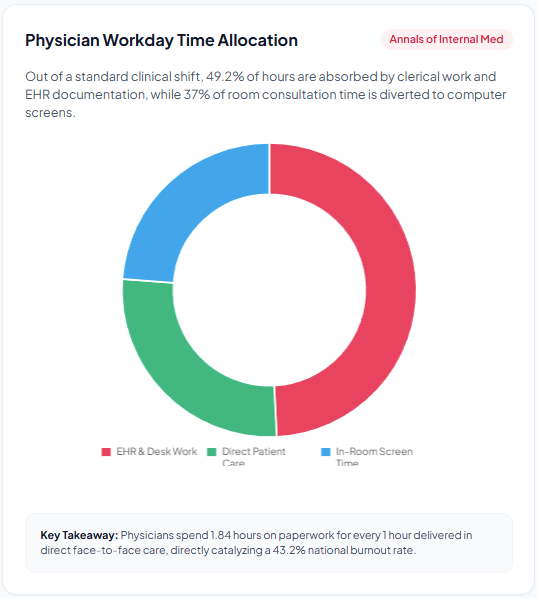
The average outpatient physician spends 1.84 hours on paperwork for every hour they spend actually seeing a patient. That’s not a minor inefficiency, it’s the single largest driver of physician burnout in the United States, according to time-motion studies published in the Annals of Internal Medicine. This guide covers where AI in clinic settings is already closing that gap, backed by real deployment data, not vendor promises.
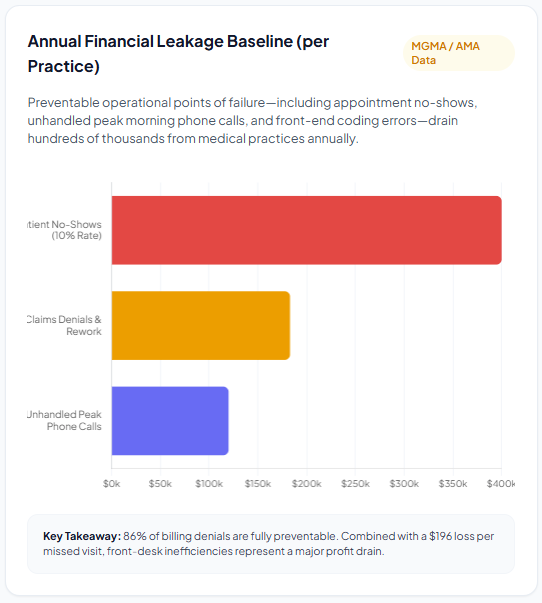
The financial side is just as stark. Systemic no-shows drain an estimated $150 billion a year from the U.S. healthcare system. A mid-sized practice with a 10% no-show rate leaves roughly $400,000 in uncollected revenue on the table annually. Front-desk phone bottlenecks compound it further: unoptimised clinics miss up to half of incoming calls during peak morning hours, and every missed call is a booking that never happens. This is the specific gap AI solutions in healthcare in Singapore are increasingly built to close.
Broader ai and healthcare adoption trends set the context here, but this guide stays deliberately narrow: what actually helps a clinic run day to day, with real numbers behind each one.
| Bottleneck | Baseline | Financial / Operational Cost |
| EHR admin overhead | 49.2% of the clinic workday spent on EHR and desk work | 1.84 hours of paperwork per 1 hour of patient face-time |
| After-hours “pajama time” | 1 to 2 hours per night per provider | A primary driver of the 43.2% U.S. physician burnout rate |
| Outpatient no-show rate | 6.81% (MGMA median) to 23% (global average) | $196-$200 lost revenue per missed visit; $150B U.S. system-wide loss |
| Inbound phone abandonment | 16% to 30% call abandonment; 4.4 min average hold | Up to 50% of peak morning calls missed, depressing schedule utilisation |
| Initial claims denial rate | 7% to 10% of gross submitted claims | $183,000 average annual loss per practice; 86% classed as preventable |
The Golden Rule: AI Runs the Repetitive Work, Humans Run the Care
Every item on the list below is an operational co-pilot, not a replacement for clinical judgment. None of these tools diagnose independently, decide treatment, or replace the conversation between a doctor and a patient. What they do is take the repetitive, data-entry-heavy work off a clinician’s plate: the charting, the phone tag, the claim rework, so that time goes back into the room with the patient instead of into a keyboard.
That distinction matters more than it sounds. Automating the backend doesn’t make care more clinical, it makes it more human, because the doctor is looking at the patient instead of a screen, and the front desk is greeting people instead of fighting a phone queue.
Seven Ways AI Actually Helps a Clinic Run
Not every application of AI for healthcare belongs on this list, plenty of it is aimed at hospitals, research, or diagnostics. These seven are specifically what AI in clinic operations looks like in practice, the ones with real deployment data behind them.
1. Ambient clinical scribing
A microphone in the exam room listens to the consultation and drafts the clinical note automatically, so the physician isn’t typing while trying to make eye contact with a patient. The note gets structured (SOAP or DAP format) and pushed into the EHR within minutes for physician review and sign-off, not replacing the doctor’s judgment, just removing the transcription work.
This is the single best-documented category here: primary care clinicians save an average of 12 minutes per consultation, about 2 hours a day, and complete ambient capture is linked to an 11% increase in billed work RVUs simply because documentation becomes more complete and specific. Leading tools include Abridge, Microsoft Nuance DAX Copilot, Suki, and Nabla.
2. Predictive patient scheduling
Instead of a static appointment book, a model trained on historical attendance data scores each booked visit for no-show risk, based on lead time, appointment type, day of week, and patient history. High-risk slots trigger automated confirmation texts, and if a cancellation does happen, an automated waitlist engine texts the next eligible patient immediately instead of leaving the slot empty.
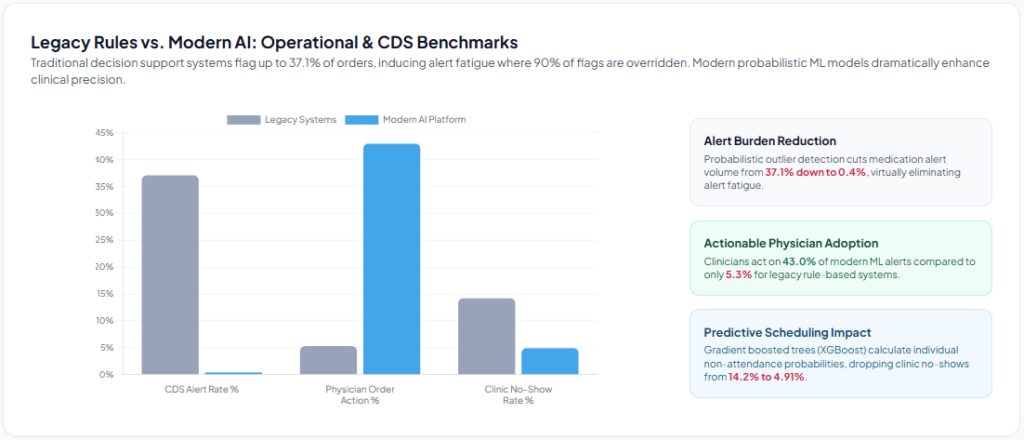
Automated SMS confirmation alone cuts no-shows by 34% to 38%. Combined with dynamic double-booking on high-risk slots, some clinics have taken no-show rates from a 14.2% baseline down to 4.91% within 90 days.
3. Virtual front-desk and call handling
A voice AI agent answers every incoming call on the first ring, handles identity verification, books or reschedules appointments against real scheduling rules, and routes anything urgent straight to clinical staff. It’s not a phone tree, it understands natural speech well enough to actually resolve most calls without a human picking up.
Enterprise deployments report an 85% reduction in call abandonment and a 79% reduction in hold times, freeing 10 to 14 hours of daily call-handling time that front-desk staff can put toward in-person check-ins instead.
4. Automated care coordination and outreach
This runs quietly in the background, continuously checking patient charts against clinical guidelines to catch care gaps: an overdue HbA1c screening, a missed mammogram window, a post-discharge follow-up that never got scheduled. When it finds one, it automatically reaches out by text, email, or voice call and writes a confirmed appointment straight back into the calendar, no staff member has to remember to chase it.
5. Automated billing and prior authorisation
Claims get checked against payer-specific rules before they’re ever submitted, catching the missing modifier or authorisation gap that would otherwise trigger a denial and a costly rework cycle. For prior authorisations specifically, voice agents can call payers directly, navigate the phone tree, and pull status updates automatically, cutting turnaround from days to minutes.
6. Clinical decision support that clinicians actually trust
Older rule-based alert systems are so trigger-happy that clinicians override 90% of what they flag, which defeats the purpose entirely. Newer probabilistic models cut that alert burden down to 0.4% of medication orders while achieving an 85% clinical validity rating, and 43% of the alerts that do fire result in an actual change to the physician’s order, compared to just 5.3% for the old rule-based systems. In early sepsis detection specifically, one platform has flagged risk 5.7 hours before clinical recognition with 82% sensitivity, real lead time for intervention.
7. Smart inventory and supply forecasting
Linked directly to the scheduling system, this predicts consumable demand (vaccines, injectables, PPE) based on upcoming appointment volume and procedure mix, then triggers reorders automatically against vendor lead times and expiration dates. The result is fewer stockouts and less capital tied up in expiring specialty drugs sitting on a shelf.
Real-World Results: What Happened When Clinics Actually Deployed This
Case studies and vendor promises are different things. These four are documented, sourced healthcare AI deployments with measured before-and-after data, exactly the kind of proof that separates real AI healthcare adoption from a pitch deck. One of them, Mass General Brigham and Emory Healthcare, is worth trusting specifically because it’s a peer-reviewed academic study published in JAMA Network Open, not a vendor case study.
| Organisation | What Was Deployed | Outcome | Financial Impact |
| Riverside Health System | Ambient AI scribing (Abridge, Epic-integrated) | +11% wRVUs, +14% HCC diagnosis capture | $5.00-$5.50 returned per $1 spent |
| Intermountain Health | Conversational voice AI for switchboard (Hyro) | 85% drop in call abandonment, 79% shorter hold times | >$500,000 annual operational value |
| Mass General Brigham / Emory | Ambient documentation (JAMA Network Open study) | 21.2% burnout reduction (MGB), 30.7% wellbeing increase (Emory) | 12 min saved per visit, ~2 hrs/day |
| Valley View Internal Medicine | Phone access and call automation redesign | Missed calls cut from 50%+ to under 10% | +17% net increase in clinical wRVUs |
Real-World Impact: What Changes After Implementation
The numbers above are the proof. Here’s what they actually look like day to day, for the four people who feel it most:
- The doctor: finishes charting during the visit itself and leaves the clinic on time, instead of opening a laptop again at 9pm
- The receptionist: spends the morning greeting patients in person instead of fighting a phone queue that was never going to clear
- The patient: books an appointment on the first call, gets a reminder before the visit, and doesn’t wait 20 minutes in a chair for a doctor who’s still finishing yesterday’s notes
- The clinic owner: gets real visibility into revenue and no-show cost for the first time, instead of finding out about a bad month when the books close
How Vinova Closes the Integration Gap
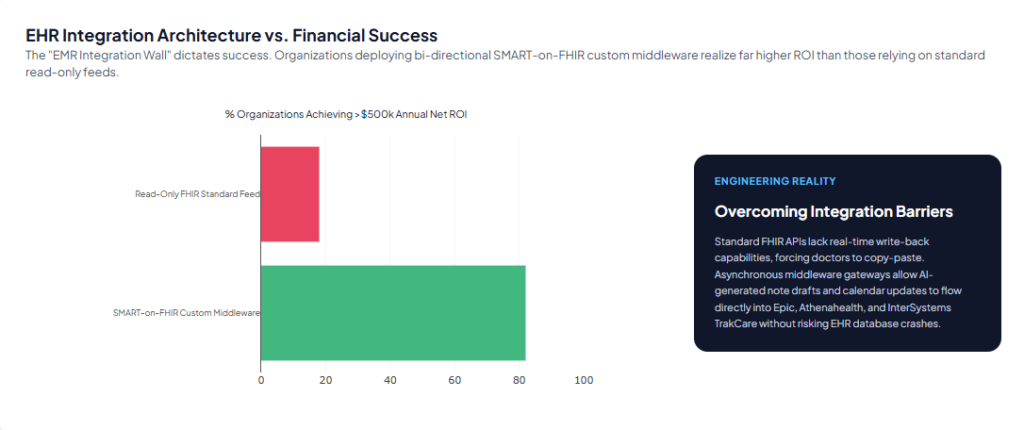
Here’s the part most vendor case studies skip: every one of the deployments above only works because it’s genuinely connected to the clinic’s EMR, not bolted on beside it. The single biggest reason AI pilots stall before reaching production isn’t the AI model, it’s what the industry calls the “EMR integration wall”: isolated third-party tools hitting rigid database schemas, read-only data feeds with no write-back capability, and staff left manually copying AI-generated notes into the record anyway. Industry benchmarks show a genuinely striking gap here: clinics with deep, bi-directional EHR integration realise over $500,000 in annual ROI at more than 4x the rate of clinics relying on basic read-only feeds.
This is exactly the layer Vinova’s healthcare engineering practice, including in digital health apps, is built around, not selling a specific scribe or scheduling tool, but making sure whichever tools a clinic chooses actually work inside its real EMR.
- Deep EMR integration, not a workaround: Vinova builds SMART-on-FHIR middleware and secure HL7 FHIR v4 gateways connecting AI modules directly into institutional dashboards (Epic/NGEMR, Altera Sunrise, InterSystems TrakCare), so AI-drafted notes and scheduling data appear where clinicians already work instead of a separate app they have to check
- AI that’s actually evaluated before it reaches a patient: Vinova runs a dedicated 40-person team supporting AI evaluation platforms like Outlier.ai (Scale AI), doing exactly the kind of Reinforcement Learning from Human Feedback and factual verification work that keeps a clinical AI tool from hallucinating a detail into a patient’s chart
- Healthcare AI delivery with a real track record: for Abbott Laboratories, Vinova deployed PyTorch deep learning models for medical imaging pattern matching inside HIPAA and PDPA-ready infrastructure, reducing inference latency by 34% in production, the same engineering discipline (compliant, audit-ready, and fast) that clinic-facing AI tools need
- Compliance built in, not retrofitted: operating under ISO 27001 and ISO 9001 certification, Vinova designs for the same governance standards this space increasingly requires, encrypted data at rest and in transit, immutable audit logging, and human-in-the-loop oversight for anything AI-generated that touches a patient record
Practical Considerations: Security, Integration, and Small Clinics
Security and compliance: HIPAA compliance, annual SOC 2 Type II certification, and a formal Business Associate Agreement are the baseline before any tool touches patient data. The strictest environments are moving toward Proof of Governance: zero-day data retention (raw audio purged the moment a note draft is generated), TLS 1.3 encryption in transit, AES-256 at rest, and QA processes built specifically to catch hallucinated details before they reach a chart. That’s what actually lets a practice prove compliance during an audit, not just claim it.
Bridging legacy EHR systems: this is the integration gap covered above, and it’s the single biggest predictor of whether a deployment actually delivers the ROI in the case studies or stalls as an expensive pilot.
Why small practices stand to gain the most: less legacy infrastructure to untangle means faster deployment, and the fixed cost of a scribe or scheduling tool is proportionally a bigger win for a solo or small practice than for a large system. SaaS pricing has brought the entry point down enough that a single provider reclaiming 2 hours a day can cover the subscription cost within about 30 days.
| Category | Pricing Model | Est. Cost | Setup Time | Time to ROI |
| Ambient AI scribing | Per-seat monthly | $0 to $500/provider/month | 1-14 days | 30-60 days |
| Conversational voice AI | Usage-based or seat | $249/seat/month or $0.20-$0.50/call | 2-4 weeks | 60-90 days |
| Predictive scheduling | Tiered monthly | $150-$400/location/month | 1-3 weeks | 30-45 days |
| Autonomous RCM and prior auth | Per-transaction or % of gain | Quote-based | 3-6 weeks | 90-120 days |
The Future of Practice Management: Proactive, Connected Care
The shift underneath all seven of these tools is the same: clinics moving from reactive firefighting, chasing no-shows, drowning in charting, guessing at revenue, toward predictive, connected operations where the system catches problems before they cost a visit or a claim. For a practice manager or owner deciding where to start, the honest priority order is: fix documentation first (the fastest, best-proven ROI), fix the phones second (the cheapest fix with the most immediate financial payoff), then layer in scheduling, billing, and clinical decision support as the practice’s data and comfort with the tools mature.
| Ready to Put AI to Work in Your Clinic? Book a free consultation with Vinova’s healthcare engineering team. We’ll map which of these AI workflows fit your clinic first, and what it actually takes to connect them to your existing EMR. No commitment required. Schedule Your Free Clinic and Healthcare AI Development Consultation with Vinova |
AI in Clinic Efficiency FAQ
What is the usage of AI in healthcare right now, specifically for clinics?
Right now, it clusters around the highest-friction, most measurable problems: documentation (ambient scribing), no-shows (predictive scheduling), and phone bottlenecks (voice AI). These three have the deepest deployment data because they solve problems every clinic already knows it has, not a hypothetical future use case.
How can AI be used in healthcare beyond just clinic operations?
Everything in this guide is deliberately narrow, clinic operations specifically. The broader question of how can AI be used in healthcare extends well past scheduling and scribing into diagnostics, medical imaging, and hospital-level resource planning, genuinely different problems with different tools, even though the underlying AI techniques often overlap.
How AI is being used in healthcare beyond just scribing?
Scribing gets the most attention because the time savings are so visible, but the highest cumulative ROI usually comes from combining it with predictive analytics running in the background: no-show forecasting, care-gap detection, and claims scrubbing all compound with documentation savings rather than replacing them.
Is AI in clinic settings only realistic for large health systems, or can a small practice actually use it?
Small practices are often better positioned to move fast, since there’s no legacy multi-vendor stack to untangle first. The barrier isn’t practice size, it’s whether the tool can actually integrate with whatever EMR the practice already runs. A single-provider clinic on a modern cloud EHR can often deploy ambient scribing in under two weeks; a large health system on a 15-year-old core system needs a genuine integration project first.
What’s the biggest reason artificial intelligence in healthcare pilots fail to reach production?
The EMR integration wall, consistently, and it’s true across the whole AI in healthcare industry, not just clinics. A tool that works beautifully in a demo but can’t write data back into the actual patient record just creates a second, disconnected system that staff have to manually reconcile, which is worse than not having it at all. This is why evaluating a vendor’s integration depth matters more than evaluating the AI model itself.
How does artificial intelligence healthcare deployment handle data privacy and compliance?
Through a combination of technical and process controls: HIPAA-compliant infrastructure, SOC 2 Type II certification, signed Business Associate Agreements, encryption in transit and at rest, and increasingly, zero-day data retention policies where raw audio or text is purged immediately after a note is drafted. Human review before anything artificial intelligence AI in healthcare generates is finalised in a patient’s chart remains a non-negotiable safeguard, not a formality.
| Vinova: Singapore’s HealthTech and AI engineering partner since 2010. ISO 27001:2022 and ISO 9001:2015 certified. HIPAA and PDPA aligned. 300+ in-house engineers across Singapore, Hanoi, Da Nang, and Ho Chi Minh City. Healthcare AI delivery for Abbott Laboratories, EMR integration expertise across Epic, Altera Sunrise, and InterSystems TrakCare. Financial Times Top 500 High-Growth Companies Asia-Pacific 2026. The Straits Times Singapore’s Fastest-Growing Companies 2024, 2025, and 2026. Explore Vinova’s HealthTech engineering projects. |