By late 2024, nearly every pitch deck boasted a “generative AI wrapper,” and financial institutions scrambled to fund exploratory pilots. Today in 2026, the experiment phase is officially over.
CFOs and boards at major banks and FinTech startups are no longer renewing proofs-of-concept without immediate, quantifiable unit-economic returns. The standard for 2026 isn’t how conversational a model sounds in a demo. It’s how effectively AI in fintech lowers cost-to-serve, accelerates underwriting velocity, or neutralises multi-rail fraud losses.
At Vinova, having partnered with financial institutions, government bodies, and global enterprises across Singapore and Southeast Asia for over 16 years, we’ve watched this transition firsthand. Moving from AI experimentation to bank-grade production requires more than fine-tuning an API. It demands secure architecture, strict regulatory compliance, and a clear roadmap to positive unit economics.
This guide examines how AI in fintech has evolved into high-ROI agentic workflows, details the top 5 production-grade use cases delivering measurable value, breaks down key technical roadblocks, and covers Vinova’s proven capabilities, engagement models, and real-world project portfolio in deploying secure, compliant AI solutions. The AI in fintech market and the broader generative AI in fintech market have moved well past the pilot stage, and this guide covers what actually separates production deployments from stalled proofs-of-concept.
Table of Contents
1. What “AI in FinTech” Actually Means in 2026
To build an actionable strategy, leaders need to separate three technical pillars now operating in modern financial architecture, the same distinction underlying both AI and machine learning in fintech and artificial intelligence in fintech more broadly:
- Predictive ML, the baseline: models trained on historical transactional data to detect static patterns, score traditional credit risk, and flag basic anomaly spikes
- Generative AI, the 2024 wave: LLMs used primarily for natural language search, financial summarisation, and basic customer service wrappers
- Agentic AI, the 2026 standard: autonomous multi-step networks capable of reasoning, planning, calling financial APIs, verifying logic against regulatory guardrails, and resolving end-to-end back-office tasks without human intervention
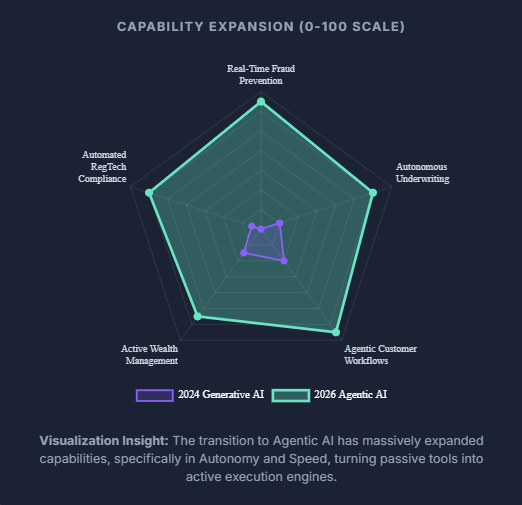
FinTechs are no longer asking what artificial intelligence can generate. They’re re-engineering operational architecture around what it can execute.
2. Top 5 High-ROI Use Cases of AI in FinTech
The primary pillars of financial services remain constant, but the underlying systems have shifted from human-led manual checks to high-speed, autonomous execution.
| Pillar | 2024: Passive and Generative | 2026: Autonomous and High-ROI |
| Fraud detection | Post-transaction fraud flags | Sub-10ms cross-border pre-clearance prevention |
| Credit and underwriting | Bureau-based credit scoring | Real-time cash-flow and document-intelligence underwriting |
| Customer operations | Conversational FAQ chatbots | End-to-end agentic dispute and onboarding workflows |
| Wealth management | Static robo-advisors | Dynamic tax-loss harvesting and yield copilots |
| Trading and compliance | Sentiment-based trading | Specialised SLMs and automated RegTech compliance |
1. Fraud detection and real-time risk management
2024 baseline: rule-based engines and predictive models flagged suspicious transaction patterns after execution, yielding high false-positive rates that frustrated legitimate cardholders.
2026 evolution: real-time anomaly engines evaluate multi-rail, cross-border payments in single-digit milliseconds before clearance. Combining behavioural biometrics with graph neural networks, modern platforms stop unauthorised transactions in flight while reducing false positives by over 45%.
Business impact: directly preserves capital reserves by neutralising account takeover and synthetic identity fraud before funds leave the ecosystem.
2. Next-gen credit scoring and autonomous underwriting
2024 baseline: lenders attempted to supplement legacy credit scores with alternative data, but document verification and manual review caused multi-day underwriting delays.
2026 evolution: multimodal document intelligence paired with real-time open banking APIs lets AI pipelines analyse business cash flows, tax filings, and supply-chain ledgers in real time. End-to-end commercial and retail loan approvals now take seconds, not days.
Business impact: reduces default rates, expands access for thin-file borrowers, and delivers an average 40% reduction in manual processing costs per loan file.
3. Agentic customer operations and account workflows
2024 baseline: customer service relied on conversational LLM chatbots restricted to answering FAQs. Complex user actions invariably triggered human support escalation.
2026 evolution: multi-agent workflows handle complex back-office actions directly. When a customer requests a charge dispute or account update, autonomous agents perform identity checks, verify transaction logic against risk rules, update core database records, and issue instant resolutions.
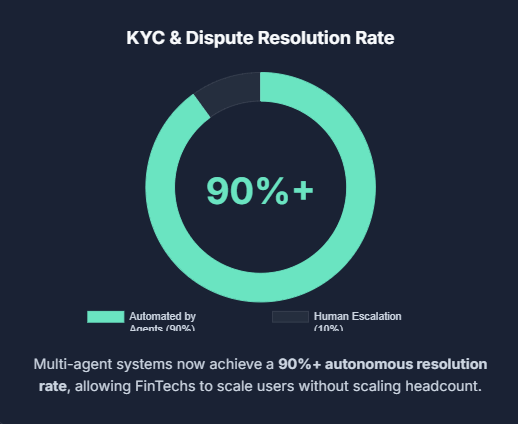
Business impact: KYC and dispute resolution automation rates routinely hit 90%+, letting platforms scale customer bases significantly without expanding support headcount.
4. Autonomous wealth management and personal finance copilots
2024 baseline: first-generation robo-advisors allocated portfolios using static risk questionnaires, offering passive quarterly rebalancing.
2026 evolution: financial copilots act as active capital managers, executing continuous intra-day tax-loss harvesting, automatically reallocating idle cash into optimal high-yield vehicles, and optimising dynamic personal debt payoffs.
Business impact: increases customer lifetime value and asset retention while democratising institutional-grade wealth management tools for mass retail users.
5. Algorithmic trading and automated RegTech compliance
2024 baseline: high-frequency trading algorithms depended on rigid parameters, while compliance teams spent thousands of manual hours auditing transactions for regulators.
2026 evolution: specialised Small Language Models parse market feeds and unstructured filings for quantitative trading desks, while RegTech agents continuously log audit traces and auto-generate compliance filings structured for global oversight bodies.
Business impact: eliminates costly regulatory non-compliance penalties, speeds up audit preparedness, and provides institutional desks with sub-second decision advantages.
3. Core Business Benefits Driving Adoption in 2026
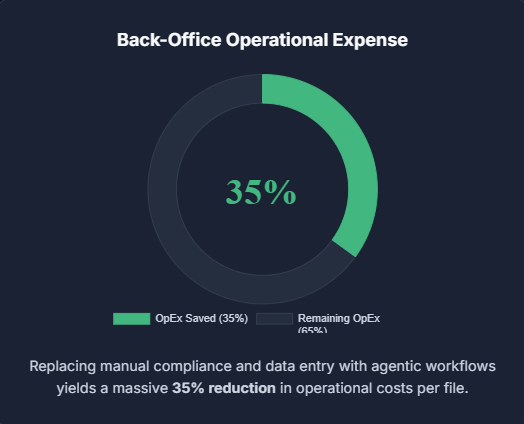
- Proven ROI and operational efficiency: enterprise benchmarks show financial institutions achieving an average 2.3x to 3.5x return on agentic AI investments within 12 to 18 months, with back-office operational costs falling by up to 25% to 35%
- Accelerated time-to-decision: millisecond-level credit risk assessments, instantaneous dispute resolutions, and automated onboarding eliminate the friction points that historically caused user drop-off
- Immutable auditability: automated governance logging provides a verifiable, step-by-step reasoning trail for every automated financial action, maintaining strict audit readiness
4. Implementation Roadblocks (And How Vinova Solves Them)
Deploying autonomous systems inside heavily regulated financial environments presents real technical, architectural, and legal hurdles:
Problem 1: Compute overhead and latency limits
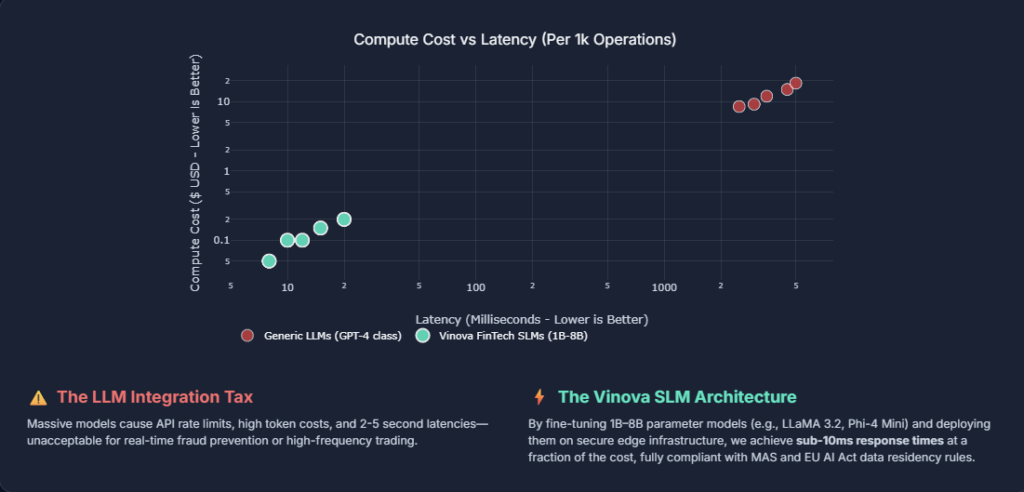
The challenge: querying multi-billion parameter foundation LLMs for every micro-transaction destroys software margins and introduces unacceptable latency.
Vinova’s solution: we design hybrid architectures using domain-specific Small Language Models (1B-8B parameter models like Phi-4 Mini or Llama 3.2), deployed locally on secure private clouds or edge infrastructure, delivering sub-10ms response times at a fraction of standard API costs.
Problem 2: Evolving global AI regulations (EU AI Act and MAS guidelines)
The challenge: compliance frameworks, the EU AI Act (with high-risk AI mandates for credit scoring and underwriting taking strict enforcement effect August 2, 2026), the Colorado AI Act, and Singapore’s MAS FEAT (Fairness, Ethics, Accountability, and Transparency) principles, demand absolute explainability and bias prevention.
Vinova’s solution: drawing on our experience building compliant systems for government agencies and Tier-1 banks, Vinova integrates real-time model observability layers, vector-store encryption, continuous bias testing, and human-in-the-loop fail-safes directly into the core SDLC.
Problem 3: Legacy core banking integration, the “integration tax”
The challenge: decades-old core banking infrastructure cannot natively stream vector data or support the sub-second API polling autonomous agents require.
Vinova’s solution: as an ISO 27001 and ISO 9001 certified engineering partner, Vinova builds event-driven middleware and real-time feature stores that act as a secure translation buffer between legacy mainframes and modern AI services — the same integration discipline covered in our guide to the ERP finance module.
5. What Vinova Can Do for Your AI in FinTech Project
Whether you’re an established financial institution modernising legacy core systems or a high-growth FinTech launching an AI-native product, Vinova provides end-to-end consulting, engineering, and managed execution across the complete AI development lifecycle.
| Service Category | What Vinova Delivers |
| 1. Discovery and AI strategy | Design thinking workshops, ROI feasibility, and SLM vs. LLM architecture blueprints |
| 2. Custom AI engineering | Fine-tuning 1B-8B SLMs, RAG vector pipeline setup, and agentic API integrations |
| 3. Data alignment and RLHF | Prompt engineering, RLHF data curation, and model evaluation (a dedicated 40-engineer team supporting a global AI evaluation platform) |
| 4. RegTech and guardrails | MAS FEAT and EU AI Act compliance, automated audit logging, human-in-the-loop fail-safes |
| 5. Modernisation and core integration | Secure middleware connecting AI vector stores to legacy core banking, SAP, Odoo, and payment rails |
| 6. AI-assisted QA and DevOps | Automated V-Model testing, Playwright regression, ISO 27001/ISO 9001 DevSecOps CI/CD pipelines |
Engagement models built to fit your scale
- End-to-end turnkey delivery: Vinova takes complete ownership from initial architecture design and UX prototyping to production deployment and SLA maintenance, the model behind our annual >SGD $1,000,000 Digital Asset Hub partnership with a MAS-regulated digital asset trading platform’s Asia-Pacific operations
- Dedicated AI Offshore Development Centre: build your dedicated engineering capability in Vietnam, managed under accountable Singapore governance, scaling full-stack AI engineers, data pipeline specialists, and QA automation engineers with up to 40% cost efficiency
- Agile resource augmentation: quickly plug experienced AI/ML developers, prompt engineers, cloud architects, or ISTQB-certified software testers directly into your existing sprint teams
6. The Vinova Advantage and Real-World Track Record
With over 16 years of experience, 300+ successfully delivered projects, and 300+ in-house engineers across Singapore, Hanoi, Da Nang, and Ho Chi Minh City, Vinova’s capabilities are validated by real-world enterprise deployments across regional banking, institutional trading, and global AI infrastructure.
Real-world proof: Vinova’s FinTech and BFSI project portfolio
MAS-regulated digital asset trading platform, Digital Asset Hub and B2B trading platform: selected to support a MAS-regulated digital asset trading platform’s Asia-Pacific operations, Vinova architected and operates a high-performance Digital Asset Hub and B2B trading platform for the region. Operating under an annual contract value exceeding SGD $1,000,000, Vinova implemented cloud-native infrastructure on AWS with built-in compliance, automated transaction logging, and security protocols strictly aligned with MAS regulatory standards.
Regional insurance and banking clients, digital operations and claims automation: Vinova engineered a claims management platform for a regional general insurance provider, incorporating intelligent workflow routing and automated document processing for claims management. Vinova has also partnered with Tier-1 Singapore banks and regional insurance providers to build high-availability mobile and web applications featuring real-time risk verification and automated onboarding workflows.
Enterprise AI engineering and data alignment: Vinova deployed a dedicated team of 40 AI-specialised engineers supporting a global AI model-evaluation and data-annotation platform. This team executes advanced prompt engineering, model output evaluation, and Reinforcement Learning from Human Feedback data pipelines to align AI models for enterprise deployment.
Why leading financial institutions partner with Vinova
- Proven banking and RegTech track record: trusted by government and regulatory agencies, Tier-1 Singapore banks, MAS-regulated digital asset platforms, regional insurance providers, and national utilities/infrastructure providers
- AI-native SDLC: AI isn’t an afterthought at Vinova, it’s built into our core development process, including a Shift-Left QA framework using automated V-Model testing to catch vulnerabilities and logic drift before deployment
- The Hybrid Global Delivery Model: combining high-touch, accountable onsite governance and project management in Singapore with a highly scalable, ISO-certified offshore engineering engine in Vietnam, minimising total cost of ownership while maintaining enterprise standards
| Ready to Scale Your FinTech AI Architecture? Partner with Vinova to build bank-grade AI into your next-generation financial platform. Book a free consultation with our Singapore-based team. No commitment required. Schedule Your Free AI in FinTech Consultation with Vinova |
AI in FinTech FAQ
What’s the difference between Generative AI and Agentic AI in FinTech?
Generative AI produces text, summaries, or content based on user prompts. Agentic AI goes further, reasoning through multi-step goals, planning workflows, making system API calls, and completing financial operations (issuing refunds, assessing credit risk) autonomously. This distinction is central to artificial intelligence fintech strategy in 2026, since the two require genuinely different architecture, not just a different prompt.
How does AI improve fraud prevention compared to legacy systems?
Legacy systems evaluate basic static rules, flagging transactions over a certain dollar threshold, for example. AI engines evaluate high-dimensional data, including real-time behavioural telemetry, cross-channel device habits, and continuous anomaly scoring, to block fraud before payments clear rather than flagging it after the fact.
Why do many FinTech AI pilots fail to reach production?
Most pilots stall due to legacy infrastructure friction, unpredictable compute costs from oversized models, insufficient data governance guardrails, and a failure to establish clear unit-economic metrics from day one, treating the pilot as a demo rather than a production plan.
How are financial institutions handling 2026 regulatory compliance for AI?
Institutions maintain compliance by using fine-tuned SLMs with transparent decision logging, enforcing strict data access controls, running regular audits for algorithmic bias, and maintaining human oversight protocols required under frameworks like the EU AI Act and MAS guidelines.
Is artificial intelligence in fintech only relevant for large banks, or does it apply to smaller FinTech startups too?
Both, though the entry point differs. Large banks are typically integrating financial artificial intelligence and artificial intelligence finance capability into legacy core systems, which is why the “integration tax” problem matters so much to them specifically. Smaller FinTechs building AI in finance native from day one skip that problem entirely but face a different one: unpredictable compute costs from over-relying on large foundation models for every transaction. The SLM-based hybrid architecture approach solves both, just applied at different points in each company’s stack.
| Vinova: Singapore’s AI in FinTech and BFSI engineering partner since 2010. ISO 27001:2022 and ISO 9001:2015 certified, MAS FEAT and EU AI Act aligned. 300+ in-house engineers across Singapore, Hanoi, Da Nang, and Ho Chi Minh City. Clients span government and regulatory agencies, Tier-1 Singapore banks, MAS-regulated digital asset platforms, and regional insurance and utilities providers. Financial Times Top 500 High-Growth Companies Asia-Pacific 2026. The Straits Times Singapore’s Fastest-Growing Companies 2024, 2025, and 2026. Explore Vinova’s AI and FinTech engineering services. |