By the Vinova AI Engineering Team. Reviewed under ISO 27001:2022 and ISO 9001:2015 delivery standards.
Most AI pilots are approved on the strength of a demo and measured against nothing. The chatbot answers questions beautifully until it has to read the order database. The forecasting model is accurate until the data drifts. Six months later, nobody can say whether the invoice tool saved a single hour, because nobody wrote down how long invoices took before.
The benefits of AI are no longer reserved for large corporations. They are becoming the baseline for how businesses operate, compete, and grow. From automating repetitive tasks to making faster, data-driven decisions, AI is reshaping how small and medium-sized businesses work. At Vinova, we help SMEs and Singapore enterprises turn these benefits of artificial intelligence into practical, measurable solutions built around their own operations.
The question for a Chief Executive Officer (CEO), Chief Technology Officer (CTO), or Chief Risk Officer (CRO) is no longer whether to adopt AI. It is which use case pays back first, and who is accountable for the customer data it touches.
Key Takeaways
1. Cost and productivity. AI automates repetitive work such as data entry, scheduling, and invoice processing, and optimizes inventory, logistics, and maintenance. Documented deployments report concrete gains, such as a customer-support chatbot platform reporting a 70% to 75% automation rate.
2. Customer engagement. 24/7 chatbots, personalized content, and targeted marketing lift conversion and satisfaction. HP Tronic reported a 136% increase in new-customer conversion on one welcome campaign in the Czech Republic.
3. Accessibility. Cloud AI, AI-as-a-Service (AIaaS), and no-code or low-code tools make adoption achievable without a dedicated technical team.
4. Measured return on investment (ROI), with caveats. An IDC study commissioned by Microsoft reports an average return of USD 3.70 for every USD 1 invested in generative AI, with top performers reporting about USD 10. The sample is large enterprises, so SMEs should measure their own baseline
Table of Contents
Benefits of AI for Cost and Productivity: How SMEs Reduce Costs and Increase Output
Artificial intelligence helps SMEs reduce costs, improve efficiency, and increase productivity by automating tasks, streamlining workflows, optimizing resources, and strengthening data analysis. With cloud platforms making adoption easier, these AI benefits for business are becoming practical for teams of any size. The examples below show where SMEs apply AI in daily operations.
Automating Repetitive Tasks and Streamlining Workflows
- Core automation benefits: AI excels at repetitive tasks such as data entry, scheduling, and invoice processing, which makes it one of the most immediate automation benefits an SME can capture. It frees people for higher-value work. For instance, AI can record meeting summaries or generate document templates, returning hours to the team every week.
- Accuracy and employee engagement: automation reduces human error and increases speed, reliability, and accuracy. When employees spend more time on creative and strategic work, job satisfaction can improve, which helps SMEs retain talent.
- Scalability: AI-automated processes let SMEs absorb a larger workload without a proportional rise in labor costs, so repetitive tasks do not become the bottleneck as the business grows.
Optimizing Resource Allocation and Predictive Capabilities
- Inventory management: AI improves demand prediction, which reduces overstocking and stockouts.
- Supply chains: AI tools optimize logistics, resource allocation, and shipping rates, making supply chain planning one of the most direct cost-reduction opportunities for SMEs.
- Human resources: AI supports faster resume screening and candidate matching, shortening the hiring cycle.
- Predictive maintenance: AI analyzes equipment and operational data to flag likely failures before they happen. Businesses can schedule maintenance proactively, reduce downtime, and lower repair costs. The case studies below include a manufacturer that reported a 30% reduction in unplanned downtime.
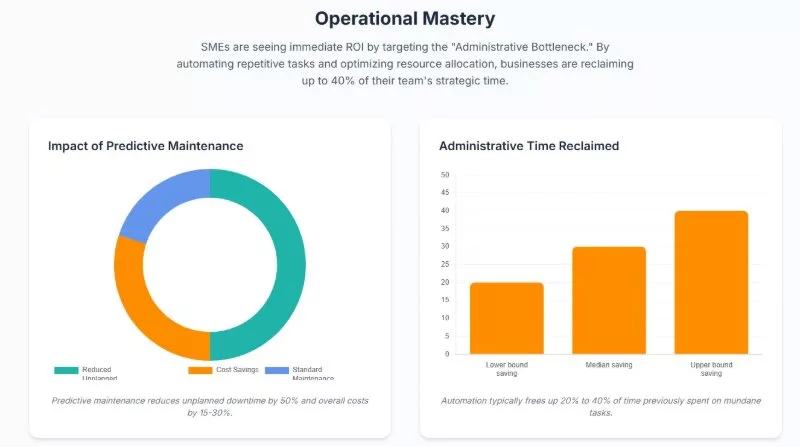
- Financial health and agility: these optimizations improve capital efficiency and working capital. Less cash tied up in unsold goods and fewer unexpected repair bills contribute to healthier cash flow, so SMEs can allocate resources more deliberately.
Streamlining Workflows and Faster Data Analysis for Better Decision-Making
- Intelligent workflows: AI can streamline an entire workflow, not only a single task. Fashion marketplace Miinto, for example, used image matching to detect duplicate product listings, and reported that its product-arrival process became more than 40% more efficient (see the case studies below).
- Actionable insights: AI processes data at a speed no small team can match. By surfacing trends in customer behavior and market dynamics, it turns data overload into decisions that even a small team can act on.
- Continuous improvement: tools for Key Performance Indicator (KPI) analysis and benchmarking let businesses measure progress, find the next optimization, and refine strategy on evidence rather than instinct.
The Role of Cloud AI and AI-as-a-Service
- Lower barriers to adoption: Cloud AI and AIaaS reduce upfront infrastructure cost and the technical resources an SME needs. Many organizations also rely on managed IT services in Singapore providers for deployment and support.
- What cloud AI gives an SME: inherent scalability that grows with the business, flexible pay-as-you-go pricing, and access to the latest updates and features without additional cost. This lets an SME experiment at reduced risk, scale what works, and keep its resources on core business activity.
Benefits of AI for Customer Engagement: Applications for SMEs
Beyond internal operations, one of the most visible AI benefits for business is better customer engagement. AI lets SMEs personalize interactions, improve the customer experience, and deliver stronger AI benefits for customer service, which builds lasting relationships.
Intelligent Chatbots and 24/7 Customer Support
- Meeting modern expectations: AI chatbots give instant, round-the-clock answers to common questions, which cuts wait times and covers hours when no one is in the office. For an SME with limited staff, that is a scalable way to keep service levels up. If the chatbot cannot read your order system, it answers “where is my order?” with an apology, and the ticket lands on a human anyway. LimeChat, for instance, reported an automation rate of about 70% to 75% on its AI support assistant.
- Advanced capabilities and agent support: chatbots built on natural language processing hold more natural conversations, and some add sentiment analysis to read customer emotion. The practical gain is a lighter load on human agents, who can focus on complex or sensitive issues that need empathy.
- Chatbots as data collection tools: every handled conversation reveals common pain points and emerging questions. SMEs can use that data to improve offerings and service strategy before problems become complaints.
Personalized Customer Experiences and Support
- Data-driven personalization: AI analyzes customer data such as purchase history and browsing behavior to build detailed profiles, which powers personalized experiences and product recommendations. HP Tronic, a consumer electronics retailer, reported a 136% increase in new-customer conversion on a personalized welcome campaign (details below).
- Proactive engagement and loyalty: AI can spot customer trends and address likely service issues early. That granular understanding makes customers feel valued, which supports loyalty, repeat business, and Customer Lifetime Value (CLV).
Automated and Targeted Customer Communication (Marketing and Sales)
- Efficient marketing and sales: AI segments customers for tailored messages and directs ad spend toward the segments most likely to convert, so a small marketing budget goes further.
- Insights and reputation management: AI improves sales forecasting and can predict customer churn, so teams can reach at-risk customers first. Sentiment analysis of reviews and social media shows how the market sees the business, which lets SMEs respond to negative feedback quickly and feed the findings back into product and service decisions.
The Growing Ecosystem of Accessible AI Tools for SMEs
As more AI companies in Singapore and globally expand their offerings, AI is becoming more accessible and affordable for SMEs. Cloud platforms and flexible pricing lower the barrier to adoption and support innovation across industries. For a small business, these tools act as a force multiplier: they automate routine work so the team can focus on growth.
The Rise of Accessible and Affordable AI Platforms
AI tools built for SMEs, delivered mostly through cloud services, are making it simpler to integrate AI without a dedicated expert team. Many offer SME-friendly pricing such as free plans and entry-level subscriptions, which makes them financially viable to trial.
That accessibility lets SMEs test AI against real business problems at reduced risk. In SMEs, where one person often carries several responsibilities, easy-to-implement tools augment capability, automate routine tasks, and leave room for strategic work.
A Toolbox for Diverse Business Needs
AI tools for SMEs now span nearly every business function, so teams can choose by the pressing need and the quickest route to payback.
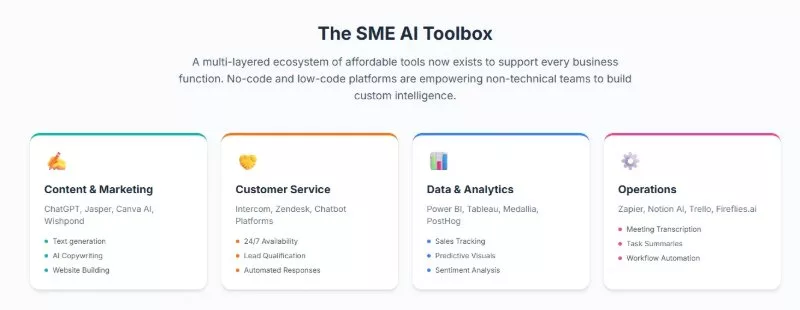
- Content creation and marketing: ChatGPT, Jasper, and Canva AI (including Magic Write) offer text generation, AI copywriting, and design assistance. involve.me provides AI for interactive lead funnels, and Wishpond includes an AI website builder.
- Customer service and engagement: AI-driven chatbot platforms such as Intercom and Zendesk enable 24/7 support and automated lead qualification.
- Operations and productivity: Trello can be AI-enhanced, Notion AI summarizes documents and generates tasks, Fireflies.ai automates meeting transcription, Zapier enables no-code workflow automation, and Lindy offers personal AI assistance.
- Data analytics and decision-making: Microsoft Power BI offers AI-enhanced visualization. PostHog, Tableau, and Medallia provide AI-powered product, business, and customer-feedback analytics.
- Finance and accounting: Vic.ai automates accounting processes such as invoice handling.
- HR and recruitment: Manatal, hireEZ, and Zoho Recruit use AI for resume scanning and candidate matching.
- Supply chain and fulfillment: Coupa supports supply chain planning, and ShipBob brings AI to e-commerce fulfillment.
- Security: Sift uses machine learning for fraud detection, and Feedzai offers AI-powered financial crime prevention.
The table below consolidates these categories. Pricing models change often, so confirm current plans with each vendor before budgeting.
Table 1: Overview of Easy-to-Implement AI Tools for SMEs
| Tool Category | Example Tools | Key AI-Powered Features | Example SME Use Case | Typical Pricing Model |
| Content and Marketing | ChatGPT, Jasper, Canva AI, involve.me, Wishpond | Text generation, AI copywriting, AI website builder | Drafting blogs, creating social posts, building lead forms | Free tier or entry-level subscription |
| Customer Service | Intercom, Zendesk, AI chatbot platforms | Automated responses, 24/7 availability, lead qualification | Answering FAQs, qualifying website leads | Free tier or tiered subscription |
| Operations and Productivity | Trello, Notion AI, Fireflies.ai, Zapier, Lindy | AI summaries, task generation, meeting transcription, AI assistant | Organizing projects, automating data transfer, managing schedules | Free tier or entry-level subscription |
| Data Analytics | Power BI, PostHog, Tableau, Medallia | AI-enhanced dashboards, predictive visualizations, sentiment analysis | Tracking sales, understanding user behavior, analyzing customer satisfaction (CSAT) scores | Free tier on some, tiered subscription |
| Finance and Accounting | Vic.ai | Automated invoice processing, anomaly detection | Streamlining accounts payable, improving accuracy | Subscription |
| HR and Recruitment | Manatal, hireEZ, Zoho Recruit | Resume scanning, candidate matching, sourcing automation | Speeding up hiring, finding qualified candidates | Subscription |
| Supply Chain | Coupa, ShipBob | Demand forecasting, inventory optimization, shipping updates | Optimizing stock, managing e-commerce fulfillment | Subscription |
| Security | Sift, Feedzai | Machine learning-based transaction monitoring, anomaly detection | Protecting against payment fraud | Subscription |
The Rise of No-Code and Low-Code AI
No-code and low-code platforms such as FlutterFlow, Framer, Wix Studio, Bubble, and Webflow are changing how SMEs build AI-powered applications and automated workflows. By reducing the need for deep programming expertise, they make AI adoption faster and more accessible. Many businesses still work with an experienced iPhone app development company to accelerate implementation, integrate advanced features, and secure production-ready quality.
These platforms typically offer drag-and-drop interfaces and pre-built templates with AI features such as website generators, text assistants, and agent builders, plus Application Programming Interface (API) integrations with models like OpenAI’s GPT or Google’s Gemini. That lets SMEs embed chatbots, summarization tools, and recommendation engines into custom applications, and prototype and iterate quickly.
The Catch: no-code platforms get a prototype running in an afternoon. They do not get it through a security review, a Personal Data Protection Act audit, or a legacy database integration. If the prototype handles customer data without those three, the afternoon saved becomes a quarter spent on remediation.
Case Studies: The Benefits of AI That Documented Deployments Delivered
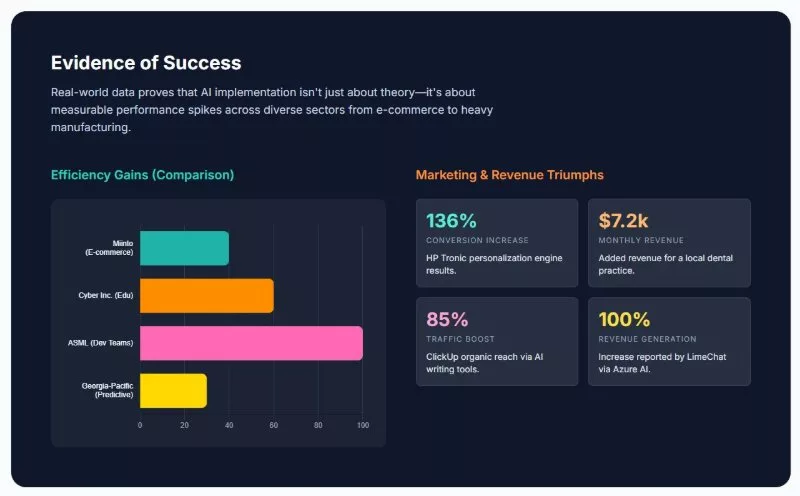
The benefits of AI in the workplace show up in published results across sectors. Each figure below comes from a named public source, and each is a reported result for a specific scope and baseline, not a guarantee. Several organizations are larger than a typical SME. We include them because the technique, not the company size, is what an SME can learn from.
Efficiency and Productivity Gains
Table 2: Reported Efficiency and Productivity Outcomes
| Organization (Sector) | AI Applied | Reported Outcome | Source |
| Miinto (Fashion e-commerce platform) | Image matching (Google Cloud Vision API product search) to detect duplicate product listings; operators confirm matches before stock is merged | Product-arrival creation process more than 40% more efficient; conversion up to 20% where duplicates were merged | Google Cloud |
| ASML (Semiconductor equipment) | Machine learning platform on Google Cloud for predicting process performance | Overall engineering efficiency, including time to market, improved by up to 40% | Google Cloud |
| Epiroc (Mining and drilling equipment) | Azure Machine Learning to predict steel density, hardness, and flexibility | 30% reduction in customer rejections and product returns | Microsoft |
| Georgia-Pacific (Manufacturing) | AI-driven predictive maintenance | Unplanned downtime reduced by 30% | SAS |
| Siemens Gamesa (Wind turbine blades) | Deep learning on non-destructive testing images to flag manufacturing defects | Blade inspection time cut from about 6 hours to 1.5 hours, a reduction of about 75% | Fujitsu |
Enhanced Customer Engagement and Marketing Results
AI helps SMEs deepen customer relationships and improve marketing outcomes, a strong example of the benefits of AI for small business owners with limited marketing budgets.
Table 3: Reported Customer Engagement and Marketing Outcomes
| Organization (Sector) | AI Applied | Reported Outcome | Source |
| LimeChat (Customer-service technology) | AI support assistant built with Azure OpenAI | About 70% to 75% automation rate; incorrect answers fell from 8% to 9% down to 0.5%; one client, Wow Skin Sciences, saw conversion rise 50% | YourStory |
| HP Tronic, Datart site (Consumer electronics retail) | Personalized welcome weblayer powered by Bloomreach AI, offering a EUR 20 voucher to first-time visitors | New-customer conversion rate up 136% to 16.4% in the Czech Republic, and up 133% to 15.2% in Slovakia | Bloomreach |
| Mongoose Media (Marketing agency), for a client site | Jasper AI content tool for blog drafting | 1,500 to 3,000 words drafted in under 2 hours, against 8 to 10 hours before; client’s monthly organic visitors rose 166% (from just under 3,000 to 7,975) over about two months | Jasper |
| ClickUp (Productivity software) | Surfer, a content-optimization tool (not a text generator), for SEO research and scoring | 150+ new blog posts and 130+ optimizations; non-branded organic traffic up 85% | Surfer |
Two cautions apply. The HP Tronic campaign combined personalization with a voucher offer, so the uplift is not attributable to personalization alone. The Mongoose Media traffic rise coincided with a Google algorithm update, so it should be read as an indicator, not proof of cause.
General ROI and Business Impact
Broader research on the benefits of AI points the same way. An IDC study commissioned by Microsoft reports an average return of USD 3.70 for every USD 1 invested in generative AI, and about USD 10 for top-tier adopters.
Table 4: Generative AI Return on Investment (IDC, Commissioned by Microsoft)
| Measure | Reported Figure | How to Read It |
| Average return per USD 1 invested in generative AI | USD 3.70 | Average across surveyed enterprise organizations; not an SME-specific figure |
| Return for top-tier AI adopters | About USD 10 per USD 1 | The gap between average and top performers is the case for a disciplined rollout |
A common thread runs through these results: each addressed a specific business problem with a targeted AI tool and a measurable baseline. SMEs can win through incremental adoption, one use case at a time, instead of a company-wide transformation.
The Rule: one use case, one baseline, one named owner. A pilot missing any of the three is a demo.
Adopting AI with Governance: What a Singapore SME Should Settle First
Adopting AI with Governance: What a Singapore SME Should Settle First
The benefits of AI above only hold if the data feeding the tools is handled correctly. Before the first pilot goes live, settle four points:
- Personal data and the Personal Data Protection Act (PDPA): customer data fed into an AI tool is still personal data under the PDPA. The Personal Data Protection Commission (PDPC) Advisory Guidelines on the use of personal data in AI recommendation and decision systems (March 2024) set out how consent, notification, and accountability apply.
- Vendor transfers: if a tool processes data outside Singapore, Section 26 of the PDPA requires comparable protection under a legally enforceable arrangement. Check where the vendor processes and stores data before signing.
- Breach readiness: the PDPC must be notified as soon as practicable, and no later than 3 calendar days, after an organization assesses a breach as notifiable. Penalties are tiered: up to 10% of annual Singapore turnover where turnover exceeds SGD 10 million, and up to SGD 1 million otherwise.
- Human review and a baseline: keep a person accountable for AI outputs that affect customers, and record the baseline metric before the pilot so the benefit can be measured rather than assumed.
How Vinova Helps Enterprises Capture the Benefits of AI in Production
Off-the-shelf and low-code platforms made AI accessible. They did not make it safe. Between a successful pilot and a production system, enterprises still meet the same five obstacles: regulatory exposure, data breaches, model drift, legacy integration friction, and spending nobody measures. If a forecasting model is wired point-to-point into a legacy Enterprise Resource Planning (ERP) database, the first schema change corrupts the forecast, and the procurement team learns about it from a stockout. Vinova structures delivery around those obstacles, so the benefits of AI described above survive contact with real customer data.
Pilot-First Delivery: Scope the Use Case That Pays Back First
Rather than a company-wide AI revamp, Vinova starts narrow, because vague mandates produce vague returns.
- Targeted Use-Case Scoping: a 2- to 4-week Product Discovery phase identifies which AI use case pays back first, whether that is invoice processing, support triage, or demand forecasting, before any model is selected.
- Baseline Measurement: Vinova benchmarks existing operational KPIs before the pilot launches, so efficiency gains are validated against a recorded starting point rather than assumed.
- Total Cost of Ownership (TCO) Advisory: Vinova recommends off-the-shelf or Software-as-a-Service (SaaS) integrations where they fit and reserves custom development for core intellectual property, which keeps the hidden architecture tax off the budget.
The Rule: no pilot launches without a written baseline. A benefit nobody measured is an anecdote.
Regulatory Alignment: PDPA, IM8, and MAS TRM Built In
Compliance retrofitted after launch is the brutally expensive kind, so Vinova designs it in before the first sprint.
- PDPA and Advisory Guidelines: AI recommendation and decision engines are configured in line with the PDPC Advisory Guidelines (March 2024), with transparent consent mechanisms and a named accountable owner.
- No Production Data Offshore: under the cross-border requirements of Section 26 of the PDPA, Vinova signs Data Protection Agreements that incorporate the ASEAN Model Contractual Clauses (MCCs). Offshore developers work only with synthetic or anonymized datasets through Singapore-hosted Virtual Desktop Infrastructure (VDI), so real Personally Identifiable Information (PII) never leaves Singapore.
- Enterprise and Public Sector Readiness: ISO/IEC 27001:2022 and ISO 9001:2015 certified delivery, GovTech Category 1B approval, and contractual audit rights give financial institutions and government agencies the evidence they need for Monetary Authority of Singapore (MAS) Technology Risk Management (TRM) audits and GovTech Instruction Manual 8 (IM8) alignment.
Agentic AI and Decoupled Architecture: Adopt Without Downtime
Support automation and predictive maintenance both depend on models connected to systems that were never designed for them.
- Agent Risk Controls: agentic frameworks such as CrewAI and LangGraph introduce prompt injection, pipeline drift, and routing errors. Vinova applies controls aligned with the Infocomm Media Development Authority (IMDA) Model AI Governance Framework for Agentic AI.
- Event-Driven Integration: Apache Kafka, Debezium for Change Data Capture (CDC), Apache Airflow, and dbt replace brittle point-to-point connections between AI components, legacy transactional databases, and third-party APIs, which prevents corrupted data from propagating downstream.
- Strangler Fig Modernization: enterprises add AI microservices beside the legacy monolith and retire old functions incrementally, with no big-bang cutover and no scheduled downtime.
The Catch: event-driven integration costs more upfront than a point-to-point connector. It costs considerably less than the first corrupted dataset.
Governed AI Engineering: Human Review on Every Commit
AI coding assistants accelerate delivery. They also generate duplicated logic and unvetted dependencies at exactly the same speed.
- Commit-Level QA Gates: Vinova pairs GitHub Copilot, Cursor, and Claude with strict human review. Every commit passes Static Application Security Testing (SAST), Software Composition Analysis (SCA), and automated regression suites, which catches AI code churn, security vulnerabilities, and code duplication before merge.
- Human-in-the-Loop Governance: any AI output that affects a customer decision or a compliance obligation goes through a mandatory second-layer check by a human reviewer.
If generated code ships without a second reviewer, the duplicated logic and the unpatched dependency reach production together, each with a green checkmark.
Hybrid Delivery Continuity: Domain Knowledge That Stays
- Onshore Strategy, Scalable Delivery: Singapore-based Business Analysts define the technical and architectural requirements, while Vinova’s 300+ in-house engineers across Hanoi, Da Nang, and Ho Chi Minh City deliver at sustainable price points.
- Shadow Bench Protection: with 8% to 12% annual voluntary attrition and dedicated Shadow Bench Protection, enterprise AI workflows stay with long-term squads who understand the domain logic and the data structures.
If the engineer who understands the feature pipeline leaves mid-project, the retraining schedule leaves with them.
The Takeaway: the benefits of AI are available to anyone with a subscription. Keeping them under audit, on real customer data, is the part that takes engineering.
Conclusion: Capture the Benefits of AI with Accountability
The benefits of AI for SMEs and enterprises are clear: lower costs, stronger customer experiences, and faster, more confident decisions. Whether the goal is efficiency, customer engagement, or deeper business insight, the right AI strategy changes how an SME competes and grows, provided someone owns the data and the outcome. Vinova’s approach is built around that accountability:
- Fiduciary Governance & Regulatory Alignment: Delivery operations certified under ISO/IEC 27001:2022 (Information Security) and ISO 9001:2015 (Quality Management) and GovTech Category 1B approved, with delivery designed to align with PDPA, IM8, and MAS TRM requirements.
- Singapore Corporate Governance: Master Services Agreements governed under Singapore law with Singapore International Arbitration Centre (SIAC) arbitration, so intellectual property (IP) ownership, audit rights, and accountability are defined before the first sprint.
- Pilot-First AI Delivery Practice: a scoped use case with a measured baseline, human review on customer-facing outputs, and results reported against that baseline before the solution scales.
- Engineering Depth: 300+ in-house engineers across Singapore and Vietnam delivery hubs in Ho Chi Minh City, Da Nang, and Hanoi, with 8% to 12% annual voluntary attrition, so the people who build your system are still there to run it.
Vinova is a Singapore technology partner that helps SMEs and enterprises build practical AI solutions, from custom software and corporate systems to ongoing IT support. Ready to turn the benefits of AI into measurable business outcomes? Contact Vinova today for a free consultation and find the AI strategy that fits your business.development, to help businesses design and scale AI-powered solutions with confidence.
Let’s talk about how AI can work for your business. Contact Vinova today for a free consultation and discover the right AI strategy to boost efficiency, delight your customers, and drive measurable growth.
Vinova: a Singaporean Government-Grade Digital Transformation Partner, Made Accessible. For 16 years, we have designed digital systems for 300+ companies and government agencies worldwide, backed by ISO 27001:2022 and ISO 9001:2015 certification and Singapore GovTech Category 1B approval.
300+ employees across offices in Singapore, Vietnam (Hanoi, Da Nang, Ho Chi Minh City), Norway (Oslo), and Thailand (Bangkok), scaling platforms and engineering capacity to serve clients across the globe.
Financial Times Top 500 High-Growth Companies Asia-Pacific 2026. Recognized among Singapore’s Top 100 Fastest-Growing Companies in 2024, 2025, and 2026.