For Operations Directors and Sales Ops teams that have outgrown standard SaaS platforms, custom CRM development becomes a serious option when licensing costs, API limits, and workflow compromises have compounded past what configuration can fix. It is a decision to model, not to assume: a bespoke build is not automatically less expensive, faster, or more compliant, and the honest answer depends on your user count, data model, and compliance scope.
This guide from Vinova covers the crm customization decision framework, when full custom development is justified over platform crm consulting and configuration, how to model the 3-year TCO, and what Vinova’s custom crm development process delivers at each phase.
Custom CRM development pays back when the decision is modeled first: the 3-year TCO, the platform limits you actually hit, and the compliance scope, before any architecture is recommended.
Key Takeaways
1. Model the 3-year TCO before you choose. Seat licenses, AI add-ons, and consumption fees compound with users and usage. A custom build swaps them for build, hosting, and maintenance costs. Which side is lower depends on your own numbers.
2. Platform limits are real, and specific. Salesforce caps synchronous Apex at 10 seconds of CPU and 100 SOQL queries per transaction, and Zoho CRM caps concurrent API calls from 5 to 25 depending on edition. Check the limits you actually hit.
3. Data residency is a design choice as much as a legal one. The PDPA’s transfer limitation and Vietnam’s PDP Law, with fines of up to 5% of prior-year revenue for unlawful cross-border transfers, shape where CRM data can live and how it moves.
4. Configure first when the case does not close. Platform customization, including open-source Odoo, is the middle path when a full custom build is not yet justified.
Should You Build a Custom CRM or Customize a Platform?
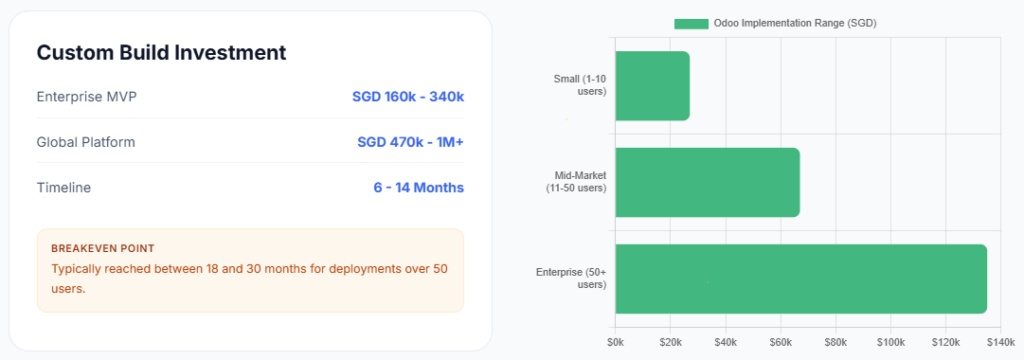
The decision between custom crm development and crm customization on an existing platform (Salesforce, HubSpot, Zoho) is not primarily about upfront cost. It is about the 3 to 5 year trajectory of licensing fees, integration overhead, workflow compromise, and data residency. As a crm consultant working across both paths, Vinova evaluates the decision with a structured Double Diamond Process before any architecture recommendation is made.
A customizable CRM platform runs on vendor-controlled database engines with proprietary object schemas, API limits, and tenancy rules. Configuration is faster, but architectural decisions are constrained by what the vendor permits. A custom CRM is a proprietary application built from scratch or on open-source components (PostgreSQL, Odoo open-source modules, Django or FastAPI), deployed on infrastructure under the enterprise’s control.
Custom CRM Development vs. Platform-Based CRM
| Dimension | Custom CRM Development | Platform-Based CRM (Salesforce, HubSpot) |
|---|---|---|
| Functional scope | Engineers write native code in Go, Node.js, or Python to support the workflows you define, within the limits of the infrastructure you fund | Constrained by vendor architecture, proprietary runtimes, metadata limits, and object caps |
| Initial cost | Higher upfront capital expense, sized after discovery by scope and compliance requirements | Lower to moderate: primarily implementation, CRM consulting, and initial setup |
| Ongoing licensing | No seat or consumption-based platform fees; infrastructure and maintenance costs instead | Recurring and growing: seat licenses plus usage-based AI action fees |
| Data residency and control | Full control of databases, hosting zones, and compliance schemas | Shared responsibility: data resides in vendor clouds, with the residency options the vendor offers |
| Integration overhead | Low for internal legacy systems; custom middleware built to specification | Low for standard SaaS via pre-built connectors; higher for legacy ERPs and non-standard systems |
| Adoption timeline | Design, build, test, and deploy a production system; scoped after discovery | Typically shorter, depending on organizational complexity and data migration maturity |
| User experience | Interfaces designed around your exact operational workflows; minimal training overhead | Teams adapt real-world processes to the vendor platform’s native interface |
| Long-term technical debt | Infrastructure and dependency maintenance; refactoring as the codebase matures | Proprietary API upgrades, deprecated features, and custom configurations to maintain after each vendor release |
From a crm consulting standpoint, the inflection point is rarely dramatic. It accumulates: one API rate limit workaround becomes five, one custom object cap becomes a re-architecture request, one compliance requirement becomes a data residency question that a shared SaaS tenancy struggles to answer. Vinova’s crm consultant team looks for this crossover point early in discovery, before a client has invested in configuration it will need to rebuild.
What Are the Four Inflection Points That Justify Custom CRM Development?
1. Workflows that do not map to standard CRM data models
Off-the-shelf CRM platforms are designed around the Lead, Account, Contact, and Opportunity data model. When your operational reality does not fit this schema (complex multi-party marketplaces, IoT-enabled supply chains, high-frequency physical asset operations), developers are forced to build mapping tables, custom metadata wrappers, and nested queries to simulate relational integrity. Over time, these workarounds degrade query performance and increase maintenance overhead. Custom CRM development builds the schema around your actual data model.
2. Platform technical ceilings that block operational scale
Platform CRMs enforce runtime limits to keep multi-tenant systems stable. The limits below are the ones most often hit by high-frequency data pipelines:
Platform CRM Limits That Commonly Constrain Scale
| Platform | Limit | Source and Note |
|---|---|---|
| Salesforce (Apex) | Synchronous transactions: 10,000 ms CPU time and 100 SOQL queries. Asynchronous: 60,000 ms CPU time and 200 SOQL queries | Salesforce Apex governor limits, per transaction |
| Zoho CRM (API) | Concurrent API calls from 5 (Free) to 25 (Ultimate and CRM Plus), with 20 on Enterprise; API credits allotted on a rolling 24-hour window by edition and user licenses | Zoho CRM API limits |
| HubSpot (developer platform) | Classic CRM cards are deprecated, with a sunset deadline of 31 October 2026 for existing apps to migrate to App Cards | HubSpot developer changelog |
In practice, a high-frequency pipeline on a platform CRM often needs an external message-queuing layer just to run reliably, and scheduled deprecations consume developer time simply to maintain existing functionality. Custom development removes vendor-imposed ceilings and replaces them with limits you size, own, and monitor yourself.
3. SaaS licensing TCO that crosses the custom build breakeven point
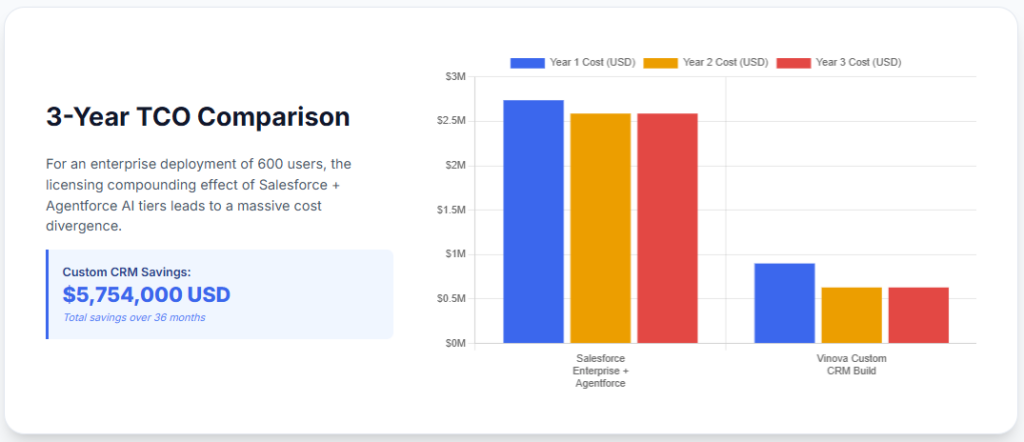
SaaS pricing compounds with user counts and AI consumption. Salesforce’s published list prices show how quickly one component moves: the Agentforce add-on is USD 125 per user per month for Sales, Service, and Field Service and Operations, and Flex Credits cost USD 500 per 100,000 credits, with a standard Agentforce action using 20 credits, or USD 0.10 per action. The table applies those list prices to an illustrative scenario of 600 users and 6 million actions a year.
Illustrative Agentforce Cost at List Price: 600 Users, 6 Million Actions a Year
| Cost Component | Calculation | Annual Cost | 3-Year Cost |
|---|---|---|---|
| Agentforce add-on | 600 users × USD 125 × 12 months | USD 900,000 | USD 2,700,000 |
| Flex Credit consumption | 6,000,000 actions × USD 0.10 | USD 600,000 | USD 1,800,000 |
| Subtotal, before seat licenses and implementation | USD 1,500,000 | USD 4,500,000 |
The scenario assumes every user holds the add-on and that consumption is billed on top, so treat it as a stress case and not a quote. Seat licenses, implementation, and administration come on top, and edition names, bundled credits, and list prices change, so check them against your own contract. The custom side of the comparison has its own cost categories: the one-time build, hosting, LLM inference where AI features are used, a maintenance team, security testing, and compliance audits. Vinova models both sides with your real inputs:
3-Year TCO (platform) = 36 × monthly seat and add-on fees + 3 × annual consumption fees + implementation
3-Year TCO (custom) = one-time build + 3 × (hosting + inference + maintenance team + audits)
Breakeven month = custom build cost ÷ (monthly platform cost − monthly custom run cost)
Vinova’s crm consulting engagements deliver this TCO comparison as the first deliverable, before any build recommendation is made.
4. Data residency requirements that shared tenancy cannot satisfy
Singapore’s PDPA, the MAS TRM guidelines, Vietnam’s PDP Law, and the EU GDPR each shape where personal data can reside and how it can move. Multi-tenant SaaS is not automatically non-compliant, because vendors offer regional hosting and contractual safeguards. But when a client needs data partitioned by jurisdiction, hosted in specific zones, or kept out of shared vendor tenancy, custom CRM development with a regional database node architecture gives direct control over all three. Vinova designs data residency into custom crm development engagements from Phase 1 schema design, not as a post-launch compliance patch.
What Are Your Platform Options, and Where Does Each Hit a Ceiling?
For organizations not yet at the custom development inflection point, or with integration requirements that benefit from a platform’s pre-built connector ecosystem, Vinova’s crm consulting practice evaluates the following platforms alongside our enterprise CRM implementation framework to give objective guidance across both paths.
CRM Platform Options, Technical Ceilings, and Vinova Position
| Platform | Best For | Key Technical Ceiling | Vinova Position |
|---|---|---|---|
| Salesforce | Large global enterprises with complex regional requirements | Synchronous Apex limits per transaction; consumption-based AI pricing at USD 0.10 per standard action | Recommended when the existing ecosystem justifies the ongoing licensing cost |
| HubSpot | Marketing-aligned sales teams running standardized cycles | Cost rises with contact volume; classic CRM cards sunset on 31 October 2026 | Viable for SMEs; custom development is considered when contact scale or workflow requirements outgrow it |
| Odoo (open-source Community Edition) | Enterprises wanting modular ERP and CRM without SaaS licensing | Needs developer expertise to customize; you own hosting and infrastructure management | The middle path between a full custom build and SaaS licensing |
| Zoho CRM | Affordability-first mid-market operations | API credits per rolling 24 hours; 5 to 25 concurrent API calls depending on edition | Suitable for simpler operational models; revisit when workflows become non-standard |
| Custom CRM (Vinova build) | Enterprises with unique data models, residency requirements, or SaaS TCO that no longer works | Limits set by the infrastructure and team you fund | Recommended when the modeled TCO crossover falls within 24 months, Vinova’s decision rule, or compliance requirements exclude shared tenancy |
Odoo deserves specific mention as a middle path. Vinova implements Odoo’s open-source CRM and ERP modules for clients that need modular breadth (sales, inventory, accounting, HR) without per-seat SaaS licensing or shared-tenancy data exposure. Scope, user count, and hosting model drive Odoo implementation cost, and Vinova prices it after discovery.
What Does a Custom CRM Actually Do? The Five Operational Modules
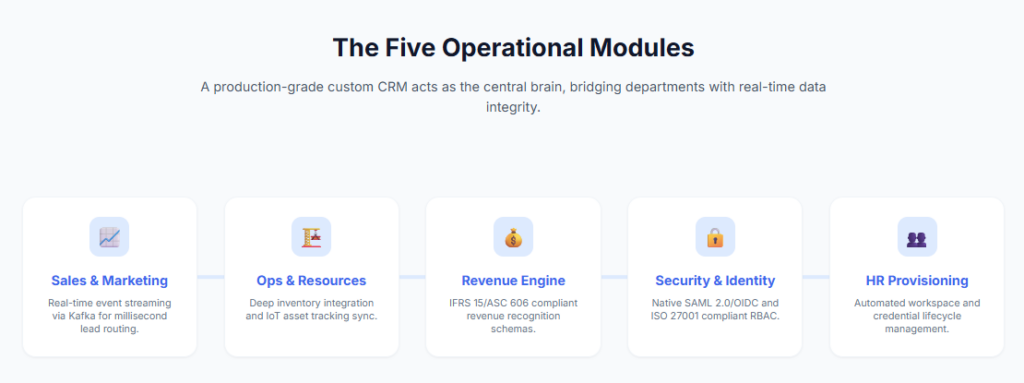
A production-grade custom crm development project at Vinova is not just a contacts database. The system is designed as a centralized operational hub coordinating activities across five departments.
Sales and marketing pipeline
Lead events from external digital channels are captured and processed through an internal real-time event-streaming layer (Apache Kafka or RabbitMQ), scored, and routed to the correct account executive without passing through third-party synchronization tools. Latency drops from batch intervals to seconds. Routing rules, and AI prospecting agents where used, send high-value MQLs to the right rep inside a target window agreed with sales, such as 15 minutes from form submission.
Operations and resource scheduling
The CRM database schema links customer records directly to inventory catalogs, dispatch systems, and physical asset trackers. Vinova deployed this architecture for a facilities management operator: when a client submits a service request, the CRM matches and schedules maintenance orders for more than 30,000 active users, replacing a legacy manual workflow.
Finance and revenue recognition
ASC 606 and IFRS 15 revenue recognition is built into the CRM’s relational data model. Contract structures, performance obligations, standalone selling prices, and revenue schedules are stored as linked tables, so whenever a contract is modified, the system triggers reallocation calculations across all active performance obligations. Downstream billing flows from CRM data without manual reconciliation through custom ERP and CRM integration.
IT, security, and identity management
The CRM integrates with enterprise identity providers through SAML 2.0 or OIDC, enabling automated user provisioning and de-provisioning based on HR status changes. Vinova’s security engineering operates under ISO 27001:2022 and ISO 9001:2015 certification. For public sector clients, delivery is designed to align with GovTech’s IM8 guidelines and VAPT requirements. For a public safety agency, Vinova architected secure Azure-hosted portals managing real-time resource allocation under strict security isolation.
HR and employee provisioning
When employees are onboarded or change roles, the CRM’s administrative modules adjust role-based access permissions and reassign client portfolios automatically. Vinova built this capability for a medical technology company, delivering an HR mobile and web application that manages employee lifecycle stages, credentials, and workspace access permissions for an enterprise workforce.
How Does Vinova’s Six-Phase Custom CRM Development Lifecycle Work?
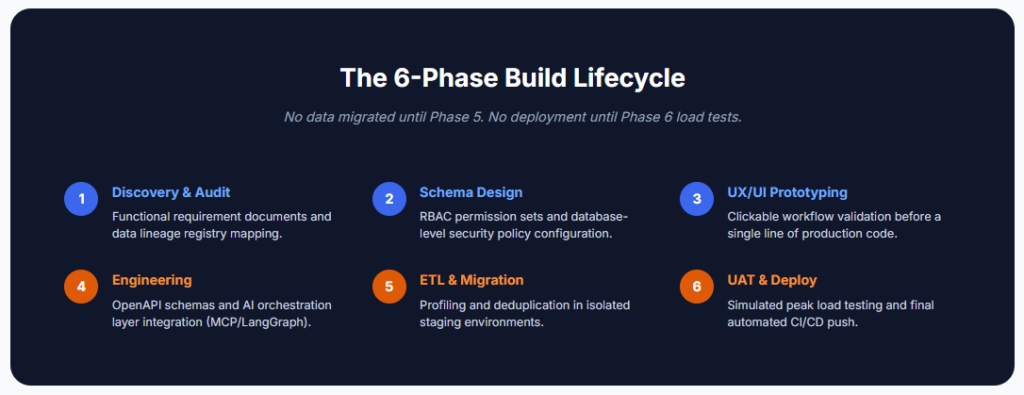
Vinova delivers custom crm development projects under a structured six-phase lifecycle, with each phase gated by a concrete deliverable before the next begins. No data is migrated until Phase 5 staging is validated, and no production deployment occurs until Phase 6 load testing and security checks pass.
Six-Phase Custom CRM Lifecycle: Gates and Deliverables
| # | Phase | What Happens | Vinova Deliverable |
|---|---|---|---|
| 1 | Discovery, process audit, and scope definition | Business Analysts audit existing workflows using Vinova’s Double Diamond Process (Discover, Define, Develop, Deliver); data bottlenecks mapped; legacy systems catalogued; risk-mitigated technical roadmap built | Functional Requirements Document; data lineage registry; documented process maps; compliance scope |
| 2 | Database schema design and security layering | Relational storage layer designed; RBAC user roles and Row-Level Security policies configured at database level; data classified into sensitivity tiers (PII, financial, public) | Schema documentation; RBAC permission sets; data sensitivity classification manifest |
| 3 | UX/UI prototyping and workflow design | Clickable prototypes built around the exact operational workflows of sales, ops, and CS teams; usability tested before any production code is written | Interactive prototype; workflow validation sign-off; component library |
| 4 | Core engineering and API specification | Backend and frontend built concurrently; APIs documented under OpenAPI schemas; AI agent integration layer configured (MCP server, LangGraph orchestration, vector database for RAG) | Working API endpoints; OpenAPI schema; AI integration layer; staging environment |
| 5 | ETL pipeline build and data migration | Legacy records profiled; deduplication and normalization applied in a staging database before any record touches production; E.164 phone normalization; email validation; sensitivity tiering enforced | Staging database; ETL pipeline; migration validation report; production-ready clean dataset |
| 6 | UAT, performance load testing, and CI/CD deployment | Role-based UAT across sales, ops, and CS teams; API latency measured under simulated peak load; encryption design targets (AES-256 at rest, TLS 1.3 in transit) verified; automated CI/CD pipeline deploys to Kubernetes or managed cloud | UAT sign-off; load test report; security verification checklist; production go-live |
Vinova case study: maritime shipping ERP. A maritime shipping group needed a custom ERP integrating vessel tracking, billing pipelines, real-time voyage monitoring, and 20+ operational modules. Vinova architected an API-first decoupled middleware layer across all modules, which increased development velocity by 60%, and the platform continues under a long-term dedicated squad.
Vinova case study: government land registration platforms. Vinova’s engineers support and modernize a Singapore statutory board’s critical legacy registration and e-lodgement platforms under strict transactional integrity, database hygiene, and high-performance querying requirements. The engagement shows Vinova’s capability for long-term custom platform maintenance in highly regulated government environments.
Vinova case study: government patent examination workbench. For a Singapore statutory board, Vinova engineered a secure digital workbench with deep Office 365 integration, multi-tier database layers, and custom API connections, so examiners can process and work with extensive patent and regulatory datasets in a secure, collaborative environment.
What Do PDPA, Vietnam’s PDP Law, and GDPR Mean for a Custom CRM?
For Singapore-based businesses operating across Southeast Asia, custom crm development that handles personal data must satisfy several overlapping regulatory frameworks at once. A generic multi-tenant platform can meet many of them through vendor safeguards, but it cannot always segment data by jurisdiction at the infrastructure level the way a purpose-built architecture can.
Singapore PDPA
Under Section 26, personal data cannot be transferred outside Singapore unless the recipient provides a standard of protection comparable to the PDPA. For custom CRM development engagements involving Vinova’s Vietnam engineering teams, all data access occurs through Virtual Desktop Infrastructure hosted in Singapore cloud zones, and Data Transfer Agreements incorporating ASEAN Model Contractual Clauses are signed before any personal data enters the development environment. Vinova holds active ISO 27001:2022 and ISO 9001:2015 certifications.
Vietnam PDP Law
Vietnam’s Personal Data Protection Law took effect on 1 January 2026, and Decree 330/2026/ND-CP sets the fine for unlawful cross-border transfers at up to 5% of the organization’s total revenue for the preceding year. As Vietnam Briefing summarizes, transferors must file a cross-border transfer impact assessment with the Ministry of Public Security, with the initial filing due within 60 days of the transfer, and the filing is appraised by the ministry’s A05 department. The sources describe filing and assessment duties rather than a blanket localization rule, so confirm your obligations with Vietnamese counsel. Where a client wants Vietnamese personal data kept in-country, Vinova’s architecture supports regional database nodes: Vietnamese citizen PII stays on infrastructure within Vietnam, and only non-sensitive, consented metadata synchronizes to the central Singapore-hosted CRM engine.
GDPR for EU operations
EU customer data is routed to Frankfurt or Dublin regional cloud nodes. Cascade deletion mechanisms handle Right to Erasure requests across all related database tables, and storage limitation policies purge inactive records after defined retention periods. Consent logging and data minimization are built into the CRM schema, not managed through external tools.
Talk to Vinova’s Custom CRM Development Team
Schedule a complimentary two-hour architectural roadmap consultation with our Singapore solutions team. We assess your current platform, identify the point at which custom development beats SaaS licensing, and map a delivery plan to your timeline and budget, with no commitment required.
What Are the Risks of Custom CRM Development and How Are They Managed?
Custom CRM Development Risks and Vinova Mitigation
| Risk | How It Plays Out | Vinova Mitigation |
|---|---|---|
| Budget overruns and scope creep | Feature requirements expand mid-development, the timeline slips, and total cost exceeds the initial estimate | MVP-first approach: core operational workflows are built and validated before advanced features are scoped. Two-week Agile Scrum cycles, with scope validation for every feature before sprint assignment |
| PDPA and Vietnam PDP Law compliance | Personal data processed by offshore engineers triggers PDPA Section 26 obligations; unlawful cross-border transfer of Vietnamese data carries fines of up to 5% of prior-year revenue | Data Transfer Agreements before any data extraction; cross-border transfer impact assessment filed with the Ministry of Public Security where required; regional database nodes for Vietnamese personal data; Singapore data hosted in AWS ap-southeast-1 |
| Dirty legacy data crashing the migration | Duplicate contacts, unnormalized phone formats, and broken relational references loaded directly into a normalized production schema cause import failures and corrupted records | Mandatory staging database for all legacy records; deduplication, E.164 phone normalization, and email validation completed before any record enters the production database |
| Long-term maintenance burden | The codebase grows without documentation, dependency updates break integrations, and technical debt accumulates faster than it can be refactored | Automated test suites in the CI/CD pipeline; API and schema documentation maintained throughout; long-term retainer squads available for post-launch evolution |
What Should You Ask Before Commissioning a Custom CRM?
How much does custom CRM development cost?
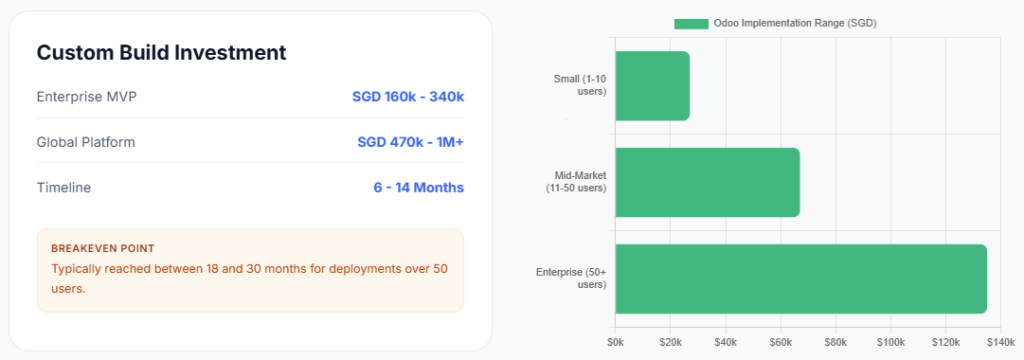
Cost depends on scope. An MVP (core sales tracking, basic integrations, database-level security) sits at one end. A comprehensive platform (cross-departmental operations, multi-tenant security, ETL pipelines, native AI capabilities) sits in the middle. Global deployments requiring deep legacy integration and cross-border compliance audits sit at the other end. Vinova scopes after a fixed-price discovery phase that produces a detailed TCO comparison and architecture recommendation before any build commitment is made, so the budget follows evidence from your own stack.
When does custom CRM development beat platform CRM consulting and configuration?
Four conditions justify custom crm development over crm customization on an existing platform: your operational workflows do not map to standard CRM data structures without significant developer workarounds; you consistently hit platform API rate limits, custom object caps, or query execution limits; your 3-year SaaS TCO crossover against a custom build is within 24 months; or your data residency requirements (PDPA, Vietnam PDP Law, MAS TRM) exclude shared tenancy. Vinova’s crm consulting discovery phase models all four criteria before recommending a path.
What is the difference between CRM customization and custom CRM development?
CRM customization configures an existing platform (Salesforce, HubSpot, Zoho, Odoo) using built-in developer toolkits, custom fields, and proprietary scripting languages to fit a company’s workflows. The platform’s underlying database architecture remains unchanged. Custom CRM development builds a proprietary application with a database schema, integration layer, and UI designed for the enterprise’s operational model, without vendor-imposed architectural constraints. As a crm consultant working across both paths, Vinova recommends starting with platform customization when the TCO case for custom development does not close within 24 months.
How long does custom CRM development take?
Duration depends on scope. A focused MVP with core workflows and standard integrations is the shortest path. A production-grade system with AI agent integration, multi-tenant security, and compliance engineering takes longer, and Vinova gives a phase-by-phase plan with dates after discovery. Every phase is gated by a working deliverable before the next begins.
How does Vinova handle CRM consulting for businesses that are not sure which path to take?
Vinova’s crm consulting process begins with a fixed-price discovery engagement that produces three deliverables: a full audit of your existing CRM or data management workflows, a structured TCO comparison between crm customization on your preferred platform and custom crm development at your operational scale, and an architecture recommendation with a phased roadmap. For teams still benchmarking CRM consulting partners in Singapore, this gives Operations Directors and Sales Ops teams a clear decision basis before any development budget is committed.
Can Vinova handle CRM customization on existing platforms as well as custom builds?
Yes. Vinova delivers crm customization on Salesforce and Odoo alongside full custom crm development engagements. For Odoo, Vinova’s open-source customization practice provides modular CRM and ERP implementation without per-seat SaaS licensing. For clients outgrowing Salesforce governor limits or Zoho concurrency caps, Vinova’s crm consultant team designs the migration from a platform-based to a custom architecture, with legacy data profiled and validated in a staging database before cutover.
How Can Vinova Support Your CRM Decision?
Vinova, a Singaporean Government-Grade Technology Partner, Made Accessible, has delivered more than 300 projects across custom software, web, mobile, data, AI and cybersecurity over 16 years. Most CRM programs go wrong at the decision stage, not the build stage, and Vinova’s approach is built around accountability:
- Fiduciary Governance & Regulatory Alignment: Delivery operations certified under ISO 27001:2022 (Information Security) and ISO 9001:2015 (Quality Management) and GovTech Category 1B approved, with delivery designed to align with the PDPA, GovTech IM8 and MAS TRM expectations that apply to your sector.
- Singapore Corporate Governance: Master Services Agreements governed under Singapore law with SIAC arbitration, so IP ownership and accountability are defined before the first commit.
- Custom CRM and Platform Engineering Practice: Architects and engineers who build custom CRMs, customize Salesforce and Odoo, and deliver enterprise system integration services with TCO modeling, schema and security design, ETL migration, and AI agent integration.
- Engineering Depth: 300+ in-house engineers across Singapore and Vietnam delivery hubs in Ho Chi Minh City, Da Nang, and Hanoi, with 8% to 12% annual voluntary attrition, so the people who build your CRM are still there to run it.
Schedule a complimentary two-hour architectural roadmap consultation with our Singapore solutions team to model your CRM decision.
Vinova: a Singaporean Government-Grade Digital Transformation Partner, Made Accessible. For 16 years, we have designed digital systems for 300+ companies and government agencies worldwide, backed by ISO 27001:2022 and ISO 9001:2015 certification and Singapore GovTech Category 1B approval.
300+ employees across offices in Singapore, Vietnam (Hanoi, Da Nang, Ho Chi Minh City), Norway (Oslo), and Thailand (Bangkok), scaling platforms and engineering capacity to serve clients across the globe.
Financial Times Top 500 High-Growth Companies Asia-Pacific 2026. Recognized among Singapore’s Top 100 Fastest-Growing Companies in 2024, 2025, and 2026.