Enterprise AI adoption in Asia-Pacific has reached an inflection point. Total digital transformation investment in the region hit USD 920 billion in 2025, with AI allocations exceeding 30% of total expenditure for the first time. Generative AI enterprise adoption surged from 18% in 2024 to 42% in 2025. But scaled, production-grade deployments remain below 12%. The gap between edutech innovation investment and edutech innovation outcomes is structural, not technical. Most institutions are treating AI as a plug-and-play productivity tool. It requires a fundamentally different approach: architectural redesign, regulatory alignment, and a delivery partner who has shipped compliant systems at this level before.
The institutions that get this right will own the credential layer, the talent pipeline, and the operational efficiency that their competitors are still running proofs of concept on. This guide maps the five AI maturity stages shaping Singapore institutions, the three Death Valleys where edutech innovation initiatives stall, how Vinova operates as an edtech expert partner across each transition, and what enterprise procurement criteria actually matter for Tech Directors and Academic Innovation Leads making platform decisions in 2026.
Table of Contents
The EduTech Innovation Maturity Spectrum: Where Singapore Institutions Actually Are
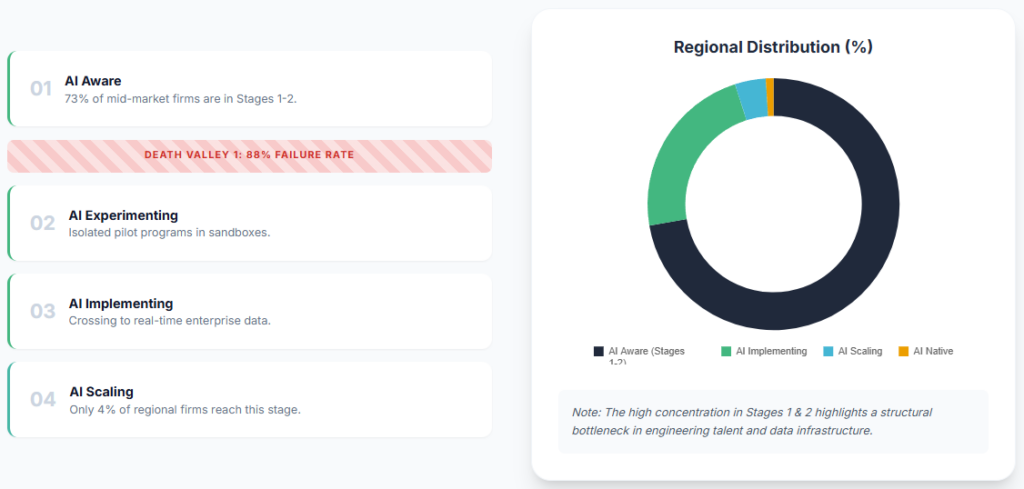
The Pertama AI Maturity Model provides the clearest diagnostic framework for Asian institutions, mapping advancement across five operational stages. The distribution across these stages explains why most edutech innovation programmes underdeliver: 73% of mid-market firms are still in the early awareness or experimentation stages. Only 4% have reached scaled, multi-department AI deployment.
| Stage | APAC Distribution | Strategic Focus | Critical Barrier | Investment Priority |
| 1: AI Aware | 73% of mid-market firms at Stages 1 or 2 | Build baseline AI literacy; identify high-impact use cases | Limited technical expertise and fragmented legacy data | Data infrastructure modernisation and workforce literacy |
| 2: AI Experimenting | Part of 73% early-stage cohort | Pilot programmes in isolated business lines | Death Valley 1: 60% of firms stall in perpetual pilot mode | Establish criteria to measure business value from pilots |
| 3: AI Implementing | 23% of mid-market enterprises | Operationalise one high-value production AI application | Death Valley 2: severe shortage of AI engineering talent | MLOps platforms and automated data pipelines |
| 4: AI Scaling | Only 4% of regional firms | Expand AI across multiple departments with shared data platforms | Death Valley 3: 55% stall on build-vs-buy architecture decisions | Reusable data fabrics and centralised AI governance frameworks |
| 5: AI-Native | Fraction of the 4% cohort | Business model re-architected around proprietary AI capability | Highly restrictive regional data infrastructure and regulatory limits | Custom core models, advanced R&D, and academic partnerships |
The most destructive bottleneck is Death Valley 1: the transition from Stage 2 experimentation to Stage 3 production. Historically, 88% of AI proofs of concept in APAC fail to reach active production. For the 12% that successfully cross this barrier, the average transition timeline is 14 months. Pilots are validated on clean, static datasets in isolated sandboxes, then fail when exposed to the real-time, unstructured data streams of live enterprise platforms (ERP, LMS, CRM, WMS).
Vinova resolves this specific failure with two structural interventions. First, the MVP Validation Framework: a fully functional, compliant proof-of-concept launched in 8 to 12 weeks for SGD 40,000 to SGD 190,000, allowing institutions to validate integration mechanics against live data before committing SGD 340,000+ to full-scale deployment. Second, the Strangler Fig Pattern: cloud-native microservices built around the edges of the existing monolith, routing traffic incrementally so that end users experience zero disruption. This is the architecture Vinova applied for Navig8 Group, enabling them to modernise a complex Marine Shipping ERP spanning 20+ operational modules while live shipping operations continued uninterrupted. Development velocity increased by 60%.
The Agentic Shift: From Augmentation to Co-Intelligence in EduTech
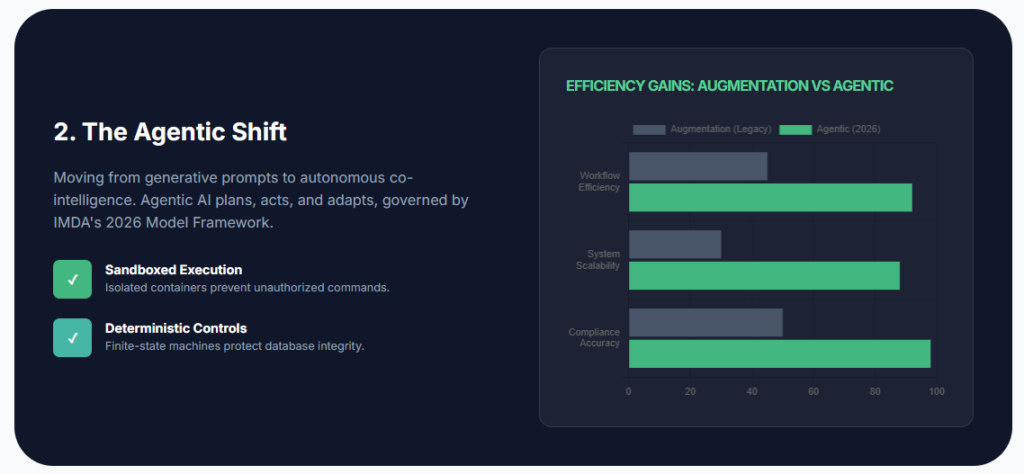
The edutech innovation agenda has moved past generative AI. Generative systems require constant human prompting to yield productivity improvements. Agentic AI platforms use orchestration layers that allow software agents to plan, act, and adapt with high degrees of autonomy: an automated enrolment advisor that verifies transcript authenticity, cross-checks prerequisite requirements, updates the SIS via API, and generates a customised study path, with minimal human intervention in the execution layer.
The World Economic Forum’s Human-Led AI (HLAI) framework defines this transition as the shift from “augmentation” to “co-intelligence.” The framework does not mandate human operators in every loop, nor resist automated efficiency. It defines the non-delegable functions that must remain under human control as operations scale, and replaces rigid role-based workflows with fluid, outcome-focused processes where handoffs between humans and agents are explicitly governed.
For Singapore institutions, IMDA’s Model AI Governance Framework for Agentic AI (January 2026) operationalises these principles with specific technical controls: sandboxed code execution in isolated containers to prevent unauthorised server commands, and deterministic finite-state machine controls preventing agents from mutating database records without explicit cryptographic human authorisation for high-risk operations. This is not optional guidance. It is the compliance baseline for any edtech expert partner deploying agentic systems in Singapore’s regulated institutional environments.
Vinova formalised its commitment to this agentic edutech innovation agenda through a strategic MoU with BnK Solution in May 2026, accelerating AI and Intelligent Automation initiatives across Singapore, Vietnam, and the wider APAC market.
The Talent Paradox: EduTech Innovation’s Biggest Overlooked Risk
Employees who integrate AI effectively into their workflows save up to a full working day per week. But scaling this productivity across an enterprise introduces a critical retention risk that most edutech innovation roadmaps fail to account for: employees who receive more than 80 hours of structured, advanced AI training annually are 59% more likely to leave their current employer.
This training paradox creates a structural operational risk. Institutions that invest heavily in upskilling their workforce prepare those employees for departure, unless they simultaneously implement robust retention strategies, structured career paths, and competitive compensation. The edutech innovation investment pays off for whoever retains the trained talent. It does not automatically pay off for the institution that funded the training.
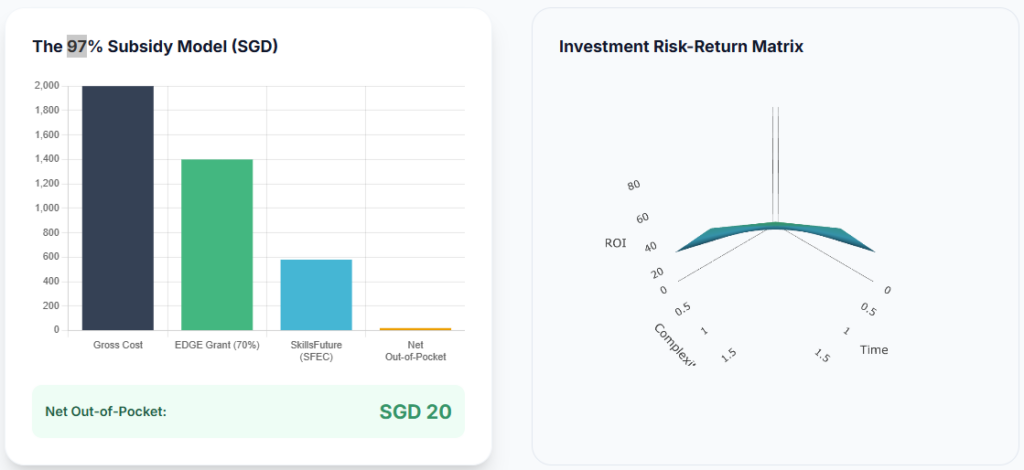
Vinova’s approach addresses this directly. For enterprise deployments, Vinova guides clients through stacking EnterpriseSG’s unified EDGE Grant (up to 70% co-funding from April 2026 to March 2029) with SkillsFuture Enterprise Credits (SFEC), reducing final out-of-pocket upskilling costs to as low as SGD 20 on a SGD 2,000 gross course fee: a 97% effective subsidy rate. The financial argument for upskilling changes entirely when the net cost is near zero. Institutions that structure this correctly can build retention programmes around the grant, not instead of it.
For Singapore’s public educational institutions, Vinova additionally navigates the formal procurement pathway: MOE bulk tenders, GeBIZ supplier panels, and the Singapore Student Learning Space (SLS) Application Development Framework (ADF). Vinova’s portfolio across GovTech Singapore (whole-of-government GRC platform), IPOS International (Digital Workbench), and the Singapore Institute of Technology (SIT AdventureLEARN) provides the IM8 compliance and GeBIZ procurement familiarity that public sector evaluations require.
Shadow AI and Governance: The Institutional Risk Profile in 2026
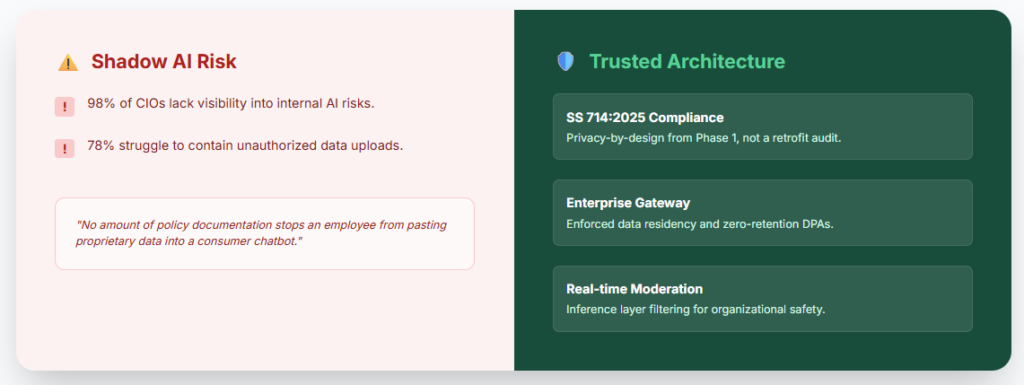
98% of enterprise CIOs report a lack of visibility into the technical and business risks of the AI systems running inside their organisations. 78% struggle to control Shadow AI: the unauthorised use of consumer-grade generative AI tools by employees uploading proprietary corporate data to external servers. This is not a security edge case. It is the default state of most enterprise environments that have deployed generative AI tools without structural governance.
The governance problem is structural. No amount of policy documentation stops an employee from pasting a proprietary dataset into a consumer chatbot. The only mitigation that works is architectural: routing all organisational AI usage through controlled, auditable enterprise systems with enforced data residency, zero-retention DPAs with model providers, and real-time content moderation at the inference layer.
For Singapore institutions, SS 714:2025 (the national standard for Singapore’s Data Protection Trustmark, effective July 2025) shifts compliance from simple prompt management to structural privacy-by-design. The standard requires rigorous third-party audits and annual surveillance of data protection management programmes. Edutech edtech platforms that were configured for PDPA compliance before SS 714:2025 may now require architectural updates to satisfy the new standard’s structural requirements. Vinova scopes all edutech innovation deployments to SS 714:2025 from Phase 1, not as a post-launch audit.
Vinova’s EduTech Innovation Delivery Standards: DORA Benchmarks and Procurement Criteria
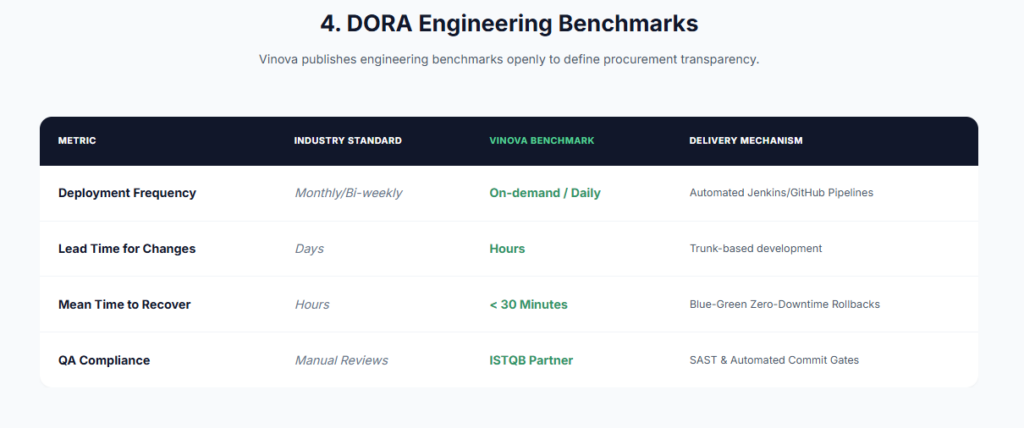
For Tech Directors and Academic Innovation Leads evaluating edutech expert partners, the gap between a vendor’s stated capabilities and their actual delivery standards is the primary procurement risk. Vinova publishes its engineering benchmarks openly against the global DORA (DevOps Research and Assessment) framework:
| DORA Metric | Industry Standard | Vinova Benchmark | How Vinova Delivers It |
| Deployment Frequency | Monthly or bi-weekly | On-demand / multiple times per day | Jenkins, GitHub Actions, and Bitbucket automated pipelines |
| Lead Time for Changes | Days | Hours | Automated environment provisioning and trunk-based development |
| Mean Time to Recover (MTTR) | Hours | Under 30 minutes | Blue-Green deployment pipelines for zero-downtime rollback |
| QA Standard Compliance | General manual reviews | ISTQB Partner since 2023 | Enforced SAST and automated testing gates on every commit |
These benchmarks translate directly into the procurement criteria that institutional decision-makers should be applying to any edutech innovation vendor evaluation:
- Vendor transparency: providers must supply clear documentation of underlying model architectures, pricing frameworks, and training data pipelines. Black-box systems are rejected by Singapore’s regulated institutional buyers for exactly this reason
- Performance SLAs: contracts must guarantee sub-500ms latency windows and minimum 99.99% system uptime at peak hours. Institutions deploying AI-assisted grading, automated enrolment, or adaptive learning systems cannot absorb ambiguous uptime commitments
- Integration flexibility: platforms must connect to existing SIS, LMS, ERP, and national systems (SLS, MIMS, GoBusiness) without requiring a complete rewrite of the institutional tech stack
- Compliance and data governance: on-premise or private cloud deployment options for high-assurance sectors; SOC 2 Type II and ISO 27001 certifications independently audited; SS 714:2025 and MAS TRM alignment where applicable
- Orchestration depth: beyond conversational capability, enterprise agents must execute complex workflows including automated database updates, scheduling, and API calls to third-party systems
Vinova’s hybrid delivery model is designed specifically around these criteria. Singapore-based senior solution architects provide direct stakeholder alignment, regulatory compliance mapping, and legal accountability. Engineering squads in Hanoi, Da Nang, and Ho Chi Minh City execute continuous automated sprints with a 1-hour timezone overlap, maintaining on-demand delivery without triggering local EP salary floors or COMPASS quotas. Senior engineer rates run from USD 2,800 to 4,500 per month all-inclusive: 40 to 60% below equivalent Singapore-only development costs, under ISO/IEC 27001:2022 and ISO 9001:2015 certified delivery processes.
Vinova’s EduTech Innovation Capabilities: What We Actually Build

Vinova is a Singapore-headquartered IT consulting and software development firm established in 2010, recognised as one of Singapore’s Fastest-Growing Companies by The Straits Times for three consecutive years (2024, 2025, and 2026), and ranked among Singapore’s Top 10 Web and Mobile Application Development Companies since 2015. ISO 9001:2015 and ISO/IEC 27001:2022 certified. ISTQB Partner since 2023.
Strategic IT and MarTech Consulting
When an institution’s data pipeline is broken, its AI recommendations are wrong, its compliance posture is exposed, and its leadership is making decisions on inaccurate signals. Vinova designs the architecture that fixes this at the source: custom compliance mapping (PDPA, SS 714:2025, MAS TRM, and IM8) and data pipeline engineering built from the foundation, not retrofitted after launch. When MAS needed compliant enterprise system integrations with DevSecOps pipelines and threat modelling, Vinova delivered systems that passed all MAS TRM regulatory stress tests.
Legacy Modernisation via Strangler Fig Pattern
Most institutions cannot afford a big-bang rewrite of their core operational systems. A failed migration takes the institution offline. Vinova’s Strangler Fig approach eliminates this risk entirely: cloud-native microservices built around the edges of the existing monolith, routing traffic incrementally until the legacy core is replaced module by module. When Navig8 Group needed to modernise a Marine Shipping ERP spanning 20+ operational modules, live shipping operations continued uninterrupted throughout. Development velocity increased by 60%.
Custom Enterprise AI and Automation
AI that doesn’t connect to the institution’s actual data systems doesn’t change how the institution operates. Vinova builds client-specific intelligent automation and machine learning models integrated directly with live ERP and CRM backends, not sandboxed proof-of-concepts. For SBI Digital Markets, Vinova maintains dedicated engineering squads of 20 to 30+ developers running high-throughput data pipelines under full MAS regulatory alignment. For the Singapore Institute of Technology, Vinova built SIT AdventureLEARN, an adaptive learning platform using Dynamic Bayesian Knowledge Tracing over ALSI diagnostic data, presented at EDUtech Asia 2026 as a Global Inspiration Case.
Scalable Offshore Development Centres (ODC)
When a Singapore institution needs to scale engineering capacity without the 10 to 18 week COMPASS EP delay or the 17% employer CPF overhead of local hiring, Vinova’s ODC model is the structural answer. 300+ engineers in Hanoi, Da Nang, and Ho Chi Minh City operate as dedicated squads for Singapore-based institutions, with a 1-hour timezone overlap that supports real-time daily standups throughout the full Singapore business day. ODC capacity is expanding to 500 engineers by 2028. All engagements run under Vinova’s Singapore legal entity, with PDPA Section 26 compliance enforced through VDI hosted in Singapore cloud zones. Reference clients include Singapore Power Group (SP Digital), Abbott Labs, Samsung, OCBC Bank, and the Singapore Police Force.
| Request a Custom Tech-Audit with Vinova Book a complimentary 2-hour technical audit with Vinova’s edtech expert engineering team. We’ll map your current AI maturity stage, identify your highest-ROI innovation priorities, and design a delivery plan aligned to Singapore’s EdTech Masterplan 2030 and compliance requirements. No commitment required. Schedule Your Free EdTech Innovation Audit with Vinova |
EduTech Innovation FAQs
Why do 88% of AI proofs of concept fail to reach production, and how do we avoid this?
The failure is almost always the same: pilots are validated on clean, static datasets in isolated sandboxes, then deployed into live enterprise environments where unstructured, real-time data from ERP, LMS, and CRM systems behaves completely differently. The fix is architectural, not methodological. Vinova’s MVP Validation Framework builds the proof-of-concept on live integration pipelines from day one, connecting to actual enterprise data streams in a controlled, staged environment before any production budget is committed. If it doesn’t work against your real data in 8 to 12 weeks, you know before you’ve spent SGD 340,000+.
What is the AI maturity stage most relevant to corporate training and institutional edutech innovation decisions?
Most Singapore mid-market institutions sit at Stage 2 (AI Experimenting) or Stage 3 (AI Implementing). The most consequential decision for edutech innovation leaders is crossing Death Valley 1: escaping perpetual pilot mode and getting a production-grade AI deployment operating in a real business function. The institutions that cross this barrier in Singapore typically have three things in common: they’ve defined concrete business value metrics before the pilot starts, they’ve built on live integration pipelines (not sandbox data), and they have an engineering partner with IM8 compliance experience who can move at production velocity without the 10 to 18 week COMPASS EP delay.
How does SS 714:2025 affect existing edutech edtech platform configurations?
SS 714:2025 shifts the compliance standard from PDPA checklist conformance to structural privacy-by-design, enforced through third-party audits and annual surveillance. For edutech edtech platforms configured before July 2025, this may require architectural changes: documented data flow mapping, formal Data Protection Impact Assessments (DPIAs) for every integration point, consent management configurations defaulting to denied until explicit user consent, and contractual zero-retention clauses with all AI model providers. Vinova scopes all edutech innovation deployments to SS 714:2025 from Phase 1. Retrofitting compliance after launch is significantly more expensive and disruptive than building it in from the start.
How do we evaluate an edtech expert partner for an institutional AI deployment in Singapore?
Five criteria that distinguish genuine edtech expert partners from vendors: independently audited ISO 27001:2022 and ISO 9001:2015 certifications (not self-declared); active GovTech IM8 compliance and public sector panel vendor status; demonstrable LTI 1.3 integration with Singapore’s Student Learning Space (SLS) or equivalent government system experience; DORA metric benchmarking published transparently (deployment frequency, lead time, MTTR); and a fixed-price discovery phase that commits to a compliance and architecture recommendation before any production budget is locked. A partner who can’t show you independently audited certifications and named Singapore public sector reference clients should not be managing your institution’s data.
What government grants are available for edutech innovation investment in Singapore in 2026?
Two stacking schemes reduce net costs to near zero for qualifying institutions. EnterpriseSG’s EDGE Grant (consolidated from EDG, PSG, and MRA, effective from April 2026 to March 2029) provides up to 70% co-funding for SMEs on edutech innovation capability development, including custom LMS engineering, AI integration, and digital transformation consultancy. SkillsFuture Enterprise Credits (SFEC) offset a further 90% of net training costs. At the 70% SME subsidy tier, a SGD 2,000 training programme costs the institution SGD 6 net after stacking. At the maximum 90% subsidy tier, Absentee Payroll recovery creates a net surplus position. The SFEC framework expires and resets on December 1, 2026 under the Enterprise Workforce Transformation Package (EWTP). Institutions with unclaimed balances should activate before November 30, 2026.
| Vinova: Singapore’s edutech expert engineering and government-grade transformation partner. ISO 27001:2022 and ISO 9001:2015 certified. GovTech IM8, PDPA, and IMDA AI Verify compliant. EdTech clients include Singapore Institute of Technology (SIT AdventureLEARN), GovTech Singapore, IPOS International, Abbott Labs, and Samsung. Financial Times Top 500 High-Growth Companies Asia-Pacific 2026. The Straits Times Singapore’s Fastest-Growing Companies 2024, 2025, and 2026. Explore Vinova’s EdTech capabilities. |