By Vinova Systems Practice · 17-minute read
The asset register listed every server and every warranty date. The dashboard was green. Then a datastore ran out of space at 4:50 PM on a Friday, and every database write in the building stopped. The register had counted the servers. It had not counted what depended on them.
Quick Answer: An IT infrastructure assessment is an evidence-based engineering review of an organization’s physical network, virtualized compute and storage, cloud environments and security controls. It finds single points of failure, puts a price on accumulated technical debt, benchmarks performance bottlenecks, and ends in a prioritized, costed modernization roadmap that also prepares you for regulatory scrutiny.
Table of Contents
Key Takeaways
- Telemetry Beats Inventories: A real IT infrastructure assessment inspects live traffic, hypervisor CPU ready time and storage queue depths. A list of serial numbers and vendor invoices cannot show you those.
- The Stack Is One System: Physical plant, network switching, compute, storage, cloud and identity fail together at their boundaries, so they have to be assessed together.
- Technical Debt Has a Price: Deferred replacements and idle capacity can be modeled as annual cost, which is how you justify modernization spend to a board.
- Singapore Rules Shape the Findings: Depending on your sector, the PDPA, the Cybersecurity Act and MAS Notices set what a defensible infrastructure looks like.
1. The Strategic Imperative: Why Infrastructure Assessments Fail Before They Start
Infrastructure debt stays invisible until peak load turns it into an outage.
Organizations often feel their infrastructure is stable because the administrative dashboards are calm. Underneath, switch packet buffers drop frames, hypervisors queue virtual machines for processor time, and legacy storage controllers sit close to deadlock. An assessment is not a passive checklist. It is an engineering investigation designed to expose brittle points before they become unbudgeted downtime.
1.1 Three Traps in Generic Assessments
Generic IT reviews tend to fail in three ways, and none of them is a criticism of the people running the systems. Internal teams are usually too close to the system to see it, which is why a second pair of eyes helps:
- The Automated Scanner Mirage: A vulnerability scan produces four hundred pages of Common Vulnerabilities and Exposures (CVE) entries, but it cannot tell you whether an uncalibrated Spanning Tree configuration will halt a warehouse fulfillment line during a link failover.
- The Static Asset Register Fallacy: Tabulating serial numbers, CPU models and operating system versions gives you an inventory, not an architecture. It does not map data flows, cross-switch dependencies or single points of failure.
- The Siloed Evaluation Failure: Inspecting servers, storage, networks and cloud subscriptions separately misses the fact that applications fail at the boundaries between them, where a hybrid cloud transit gateway saturates or storage queue exhaustion throttles a hypervisor.
1.2 Business Triggers for a Rigorous Audit
Technology leaders usually commission a full assessment for one of three reasons:
- Pre-Acquisition Technical Due Diligence: Quantifying technical debt, unpatched legacy systems and migration capital before an acquisition closes.
- Cloud Migration and Hybrid Transformation: Benchmarking compute and storage utilization first, so a lift-and-shift to Amazon Web Services (AWS) or Microsoft Azure does not blow through budget.
- Regulatory Audit Readiness: Preparing evidence for the Personal Data Protection Act (PDPA), Cyber Security Agency of Singapore (CSA) frameworks or Monetary Authority of Singapore (MAS) technology risk requirements.
| The generic checklist | The full-stack engineering assessment | |
|---|---|---|
| Method | Raw scanner output with no operational context | Live telemetry captured over a 30-day baseline |
| Scope | Hardware counts, detached from transaction flows | Dependency graph across physical, virtual and cloud layers |
| Output | A long list of findings | A single-point-of-failure matrix and a costed roadmap |
The Rule: If an assessment does not produce an updated dependency graph and a single-point-of-failure matrix, it was an inventory check.
2. Architectural Anatomy of a Full-Stack Infrastructure Assessment
A thorough assessment examines physical, virtual and cloud layers together.
Enterprise architecture now runs across mixed environments, so an assessment inspects four connected layers:
| Layer | What the assessment inspects |
|---|---|
| 4: Identity and access governance | Active Directory functional level, Microsoft Entra ID conditional access, Kerberos delegation and stale administrative access control lists |
| 3: Cloud enclaves and hybrid networking | AWS Virtual Private Cloud (VPC) and Azure Virtual Network (VNet) topologies, transit gateway saturation, Direct Connect or ExpressRoute links and Infrastructure as Code (IaC) drift |
| 2: Compute virtualization and storage fabric | Hypervisor CPU ready time, Storage Area Network (SAN) and Network-Attached Storage (NAS) queue depths, RAM overcommitment and snapshot sprawl |
| 1: Physical plant and network fabric | Main Distribution Frame (MDF) and Intermediate Distribution Frame (IDF) facilities, Power Distribution Unit (PDU) phase balance, Uninterruptible Power Supply (UPS) battery health, spanning tree health and switch buffer behavior |
2.1 Network Infrastructure Audit Methodology: Physical Layer and Layer 2/3 Switching
- Facilities and Environmental Health: Check the MDF and IDF rooms, PDU phase balance and UPS runtime curves under a simulated full load, so you know the cutover to a backup generator is clean.
- Switching Fabrics and Spanning Tree: Audit core, aggregation and access switches for backplane capacity, and check Rapid Spanning Tree Protocol (RSTP, 802.1w) and Multiple Spanning Tree Protocol (MSTP, 802.1s) root bridge priorities, so a failover does not trigger a reconvergence storm.
- Switch Buffers and Flow Control: Profile the packet buffers on Top-of-Rack switches. Bursts of iSCSI or NFS storage traffic can overflow them and cause TCP retransmission storms, so the audit also checks Priority Flow Control (PFC, 802.1Qbb) and Explicit Congestion Notification (ECN) where the design uses them.
2.2 Compute Virtualization and Storage Area Networks
- Hypervisor CPU Contention: In VMware ESXi, Hyper-V or KVM clusters, measure CPU ready time (%RDY). A common rule of thumb treats sustained readings above 5% per vCPU as a warning sign of scheduler starvation, where virtual machines queue for processor time even though CPU headroom looks fine on paper.
- Storage Latency Profiling: Compare device latency (
DAVG/cmd) with kernel latency (KAVG/cmd). As a rule of thumb, device latency sustained above roughly 20 ms points at the array or the fabric, and kernel latency above about 2 ms points at queuing inside the hypervisor, such as a Host Bus Adapter (HBA) queue depth limit. - Snapshot Sprawl and Over-Allocation: Compare thin-provisioned storage pools against forgotten snapshots. VMware’s own guidance is not to keep a snapshot longer than 72 hours, because long snapshot chains consume datastore space and slow I/O.
2.3 Cloud Infrastructure Assessment Framework: Enclaves and Infrastructure as Code
- Hybrid Routing and Transit Gateways: Inspect VPC and VNet peering, Direct Connect and ExpressRoute route table limits, and IPsec VPN tunnel latency under peak load.
- IaC Configuration Drift: Compare deployed cloud resources with the Terraform or CloudFormation state in version control, to find manual changes, open security groups and resources nobody owns.
- IAM Privilege Creep: Use least-privilege analyzers to prune wildcard permissions (
Action: "*",Resource: "*") and flag programmatic access keys that have been dormant for more than 90 days.
3. The Assessment Framework: A Six-Phase Engineering Methodology
Rigorous discovery needs stage gates and non-intrusive telemetry.
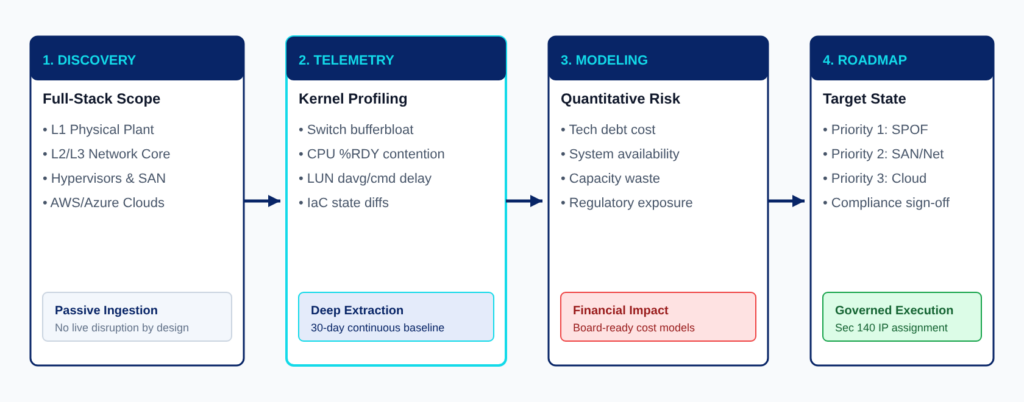
Vinova runs an infrastructure assessment in six phases that are designed to avoid disrupting production.
3.1 Phase 1: Scoping and Passive Discovery
Non-intrusive network sweeps list every active Layer 2 and Layer 3 node and produce an as-built inventory, without active payload scans that could destabilize sensitive industrial or medical equipment.
3.2 Phase 2: 30-Day Performance Baseline
Monitoring agents capture 30 days of telemetry across WAN bandwidth, hypervisor CPU and memory, storage IOPS and switch interface error counters such as Cyclic Redundancy Check (CRC) errors and packet discards. A month covers month-end, payroll and batch-job peaks that a one-day sample would miss.
3.3 Phase 3: Security and Hardening Review
Audit operating systems and hypervisors against Center for Internet Security (CIS) Benchmarks, check firewall egress rules and map the public-facing attack surface.
3.4 Phase 4: Business Continuity and Disaster Recovery Validation
Test the Recovery Time Objective (RTO) and Recovery Point Objective (RPO) you actually achieve, against what executives assume. Check that backups are isolated and immutable so ransomware cannot encrypt them, and test the failover automation.
3.5 Phase 5: Gap Analysis and Risk Scoring
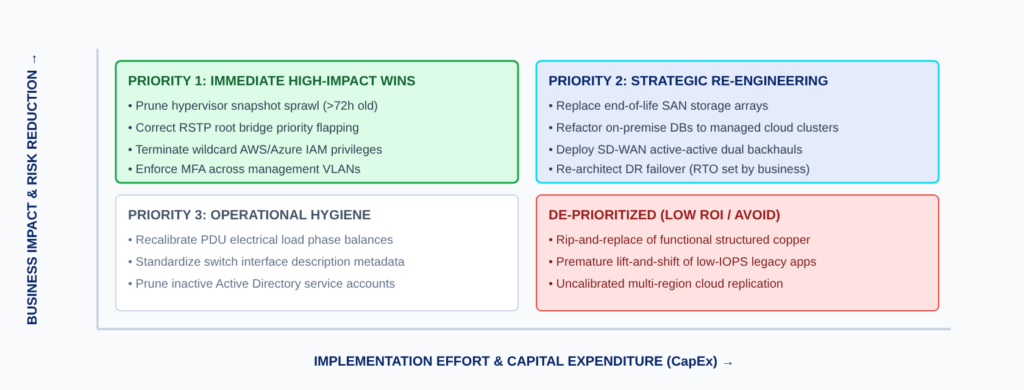
Rank each finding by likelihood of business disruption, exploitability and replacement complexity.
3.6 Phase 6: Prioritized Modernization Roadmap
Turn the findings into a plan for executives and engineers, organized into three horizons:
| Horizon | Window | Focus |
|---|---|---|
| Critical fixes | Days 1 to 30 | Single points of failure and exposed access |
| Architectural re-engineering | Days 31 to 90 | Storage, network and disaster recovery redesign |
| Long-term modernization | Months 4 to 12 | Cloud and platform migration |
3.7 IT Infrastructure Assessment Checklist
Use this checklist to scope an assessment, and ask any provider which evidence they will deliver for each line:
| Area | What to check | Evidence to expect |
|---|---|---|
| Power and facilities | PDU phase balance, UPS runtime under load, cooling, generator transfer | Load test results and a facilities report |
| Network | Spanning tree root priorities, switch buffer drops, WAN utilization, firmware age | A topology diagram and 30-day interface error counters |
| Compute | CPU ready time, memory overcommitment, host firmware and hypervisor patch levels | A utilization report by host and cluster |
| Storage | Queue depths, latency, free capacity, snapshot chains, thin-provisioning ratios | A latency and capacity growth report |
| Cloud | IaC drift, wildcard IAM permissions, dormant keys, idle resources | A drift report and a least-privilege review |
| Backup and DR | Real RTO and RPO, immutability, restore tests | Restore test logs and a failover drill result |
| Identity | Stale accounts, MFA coverage, Kerberos delegation | An account and privilege review |
| Compliance | Encryption at rest and in transit, access logging, incident notification readiness | A gap list mapped to the rules that apply to you |
4. Enterprise Architecture Technical Debt Assessment: Modeling Infrastructure Health
Infrastructure risk has to be quantified in financial and operational units.
Boards and investment committees want technical debt expressed as capital risk. Vinova models infrastructure debt with three formal equations.
4.1 Technical Debt Servicing Cost
Deferring modernization compounds across maintenance overhead, failure probability and vendor extended-support fees:
Where:
- ΔtMaintenance,k is the extra engineering hours spent troubleshooting and patching legacy component k beyond a normal maintenance baseline.
- WLabor is the blended hourly engineering rate in Singapore dollars (S$).
- PFailure,k is the modeled probability that component k suffers an unrecoverable failure in the year, based on Mean Time Between Failures (MTBF) and hardware age.
- LOutage is the projected revenue loss and business disruption if component k fails completely (S$).
- EExtended_Support,k is any vendor extended-support fee, such as a custom support contract for an out-of-support operating system.
4.2 Composite System Availability
For a system built from m sequential stages, where stage i has ri redundant elements in parallel:
Where Ai,j is the measured availability of the j-th redundant element in stage i, such as a firewall in a pair, a core switch or a clustered database host. If any stage has no redundancy (ri = 1), that single component’s availability caps the availability of the whole system.
4.3 Capacity Waste Ratio
Capital is wasted on idle, orphaned or over-allocated compute. Measure CPU and RAM separately, because cores and gigabytes cannot be added together:
Where:
- V is the number of virtual machines or cloud instances, and H is the number of physical hypervisors or bare-metal nodes.
- μCPU,v and μRAM,v are the 95th-percentile utilization ratios of allocated vCPU and RAM for instance v.
- CAlloc,v and MAlloc,v are the vCPU cores and gigabytes of RAM allocated to instance v.
- CTotal,h and MTotal,h are the physical cores and RAM on host h.
- α is the share of your compute cost that is CPU, and 1 – α is the share that is RAM.
The Rule: Deferring infrastructure replacement does not save capital. It converts a planned capital expense into unbudgeted operating cost during an emergency.
Explore Vinova’s Managed IT Services
Vinova can run a passive discovery of your environment and show you where the single points of failure sit.
5. Singapore IT Infrastructure Compliance Audit: Regulatory Readiness
An infrastructure that holds regulated data has to stand up to scrutiny in Singapore.
An assessment should check a technical design against the rules that apply to your organization. Which ones apply depends on your sector and the data you hold.
5.1 The Personal Data Protection Act 2012
- Section 24 (Protection Obligation): Organizations must make reasonable security arrangements to protect personal data. The Act does not prescribe specific technologies, so an assessment checks typical controls: encryption at rest and in transit, access limited by role, and MFA on administrative access.
- Section 48J Penalties: The maximum financial penalty is up to S$1 million, or up to 10% of annual Singapore turnover for an organization with turnover above S$10 million.
5.2 The Cybersecurity Act and CSA Certifications
- Cybersecurity Act 2018, as Amended in 2024: The Act regulates owners of Critical Information Infrastructure (CII). The 2024 amendments widened its reach, and key provisions took effect on 31 October 2025, including those for Systems of Temporary Cybersecurity Concern (STCC). Provisions on Foundational Digital Infrastructure (FDI) providers and Entities of Special Cybersecurity Interest (ESCI) had not commenced in the sources I checked, so confirm their status before relying on them.
- CSA Cyber Essentials and Cyber Trust: These are voluntary certification marks, not legal requirements. Cyber Essentials is a baseline for smaller organizations, and Cyber Trust is a tiered, risk-based mark for larger ones. Many buyers ask for them in procurement.
5.3 MAS Technology Risk Management Requirements
For financial institutions, the MAS Technology Risk Management (TRM) Guidelines of January 2021 describe good practice on physical security, system resilience and network security. The TRM Notices are legally binding, and they require critical systems to reach high availability with unscheduled downtime of no more than 4 hours in any 12 months and a recovery time objective of no more than 4 hours. Check the Notice that applies to your licence.
| Framework | What the infrastructure assessment inspects |
|---|---|
| PDPA Section 24 | Encryption at rest and in transit, role-based access and MFA on administrative paths |
| CSA Cyber Essentials or Cyber Trust (voluntary) | Segmentation, tamper-evident logging, patch cadence and backup discipline |
| MAS TRM Guidelines and Notices (financial institutions) | Single points of failure, downtime limits, recovery objectives and network isolation |
| Business continuity targets (set by you) | Tested RTO and RPO, and isolated immutable backups |
6. Practitioner Scars: Real Infrastructure Failures Uncovered in Production
Every IT infrastructure assessment finds undocumented legacy configuration, and it is a time bomb.
Friction point we hit: the storage that ran out silently. An enterprise logistics hub had intermittent database halts across its cluster. The assessment found a thin-provisioned virtual volume sitting on a deduplicated array at 98% of raw physical capacity. All write I/O stalled, and no hypervisor alert fired.
Resolution: We migrated the non-critical workloads to a secondary LUN pool, pruned snapshot chains that were eight months old, set datastore capacity alerts at 80% with automated webhooks and added a quarterly storage growth review.
Friction point we hit: the failover that pointed at a dead firewall. A financial consultancy found during an audit that its secondary disaster recovery site in AWS used hard-coded routes pointing at a retired on-premise firewall, so its automated failover plan could not have worked.
Resolution: We rebuilt the hybrid routing with dynamic BGP peering across two Direct Connect circuits, containerized the critical application failovers and introduced a quarterly failover drill.
Vinova Field Insight: Infrastructure Audit and Hybrid Cloud Migration for a Singapore Logistics Operator
The Challenge: A regional supply chain provider operating across Singapore and Malaysia had unexplained server lag, unmonitored hypervisor host contention and hardware nearing end of life in its data center, which threatened warehouse dispatch.
The Approach: Vinova ran an infrastructure assessment led by a named Service Delivery Manager and Infrastructure Lead: packet-level network flow analysis, hypervisor storage queue profiling, a cloud readiness review and a security posture check. We delivered a single-point-of-failure matrix and a phased hybrid cloud modernization blueprint.
The Result:
| Metric | Result |
|---|---|
| Single points of failure | 14 identified and resolved |
| Over-provisioned virtual storage | 42% reclaimed |
| Projected cloud spend after architecture optimization | 35% lower |
| Availability design | Topology built for 99.99% high availability |
7. Evaluation Matrix: Choosing Your Infrastructure Assessment Operating Model
How deep an assessment goes depends on how independent the assessor is.
| Evaluation Dimension | Internal IT self-audit | Automated SaaS tooling scan | Specialized systems engineering partner |
|---|---|---|---|
| Architectural depth | Surface-level, shaped by internal familiarity | Many CVE alerts, little architectural context | Full stack, from the physical plant to cloud IAM |
| Single point of failure mapping | Rarely documented because of silos | Limited: weak at multi-system dependencies | A dependency graph that exposes hidden cascade failures |
| Virtualization and storage diagnostics | Basic disk and CPU utilization checks | Standard SNMP polling | CPU ready time and LUN queue depth profiling |
| Regulatory alignment | General assumptions | Fixed rule sets, not tuned to local rules | Mapped to the PDPA, CSA and MAS requirements that apply to you |
| Actionable plan | Subject to internal priorities | A raw data dump that needs analysis | A phased, budget-tiered roadmap ready for board approval |
Option A: Internal IT Self-Audit
- Where It Works: Routine quarterly checks and license inventory reconciliation.
- The Catch: Teams cannot easily audit configurations they designed, and they get used to long-standing workarounds.
- Best for: Routine internal housekeeping.
Practitioner Verdict: Useful for housekeeping. Not independent enough for a board-level view.
Option B: Automated SaaS Tooling Scan
- Where It Works: Continuous scanning for known vulnerabilities and missing patches.
- The Catch: It produces report bloat and does not separate theoretical flaws from real operational risk.
- Best for: Verifying baseline patching.
Practitioner Verdict: Good at finding known flaws. Limited on how your systems depend on each other.
Option C: A Specialized Systems Engineering Partner
- Where It Works: Technical due diligence for acquisitions, cloud migration planning, post-incident remediation and audit preparation.
- The Catch: It needs coordinated stakeholders and administrative access across systems.
- Best for: Organizations that need an independent, board-level evaluation and a roadmap they can defend, as covered in our IT consulting guide for CIOs.
Practitioner Verdict: The right fit when the decision is expensive and the evidence has to hold up.
8. The Contractual and Delivery Playbook: Scoping an Assessment That Delivers Action
An assessment contract should name its deliverables and who owns them.
8.1 Core Engineering Deliverables
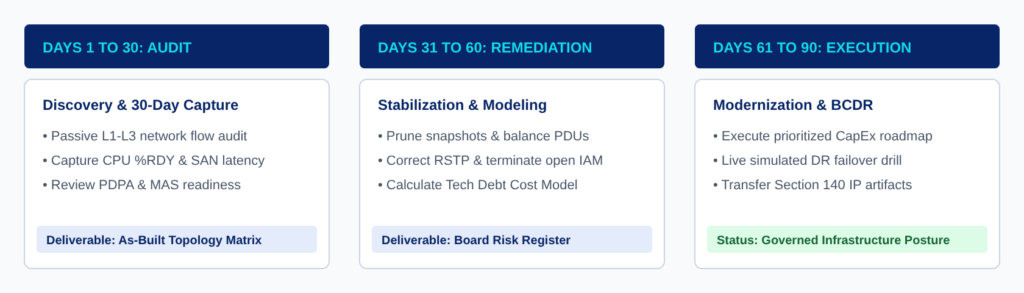
A contract should explicitly guarantee:
- As-Built Topology Schematics: Physical and logical diagrams of network paths, VLAN segmentation, hypervisor clusters and cloud peering.
- Single-Point-of-Failure Risk Register: A prioritized matrix of critical hardware, software and dependency risks, ranked by likelihood and impact.
- Capacity and Lifecycle Forecast: Headroom analysis with projected compute, storage and bandwidth saturation over 12, 24 and 36 months.
- Phased Modernization and Investment Blueprint: A sequenced plan with estimated engineering hours, hardware or cloud capital requirements and cutover schedules.
8.2 Governing Law, IP Ownership and Dispute Resolution
- Governing Law: The contract is governed by and interpreted under the laws of the Republic of Singapore.
- Intellectual Property: Custom audit scripts, configuration templates, network schematics and analytical models should be assigned to you as they are created, using an assignment of future copyright under Section 140 of the Copyright Act 2021, once you have paid.
- Dispute Resolution: If amicable resolution fails, the contract should provide for arbitration administered by the Singapore International Arbitration Centre (SIAC) under its Arbitration Rules, with Singapore as the seat. Awards are then enforceable internationally under the 1958 New York Convention.
Have your legal counsel review the final wording of any clause before signing.
9. Frequently Asked Questions
What is included in an enterprise IT infrastructure assessment?
A full evaluation of physical facilities (power, cooling, structured cabling), Layer 2 and Layer 3 networking, virtualized compute (CPU ready time, memory contention), storage networks (LUN queue depths), hybrid cloud (AWS and Azure VPCs, IAM, IaC drift), backup and disaster recovery validation, and alignment with the regulations that apply to you, such as the PDPA, CSA frameworks and MAS TRM.
How often should an organization conduct an IT infrastructure assessment?
Every 12 to 18 months, or just before a major milestone such as a cloud migration, a data center consolidation, a core ERP upgrade or an acquisition.
How does an infrastructure assessment differ from a cybersecurity vulnerability scan?
A scan probes IP addresses for known vulnerabilities and missing patches. An assessment evaluates the health, performance, resilience, capacity and design of the whole technology stack, including physical bottlenecks, bufferbloat, hypervisor contention and single points of failure that scanners cannot see.
Will an infrastructure assessment disrupt live production operations?
It should not. A well-run assessment relies on passive discovery, SNMP monitoring, API telemetry and read-only configuration exports, and any intrusive test is confined to a maintenance window you have approved in advance.
What documentation does an organization need to provide before an assessment begins?
Existing network diagrams, IP allocation sheets, server and storage asset lists, cloud subscription architectures, software license inventories, backup schedules and third-party vendor Service Level Agreements (SLAs). Where documentation is missing or outdated, the assessment team reconstructs as-built schematics through automated discovery.
The Takeaway
The Takeaway: An IT infrastructure assessment is how you stop guessing, so assess the whole stack, price the debt and fix the single points of failure before the next peak finds them.
Vinova brings government-grade engineering standards to infrastructure review: passive discovery, evidence you can audit and a roadmap your board can approve.
Vinova: Singapore’s mobile and web application development partner since 2010. ISO 27001:2022 and ISO 9001:2015 certified.
300+ in-house engineers across Singapore, Hanoi, Da Nang, and Ho Chi Minh City, including teams who build image-heavy mobile and web applications for enterprise and government clients.
Financial Times Top 500 High-Growth Companies Asia-Pacific 2026. The Straits Times Singapore’s Fastest-Growing Companies 2024, 2025, and 2026.