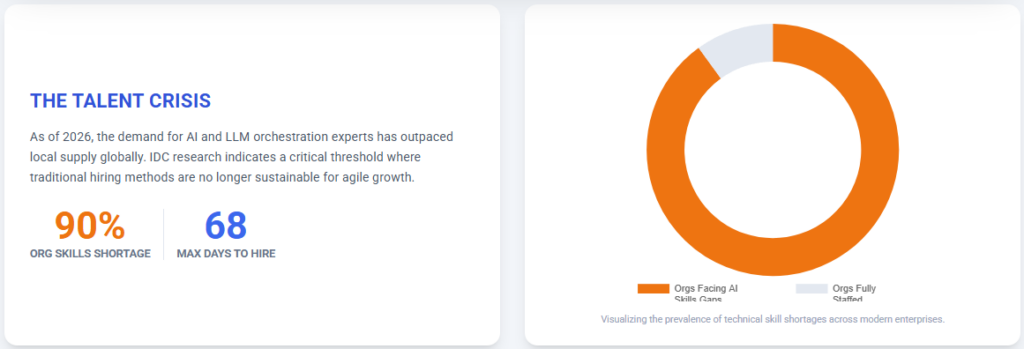
Navigating the 2026 technology landscape presents a dual challenge: tech leaders face accelerating AI adoption timelines while grappling with persistent talent bottlenecks. Recent enterprise research by IDC indicates that over 90% of organisations face critical AI and technical skills shortages, with global average time-to-fill for specialised engineering roles stretching between 52 to 68 days.
To bridge capability gaps without unsustainable fixed headcount costs, forward-thinking organisations rely on two modern remote IT staffing services strategies: IT Staff Augmentation (embedding hyper-specialised external engineers into existing workflows) and Offshore Development Centres (establishing a dedicated, co-managed engineering centre offshore). Pioneered by regional IT leaders like Vinova, headquartered in Singapore with dedicated delivery centres in Vietnam, these hybrid models provide agility, speed, and architectural control. This guide breaks down the benefits, challenges, and key decision factors for both models in 2026.
Table of Contents
Key Remote IT Staffing Services Trends Defining 2026
- Skills-based sourcing over job titles: sourcing has shifted from generic titles (“Senior Backend Developer”) to hyper-specific technical capability matching (Python + FastAPI + Distributed Systems + AI/LLM Orchestration + Cloud Security)
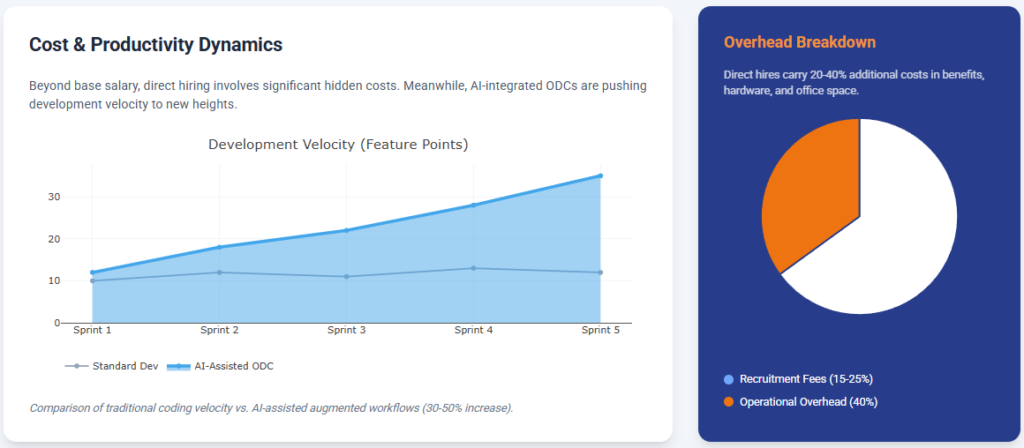
- Hybrid human-AI delivery teams: augmented engineers in 2026 are expected to be fluent in AI-assisted workflows, leveraging AI copilots, automated unit and regression testing agents, and automated documentation tools to increase velocity by 30 to 50%
- Security-embedded delivery (DevSecOps): security is no longer an afterthought. Modern augmented teams integrate DevSecOps, data privacy compliance, and AI governance into the sprint cycle from Day 1
- Shift from reactive hiring to strategic capacity planning: enterprises are replacing emergency gap-filling with predictive workforce models, using ODCs and flexible staff augmentation as permanent, elastic capacity buffers
Understanding the Delivery Models
IT Staff Augmentation (individual resources): specialised external engineers (Senior Full-Stack Developers, DevOps Engineers, AI/ML Engineers, QA Automation Engineers) join your internal team directly under your day-to-day management.
Offshore Development Centre (ODC): a dedicated, scalable offshore unit functions as an extension of your tech department. Under Vinova’s One Team Hybrid Model, high-touch strategic governance (Project Managers, Solution Architects, Scrum Masters) operates onsite or nearshore from Singapore HQ, while high-throughput, AI-assisted development execution runs from Vinova’s Ho Chi Minh City tech hub.
Advantages of Remote IT Staffing Services
1. Rapid scalability and workforce agility
Scale engineering capacity up or down dynamically based on roadmap priorities, product launch cycles, or market shifts. This eliminates the long-term financial liabilities and severance risks associated with full-time direct hires.
2. Direct access to specialised, AI-fluent talent
- AI engine and LLM orchestration / data engineering
- Cloud-native architecture and DevSecOps (AWS, Azure, GCP)
- Low-code and rapid application platforms (OutSystems, Mendix, Odoo)
- Enterprise application integration and mobile ecosystems
- Cybersecurity and automated software quality assurance
3. Significant cost optimisation
Direct hiring carries escalating overhead: recruitment fees (15 to 25% of annual base), employee benefits, stock options, hardware and office expenses (adding 20 to 40%+ to base salary), and retention friction. Operating an offshore ODC or staff augmentation setup delivers enterprise-grade software output at optimised operational expenditure.
4. Drastically reduced time-to-market
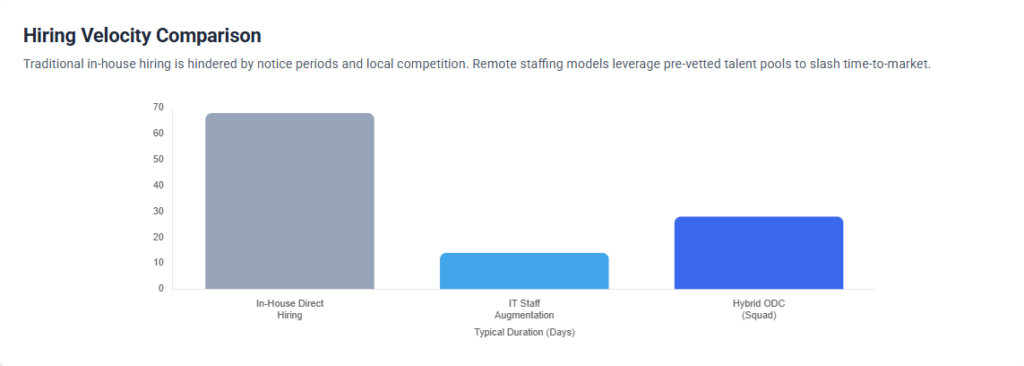
While standard tech hiring averages 50+ days per role, remote IT staffing services providers place pre-vetted specialists within 1 to 2 weeks. Vinova uses structured 2-week Agile sprint frameworks, ensuring team alignment and rapid code contribution from Day 1.
5. AI-assisted productivity engine
Modern ODCs integrate generative AI and test-automation frameworks directly into delivery. Vinova’s AI-Assisted Development and QA Frameworks accelerate code production, automate unit and regression test creation, and perform automated code security audits, yielding higher velocity with fewer bugs.
6. Retained operational and architectural control
Unlike traditional full-scope outsourcing, where project oversight is turned over to a vendor entirely, staff augmentation and hybrid ODCs keep your leadership team in control of system architecture, product roadmaps, and code standards.
Additional Tactical Benefits
- Reduced onboarding friction: senior augmented engineers bring immediate tech stack mastery, significantly cutting technical ramp-up time
- Risk-free trial (“try-before-you-buy”): evaluate engineer performance, coding style, and team collaboration in real sprint cycles before extending permanent offers
- Streamlined HR and regulatory overhead: the service provider manages payroll, local tax compliance, benefits administration, hardware provisioning, and workplace management
- Cross-pollination of innovation: external experts introduce new architectural patterns, tools, and best practices to your permanent engineering staff
- Team retention and burnout prevention: augmenting high-pressure projects reduces overtime strain on internal core engineers, lowering turnover risk
2026 Comparative Delivery Matrix
| Metric | In-House Direct Hiring | IT Staff Augmentation | Hybrid ODC (e.g. Vinova) |
| Time to fill | 52 to 68 days | 1 to 2 weeks | 2 to 4 weeks (complete squad) |
| Overhead and benefits cost | High (+20 to 40% over base) | Included in rate | Included in rate |
| Management responsibility | 100% internal | 100% client-managed | Shared (onsite lead plus offshore PM) |
| Scalability | Rigid, slow | Immediate (individual level) | Elastic (squad and centre level) |
| Knowledge retention | High (long-term) | Medium (project-bound) | High (dedicated long-term centre) |
| AI workflows and tooling | Depends on internal training | Depends on candidate | Built-in AI-assisted dev and QA |
| Security governance | Internal responsibility | Client oversight | ISO 27001 / PDPA / IM8 compliant |
Challenges and How to Overcome Them
Managing distributed tech teams requires intentional process alignment. Here is how to mitigate the common hurdles:
1. Cultural and operational misalignment
Challenge: differences in work culture, communication styles, or local business context between regional and offshore talent.
Mitigation: work with providers who maintain local regional headquarters. Vinova’s Singapore-based leadership bridges local business expectations and cultural context directly with its specialised Vietnam-based engineering hubs.
2. Real-time communication and collaboration
Challenge: asynchronous delays and communication gaps.
Mitigation: standardise modern collaboration stacks (Jira, Slack, Microsoft Teams, GitHub/GitLab) and mandate daily Agile standups. Vinova’s Vietnam ODC operates in GMT+7, one hour behind Singapore’s GMT+8, enabling seamless real-time daily interaction.
3. Data security, privacy, and AI governance
Challenge: granting third-party developers access to proprietary enterprise codebases and customer data.
Mitigation: require verified enterprise compliance certifications. Vinova enforces ISO 27001 certification for Information Security Management, Singapore PDPA and regional privacy law compliance, GovTech IM8 security alignment for public sector and regulated enterprise projects, and biometric-secured ODC facilities with encrypted VPN/MFA environments, clean-desk policies, and strict IP ownership clauses.
4. Knowledge retention and handover
Challenge: knowledge loss when contract engagements end.
Mitigation: mandate inline code documentation, automated test coverage, architectural decision records, and structured handover sprints before project offboarding.
5. Management overhead
Challenge: internal engineering managers becoming bogged down supervising individual contract developers.
Mitigation: adopt a Hybrid ODC model where the vendor supplies onsite Solution Architects and Scrum Masters to manage day-to-day execution, leaving your internal leads free to focus on core strategic goals.
Partner Selection Checklist for 2026
Evaluate potential remote IT staffing services and ODC partners against these criteria:
- Proven track record: enterprise history spanning 16+ years, 200+ dedicated tech talents, and 300+ completed projects across Banking, Fintech, GovTech, Healthcare, and Enterprise sectors
- AI-assisted capabilities: engineers trained in AI-assisted coding, automated prompt engineering, and modern testing tools
- Security and compliance credentials: verified ISO 27001 certification, PDPA compliance, and strict IP protection protocols
- Timezone proximity: regional alignment (Singapore/Vietnam GMT+8/GMT+7) for real-time daily collaboration
- Physical facilities and expansion capability: secure physical development centres capable of scaling capacity, such as Vinova’s Thu Duc HCMC centre, built to expand up to 500 headcount
- Transparent commercial models: clear Time and Materials or Dedicated Monthly Resource pricing without hidden overhead fees
Which Engagement Model Fits Your Needs?
The right choice comes down to a single question: what is your primary engineering objective?
- Choose Staff Augmentation if: you need 1 to 3 specialised individual experts (a Senior Cloud Architect, a Mobile Lead) to join an active internal team for 3 to 12 months under your direct management, typically for a short-to-mid-term specific skill gap or rush project
- Choose a Dedicated ODC if: you are building or expanding a core software platform long-term (12+ months) and need a complete cross-functional team (Developers, QA, DevOps, Scrum Master) with shared delivery governance, typically for sustained long-term product growth
| Scale Your Team with Vinova’s Remote IT Staffing Services Book a complimentary 2-hour consultation with Vinova’s Singapore-based team. We’ll assess your current skills gap, recommend staff augmentation or a dedicated ODC based on your timeline, and scope a compliant delivery plan. No commitment required. Schedule Your Free 2-Hour Remote IT Staffing Consultation with Vinova |
Remote IT Staffing Services FAQ
What’s the difference between remote IT staffing services and traditional outsourcing?
Traditional full-scope outsourcing hands an entire project or function to a vendor who manages delivery independently. Remote IT staffing services, whether staff augmentation or a hybrid ODC, embed external engineers into your existing team structure, systems, and processes, with your leadership retaining control over architecture, roadmap, and code standards. You’re solving for capacity or skill gaps, not delegating the decision-making.
How fast can remote IT staffing services actually fill a role compared to direct hiring?
Standard direct hiring for a specialised engineering role averages 52 to 68 days in 2026. A staff augmentation provider with a pre-vetted talent pool typically places a specialist within 1 to 2 weeks. A complete ODC squad, given the additional coordination of assembling a cross-functional team, generally takes 2 to 4 weeks. Either remote staffing path is materially faster than a direct hire, before accounting for notice periods or work pass processing if a direct hire requires one.
Is staff augmentation or a dedicated ODC the right fit for a 6-month project?
For a defined 6-month engagement needing 1 to 3 specific specialists working inside an existing team, staff augmentation is usually the better fit: faster to mobilise, lower coordination overhead, and scoped to exactly the skill gap you have. An ODC makes more sense once the engagement is expected to run 12+ months or requires a full cross-functional squad (developers, QA, DevOps, and a Scrum Master) with shared delivery governance, since the setup cost of a dedicated centre is harder to justify for a shorter, narrower need.
How do remote IT staffing services handle data security when engineers work offshore?
Verified certifications matter more than assurances. Vinova’s offshore engineers access client systems through Singapore-hosted Virtual Desktop Infrastructure with zero local data storage, operate under ISO 27001 Information Security Management certification, and align to PDPA and GovTech IM8 requirements for regulated engagements. Physical facilities add biometric access control, encrypted VPN and MFA environments, and clean-desk policies, so security isn’t just a contractual clause; it’s enforced structurally at the infrastructure level.
What happens to institutional knowledge when a staff augmentation contract ends?
This is the most common objection to staff augmentation, and it’s a legitimate one if the engagement isn’t managed for it. Mandating inline code documentation, automated test coverage, architectural decision records, and a structured handover sprint before offboarding is what actually prevents knowledge loss, not the engagement model itself. A dedicated ODC has a structural advantage here for longer engagements: the same core team often stays with a client for years, which is why knowledge retention scores higher for ODC than for project-bound individual augmentation in practice.
| Vinova: Singapore’s remote IT staffing services and offshore development partner since 2010. ISO 27001:2022 and ISO 9001:2015 certified. PDPA and GovTech IM8 compliant. 300+ in-house engineers across Singapore, Hanoi, Da Nang, and Ho Chi Minh City, with a dedicated ODC pool of 200+ specialists available for staff augmentation engagements. Financial Times Top 500 High-Growth Companies Asia-Pacific 2026. The Straits Times Singapore’s Fastest-Growing Companies 2024, 2025, and 2026. Explore Vinova’s remote IT staffing services: |