For Singapore-based VPs of Engineering and CTOs, software development outsourcing has shifted from a cost-cutting tactic to a core strategic capability. With domestic developer salaries at record highs, EP processing timelines stretching past 10 weeks, and AI-driven product roadmaps demanding faster shipping velocity, outsourcing is often the only lever that lets you scale without burning runway. This guide covers models, costs, compliance, and what actually works for Singapore-headquartered businesses in 2026.
Table of Contents
Key takeaways
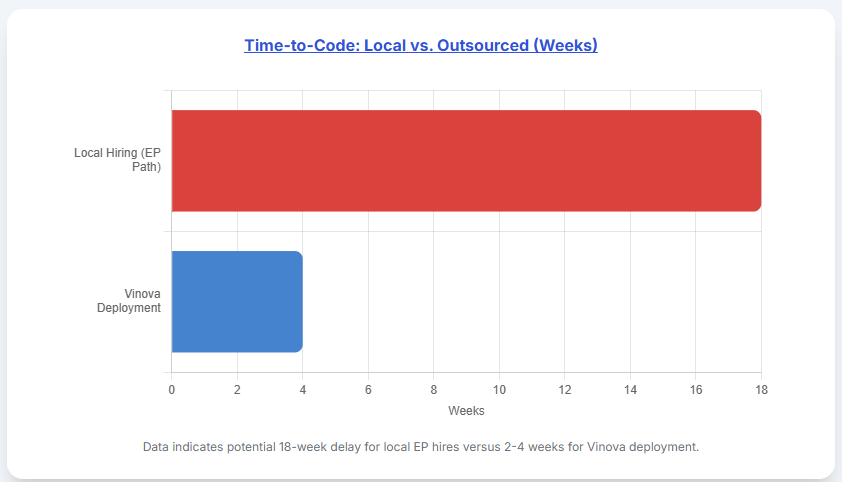
- Outsourcing software development allows Singapore companies to bypass 10–18 week local hiring timelines, scaling dedicated teams within 2–4 weeks without triggering complex Employment Pass or CPF constraints.
- A dedicated team including a senior developer, mid-level developer, and part-time QA specialist costs USD 6,500–9,500 monthly, significantly lower than the SGD 14,500–21,000 required for one local senior hire.
- Vietnam offers a strategic partner location with 530,000–560,000 developers, a UTC+7 timezone just one hour behind Singapore, and lower annual attrition rates of 10–15% compared to other regions.
- Ensure regulatory compliance by mandating ISO 27001 and SOC 2 Type II certifications while executing Data Protection Agreements to meet Singapore’s PDPA and MAS third-party risk management standards.
The Singapore Context: Why This Decision Hits Different Here
Ninety-five percent of Singapore employers report significant difficulty hiring qualified tech talent. For a mid-level software engineer, you’re looking at a base salary of SGD 6,000–8,500/month; senior engineers command SGD 10,000–15,000+. Factor in 17% employer CPF contributions (OW ceiling now SGD 8,000/month), SDL, health insurance, recruiter fees, and office overhead, and the fully loaded monthly cost of a single senior hire lands between SGD 14,500 and SGD 21,000+.
Then there’s the timeline problem. Sourcing a senior engineer takes 6–10 weeks from job post to offer. If that hire needs an Employment Pass (EP) under the COMPASS framework, add another 4–8 weeks for processing. That means your new developer isn’t committing code until 10–18 weeks after you started. For companies trying to ship competitive products in 2026, that’s not a hiring pipeline. That’s a roadmap killer.
Software development outsourcing bypasses this entirely. At Vinova, we can deploy a cross-functional dedicated team and reach active sprint velocity in 2–4 weeks, without triggering COMPASS quotas, EP salary floors, or CPF obligations.
When Software Development Outsourcing Makes Sense (and When It Doesn’t)
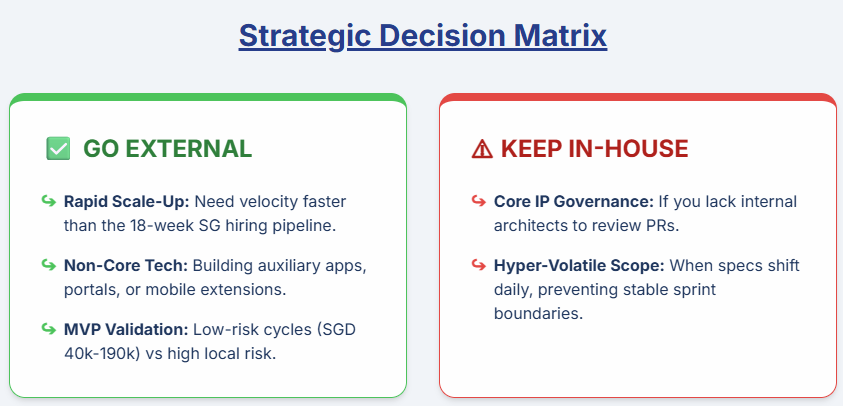
Go external when:
- You need to scale faster than Singapore’s hiring pipeline allows. Think: launching a new product line or responding to sudden user growth
- You’re building outside your core stack (mobile, integrations, back-office portals) and don’t want permanent headcount for auxiliary workstreams
- You’re validating an MVP before committing to a full team. Vinova’s rapid MVP cycles run 8–12 weeks and cost SGD 40,000–190,000, vs. the SGD 340,000+ risk of an unvalidated local build
- You’re modernising legacy systems. Dedicated external squads can own the migration lifecycle while your internal team keeps shipping features
Keep it in-house when:
- Your core IP lacks internal architectural oversight. Outsourced code diverges fast if no internal lead is reviewing PRs and enforcing quality gates
- Product specs are shifting weekly. Distributed teams need stable sprint boundaries; hyper-volatile direction creates communication lag that erodes any velocity gain
Software Development Outsourcing Models: Which One Fits?
The right model depends on your timeline, control requirements, and how long you need the team. Here’s the short version:
| Model | Best For | Control Level | Cost Structure |
| Dedicated Team | Long-term roadmap execution | High (shared delivery ownership) | Monthly retainer per engineer |
| Staff Augmentation | Short-term skill gaps | Maximum (managed by your leads) | Time & Materials |
| Fixed-Price | Well-scoped, low-complexity projects | Low (vendor owns execution) | Lump-sum milestone payments |
| Offshore Dev Centre (ODC) | Enterprise-scale, multi-year expansion | High (aligned with enterprise governance) | Cost-plus managed service fee |
For most Singapore-based companies with a live product and a growing roadmap, the Dedicated Development Team model is the right default. Vinova runs long-term dedicated squads of 20–30+ engineers for enterprise clients like Navig8 Asia and SBI Digital Markets, where the same team has maintained ownership over deep architectural platforms for 2–3+ years. That continuity is what separates a genuine outsourcing partner from a body shop.
What Software Development Outsourcing Actually Costs in 2026
The Singapore baseline
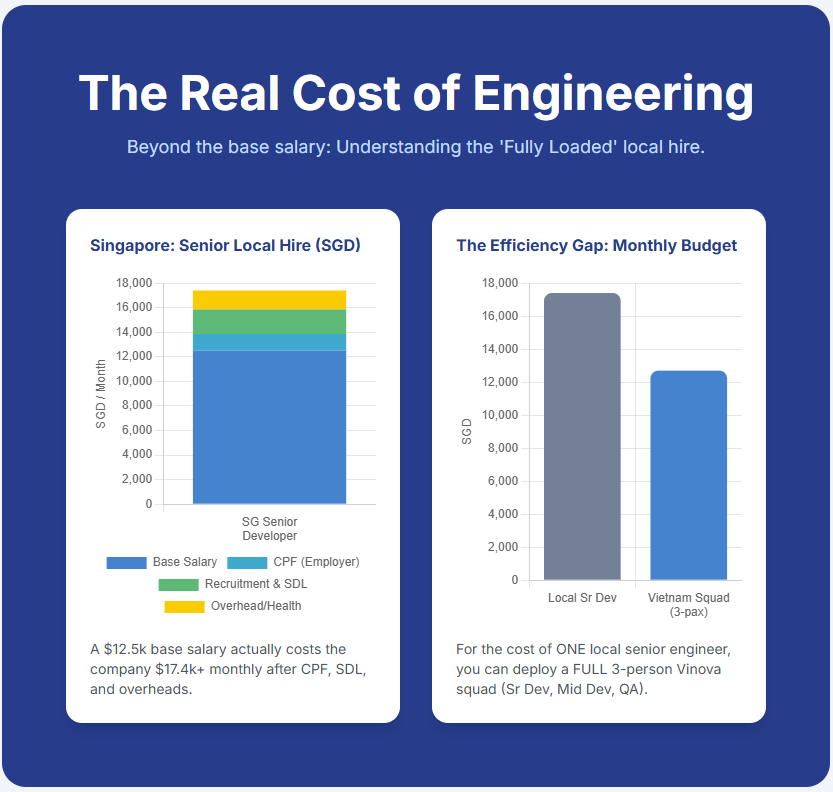
A mid-level Singapore engineer at SGD 7,500/month has a fully loaded cost of approximately SGD 11,286/month (≈ USD 8,400). A senior engineer at SGD 12,500/month costs closer to SGD 17,404/month (≈ USD 13,000), before you factor in recruitment fees (15–25% of annual base), hardware, and enterprise software licensing.
Vietnam outsourcing rates (via Vinova)
A dedicated team of one senior developer, one mid-level developer, and a part-time QA specialist through Vinova costs approximately USD 6,500–9,500/month (≈ SGD 8,700–12,700). That’s less than the loaded cost of a single senior local hire. Blended hourly rates run USD 26–37 depending on seniority.
Hidden costs to budget for
- Ramp-up alignment (weeks 1–4): expect sub-optimal output as the team learns your codebase. Build this into your timeline
- QA overhead: mandate that your vendor provides senior, self-governing QA specialists, or your internal tech leads absorb this cost
- Collaboration tooling: Jira, Confluence, Slack, Loom, MFA-protected repos. Budget for enterprise licences
- Knowledge transfer at contract end: allow 2–4 weeks of joint execution for documentation handover
Why Vietnam Is the Natural First Choice for Singapore Companies
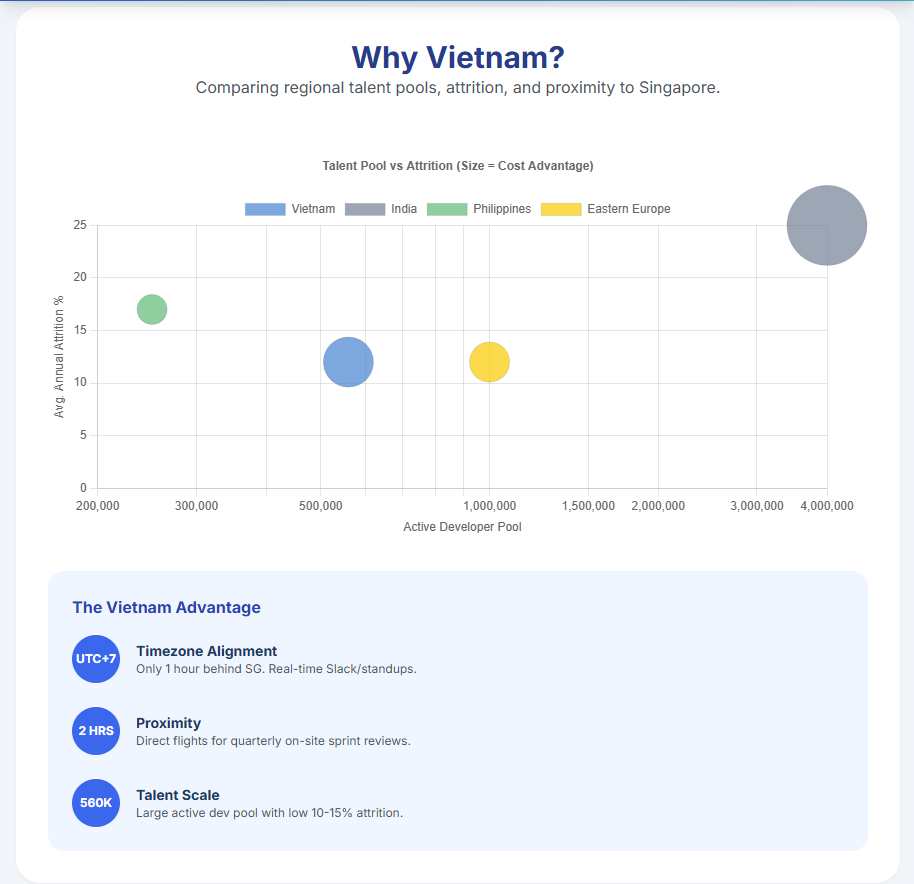
- Timezone: Vietnam runs UTC+7, exactly one hour behind Singapore. Daily standups, real-time Slack threads, and pair-programming sessions work without anyone staying late. Compare this to Eastern Europe at 6–7 hours behind, where your collaboration window shrinks to a 1–2 hour afternoon overlap.
- Proximity: Direct flights from Changi to Ho Chi Minh City, Hanoi, or Da Nang average two hours. Singapore passport holders enter visa-free for up to 30 days, so quarterly on-site sprint reviews are genuinely easy to run.
- Talent scale: Vietnam has 530,000–560,000 active software developers, with 50,000–60,000 IT graduates entering the market annually. Scaling from a team of 5 to 50 doesn’t trigger a local bidding war.
- Stability: Vietnam’s average developer attrition is 10–15%, vs. 20–30% in India. For dedicated team engagements, lower attrition means institutional knowledge stays in your codebase, not walking out the door.
How Vietnam compares to alternative outsourcing destinations:
| Destination | IT Talent Pool | Timezone vs SG | Cost Index | Avg. Annual Attrition |
| Vietnam | 530K – 560K | –1 hr (UTC+7) | Low | 10%–15% |
| India | ~4,000,000 | –2.5 hrs (UTC+5.5) | Low–Medium | 20%–30% |
| Philippines | ~250,000 | 0 hrs (UTC+8) | Low–Medium | 15%–20% |
| Eastern Europe | ~1,000,000 | –6 to –7 hrs | High (2–3× VN) | 10%–15% |
Vinova’s delivery model is purpose-built for the Singapore–Vietnam axis. With senior technical architects and product managers physically based in Singapore, we directly coordinate with elite engineering squads across Hanoi, Da Nang, and Ho Chi Minh City.
We maintain a unique competitive edge through exclusive pipelines into Vietnam’s premier technical universities. We don’t just hire; we curate top-tier talent trained in advanced architectural standards. This ensures our clients access a sophisticated, disciplined caliber of developer that is rare in the broader outsourcing market.
Risks to Manage and How to Actually Handle Them
PDPA Section 26 and cross-border data transfer
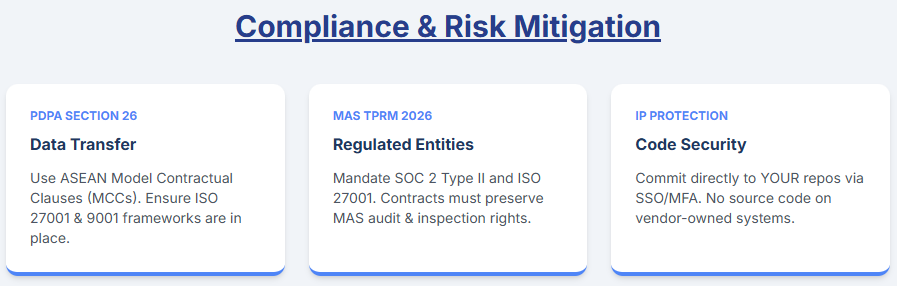
Under Singapore’s Personal Data Protection Act, Section 26 prohibits transferring personal data outside Singapore unless the recipient provides comparable protection. For software development outsourcing, this means executing a Data Protection Agreement (DPA) incorporating the ASEAN Model Contractual Clauses (MCCs), which mandate strict data security measures, breach notification obligations, and restrictions on onward transfers to unauthorised sub-processors. Vinova operates under ISO 27001 and ISO 9001 certified delivery frameworks, with documented DPO oversight aligned to PDPA standards.
MAS Third-Party Risk Management (for fintech and regulated entities)
Under the proposed MAS TPRM Guidelines (March 2026), financial institutions must manage risk across all third-party arrangements, not just material outsourcing. For software development vendors handling transactional components or customer data, MAS expects rigorous board-approved due diligence and vendor certifications: specifically SOC 2 Type II and ISO 27001. Contracts must also explicitly preserve MAS audit and inspection rights. Vinova holds both certifications and has delivered to MAS-regulated clients including OCBC Bank and Prudential.
IP protection and vendor lock-in
Mandate that all outsourced developers commit code directly to your cloud repositories (GitHub, GitLab, Bitbucket) with SSO and MFA enabled. No source code should reside on vendor-owned systems. Include contractual transition clauses and require the vendor to maintain a shadow bench: pre-trained developers who can step in mid-sprint if a primary developer departs, with zero ramp-up cost to you.
How to Choose the Right Software Development Outsourcing Partner

1. Demand Singapore or SEA reference clients
Ask for peer CTOs you can call, specifically at companies operating under Singapore’s regulatory environment. Generic Clutch reviews tell you nothing about PDPA compliance posture or MAS-regulated delivery experience.
2. Verify security certifications
ISO 27001 and SOC 2 Type II are non-negotiable for any vendor touching customer data. Confirm the certificates are active and independently audited, not self-declared.
3. Run a milestone-gated pilot before committing
Structure a 2–4 week pilot around a low-risk workstream: an API integration layer, an internal dashboard, or a specific legacy microservice. Evaluate code quality, PR discipline, and communication responsiveness before signing a multi-quarter contract. Vinova’s pilot engagement for the Intellectual Property Office of Singapore (IPOS), building a “Digital Workbench” tool, is a direct example of how scoped validation builds the foundation for longer-term enterprise partnership.
| Ready to Scale Your Engineering Team? Book a complimentary 2-hour consultation with Vinova’s engineering leads. We’ll assess your current bottlenecks, map an outsourcing model to your roadmap, and give you a clear cost comparison vs. hiring locally in Singapore. No commitment required. Schedule Your Free 2-Hour Consultation with Vinova |
FAQ
How does COMPASS change the outsourcing calculus for Singapore firms?
The COMPASS points-based system sets minimum EP salary floors at SGD 5,600/month (non-financial) to SGD 11,800/month (senior, financial services), with firm-level penalties for over-representing any single nationality. These thresholds rise again on January 1, 2027. Software development outsourcing bypasses these constraints entirely: you scale engineering capacity without triggering EP quotas or COMPASS scoring.
What’s the real cost difference between a Singapore senior engineer and a dedicated Vietnam team?
A senior Singapore engineer costs SGD 14,500–21,000+/month fully loaded. Through Vinova, a dedicated team of one senior developer, one mid-level developer, and a part-time QA specialist costs USD 6,500–9,500/month (≈ SGD 8,700–12,700). That’s less than the loaded cost of that single local hire.
What’s the difference between a dedicated development team and staff augmentation?
Staff augmentation plugs individual developers into your existing sprints. Your internal leads manage them daily and attrition risk sits entirely with you. A Dedicated Development Team transfers significant delivery responsibility to the vendor: they provide a self-governing squad with an internal PM or tech lead, maintain sprint velocity, and contractually manage personnel transitions. For Singapore companies without the internal management bandwidth to babysit external developers, the dedicated team model is lower operational drag.
How do we stay PDPA-compliant when our code and data crosses the border?
Execute a DPA incorporating the ASEAN Model Contractual Clauses before any data transfer. Ensure your vendor has a designated DPO, active ISO 27001 certification, and documented breach notification procedures. For MAS-regulated entities, also require SOC 2 Type II and confirm the vendor’s contracts preserve audit rights for both your team and MAS.
| Vinova: Singapore-headquartered. Vietnam-powered. ISO 27001 & ISO 9001 certified.300+ in-house engineers across Hanoi, Da Nang, and Ho Chi Minh City. 300+ projects delivered. Trusted by Samsung, OCBC Bank, Prudential, GovTech, and Singapore Power Group. → Schedule a 2-hour consultation |