By the Enterprise Architecture & Blockchain Engineering Practice at Vinova
Reviewed by Lead Solutions Architect, Vinova Singapore
Discovering an unhandled edge case or boundary defect in enterprise software at 2:00 AM is an operational nightmare. In conventional cloud infrastructure, the remediation playbook is straightforward: the on-call engineering team isolates the microservice, rolls back the latest container image, hotfixes the database snapshot, and redeploys the pipeline before the morning markets open.
On a distributed ledger, that safety net does not exist.
Smart contracts execute deterministically, irreversibly, and without administrative mercy. There is no database rollback, no customer support override, and no post-facto executive discretion. When business logic executes on-chain, an arithmetic truncation, an unchecked external call, or a misinterpreted oracle payload does not merely trigger an alert in Datadog—it irrevocably moves capital, locks multi-party escrow balances, or creates an immediate statutory compliance violation.
As Singapore transitions decisively away from speculative crypto tokens toward sovereign, institutional programmable rails—spearheaded by the Monetary Authority of Singapore (MAS) through initiatives like Project Orchid’s Purpose-Bound Money (PBM) Technical Framework and Project Guardian for Institutional Asset Tokenisation—programmable logic is becoming critical core infrastructure.
For Chief Information Officers, Enterprise Architects, and Technology Steering Committees, evaluating distributed state machines requires stripping away industry hype. Smart contracts can never be treated as speculative experimental scripts; they demand the same defensive engineering, mathematical verification, and formal audit rigor applied to statutory registries and Tier-1 core banking systems.
Table of Contents
Key Takeaways:
- The 3-Party Qualification Rule: Keep your database if two or fewer parties coordinate. On-chain logic is only justified when three or more commercial rivals must share state without a trusted intermediary.
- Storage Audits Over Multi-Sigs: Multi-sig sign-offs cannot detect proxy storage collisions. Automate storage-layout checks in CI/CD to prevent logic upgrades from silently overwriting asset balances.
- Sliding Windows for IoT Telemetry: Never trigger demurrage or title handoffs on single oracle pings. Buffer physical sensor jitter with sliding challenge windows across multiple corroborated checkpoints.
- Pull Over Push for Disbursements: Never loop through payee arrays in a single transaction. Update internal claimable balances and let counterparties withdraw individually to prevent gas-limit DoS lockups.
1. The Enterprise Decision Gate: When to Deploy Smart Contracts vs. Enterprise Databases
Before allocating capital to distributed ledger initiatives, enterprise leadership must confront an uncomfortable architectural reality: most business workflows do not need a blockchain.
Often, the real bottleneck is siloed systems that were never properly connected in the first place, a problem worth ruling out through conventional integration before reaching for a distributed ledger.
In traditional enterprise architectures, business logic executes within centralized boundaries: an ERP queries a private API, triggers a localized cron job, updates an ACID-compliant SQL database (e.g., PostgreSQL or Oracle), and emits webhooks to counterparties. This architecture remains the undisputed gold standard for high-throughput, single-tenant internal processing.
However, centralized architectures break down when transactions must bridge legal entities where no single party is permitted—or commercially trusted—to hold master database root credentials.
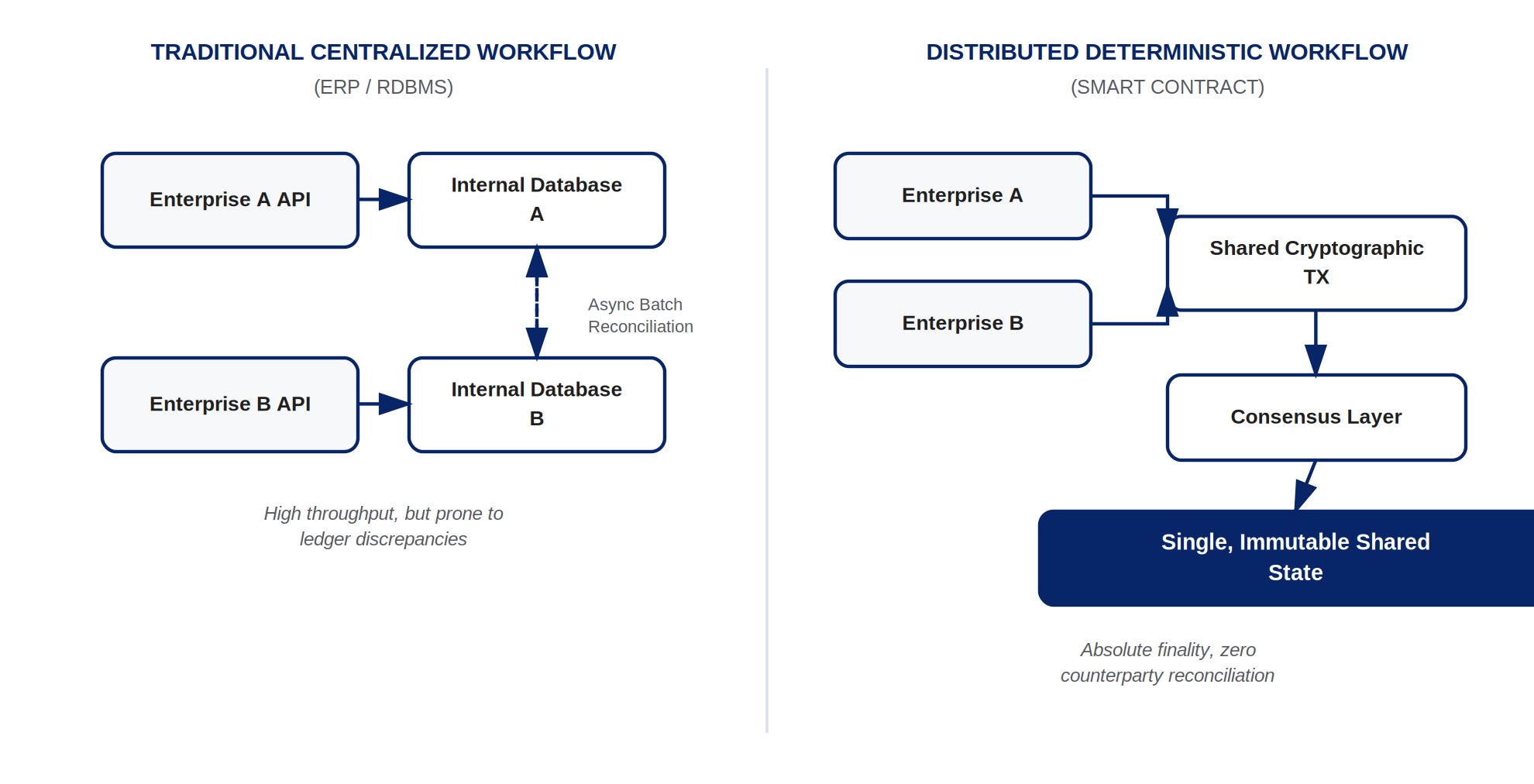
The 3-Part Evaluation Matrix
To prevent costly over-engineering and ensure technology budgets deliver defensible ROI, Vinova advises enterprise steering committees to evaluate candidate workflows against a strict three-part decision gate before writing a single line of smart contract code:
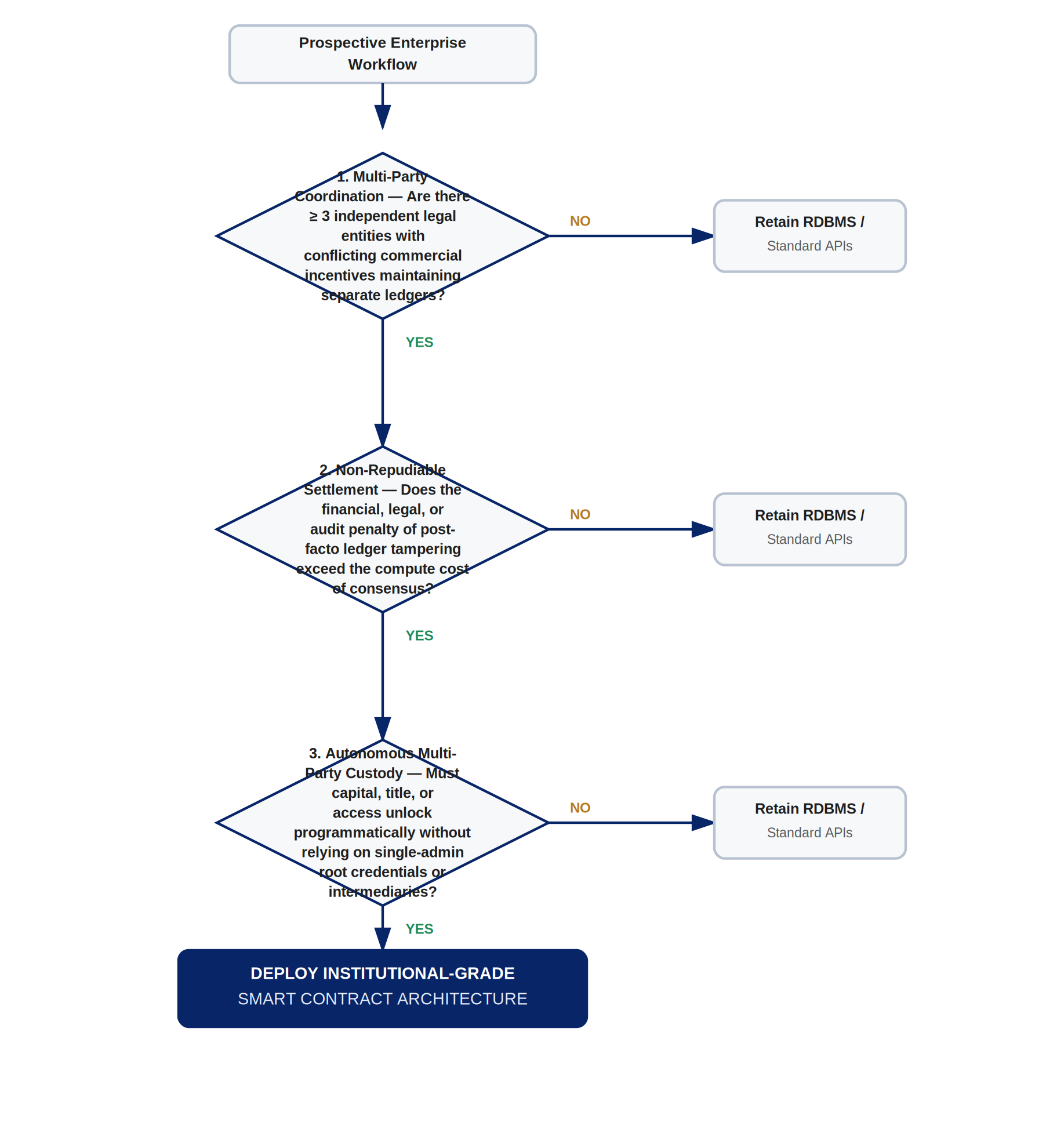
Multi-Party State Reconciliation: If state transitions occur purely within internal divisions or bilateral commercial relationships with high mutual trust, relational databases paired with mutual TLS APIs deliver superior throughput at a fraction of the operational cost. A smart contract is justified only when three or more distinct legal entities must coordinate on a single state without ceding operational hegemony to a centralized intermediary.
Non-Repudiable Settlement & Statutory Finality: In sectors subject to stringent regulatory oversight—such as maritime shipping registries, cross-border customs declarations, or statutory credentials—post-facto database manipulation carries severe regulatory, legal, and financial penalties. Smart contracts offer mathematical immutability: state transitions are cryptographically sealed, creating an unimpeachable audit trail that satisfies statutory inspection without manual reconciliation.
Autonomous Execution Without Single-Point Administrative Risk: When financial escrow, contractual milestone releases, or dynamic asset transfers must occur automatically upon the verification of external criteria, traditional setups depend on human administrative sign-offs. Smart contracts replace administrative discretion with deterministic code, eliminating counterparty default risk and operational latency.
2. The Architectural Reality: Immutability, Composability, and Real-World Bridges
Deploying logic onto a distributed ledger introduces operational trade-offs fundamentally distinct from conventional enterprise cloud engineering.
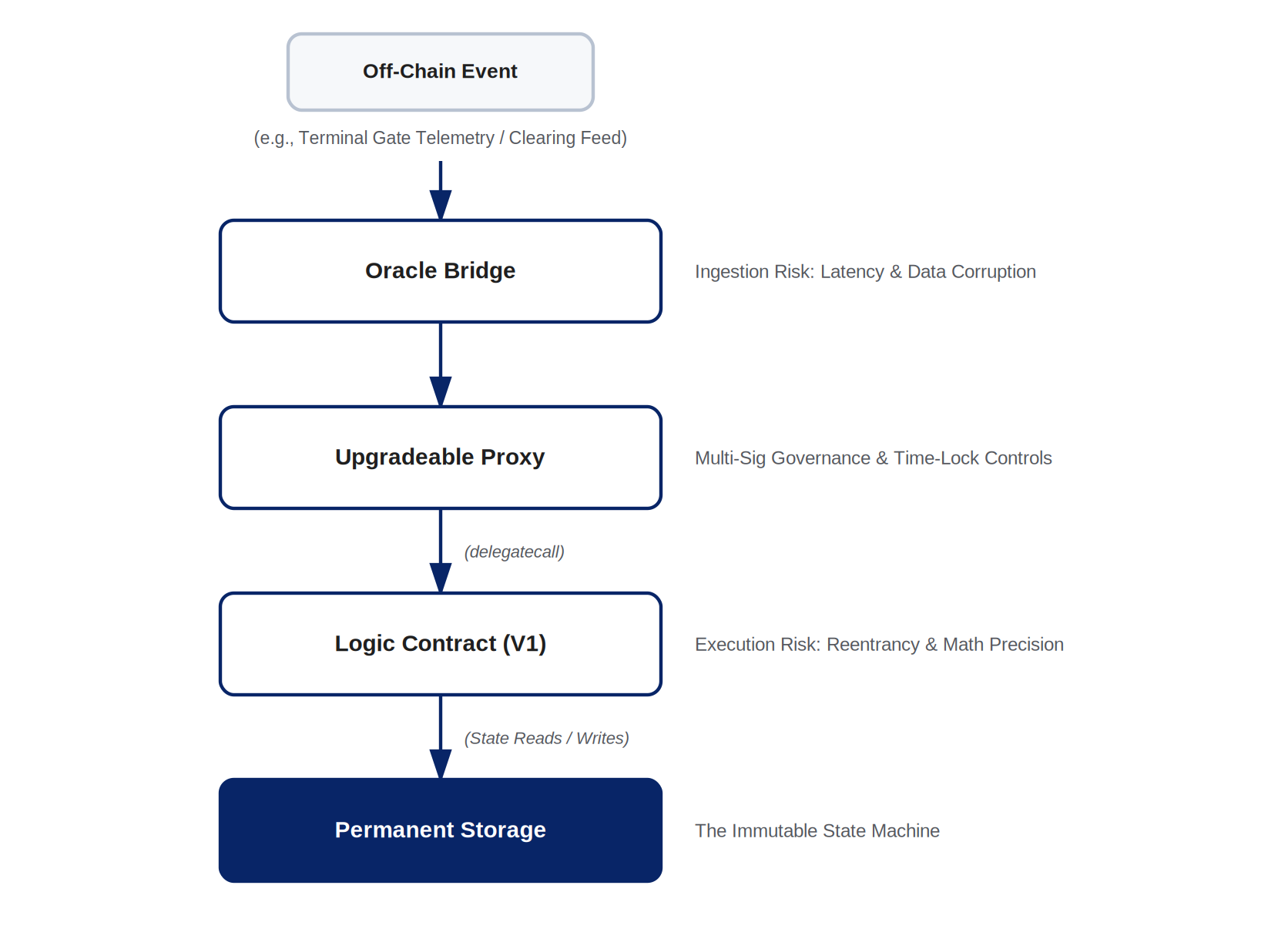
1. The Execution Lifecycle and Settlement Finality
Unlike web microservices that manage asynchronous jobs via message brokers and retry queues, smart contract transactions follow strict atomic execution constraints:
- The transaction is signed via an enterprise key management module or Multi-Party Computation (MPC) vault.
- It enters the network mempool and is verified by consensus nodes according to predefined gas allocation parameters and deterministic validation rules.
- The virtual machine processes the compiled bytecode, updates global storage variables, and emits structured event logs for external downstream indexers and enterprise ERP connectors.
- Once included in a finalized block, the state transition is irreversible: it cannot be deleted, altered, or silenced by administrative override.
2. The “Immutable Bug” Liability
In SaaS development, an operational defect triggers an emergency hotfix pushed directly to a container cluster. On a distributed ledger, immutability cuts both ways. If a boundary-condition error, arithmetic truncation bug, or access-control loophole is committed to a live network, it remains permanently active.
For Singapore enterprises operating under stringent statutory guidelines and data protection mandates (such as the Personal Data Protection Act – PDPA), an immutable defect cannot simply be remediated by rolling back a database snapshot. Remediation requires pre-planned, defensively architected upgrade paths.
3. Composability vs. Systemic Contagion
Smart contracts can interface with external contracts as modular building blocks. While composability enables rapid integration with regional payment rails, tokenized asset registries, and liquidity protocols, it introduces systemic risk. An authorization loophole or economic exploit in an upstream third-party registry or decentralized protocol can propagate directly into an enterprise’s proprietary logic if trust boundaries are not rigorously isolated.
4. The Oracle Dilemma: Bridging Real-World Telemetry
Blockchains operate as cryptographically closed computation engines. They cannot natively initiate outbound network requests to query off-chain databases, statutory registries, or maritime logistics feeds.
To react to off-chain occurrences—such as vessel docking verification at the Port of Singapore, cold-chain sensor alerts, or interbank clearing messages—smart contracts depend on Oracles. The security perimeter of any smart contract system is strictly bounded by the integrity of its oracle architecture: an otherwise mathematically sound contract will trigger erroneous or fraudulent payouts if fed manipulated, delayed, or spoofed external data.
For the fundamentals underpinning all of this — how smart contracts actually work, the engineering lifecycle, and supported chains — see our comprehensive smart contract development guide.
3. Selecting an Implementation Partner: The Singapore Enterprise Evaluation Checklist
Enterprise procurement leads, government innovation officers, and corporate architects operate under stringent vendor qualification, tender governance, and technology risk frameworks. Evaluating a blockchain engineering partner requires looking beyond generic development agency credentials.
Before committing capital to a distributed architecture partner, enterprise evaluation committees should verify four core engineering competencies:
| Evaluation Criterion | Core Technical Requirement |
|---|---|
| 1. Upgradeability Without Amnesia | Implementation of standardized proxy patterns (EIP-1822 UUPS / Transparent Proxy). Complete decoupling of application state from logic. Verified absence of storage slot collision risks. |
| 2. Institutional Security Governance | Operational alignment with ISO/IEC 27001 ISMS. Segregated development workspaces and secure vaults. Strict NDAs, role-based code repositories, and audit-ready documentation packages. |
| 3. Domain-Specific Threat Modeling | Threat modeling tailored to real-world friction (oracle latency, telemetry spoofing, MEV). Formal invariant and property-based fuzz testing. Rejection of generic superficial automated linters. |
| 4. Multi-Sig & Time-Lock Administration | M-of-N executive sign-off schemes for privileged administrative and upgrade functions. Unskippable on-chain time-locks providing audit cooling-off periods before logic execution. |
This checklist covers the technical competencies to verify. For the broader hiring framework — in-house vs. freelance vs. offshore hybrid, cost benchmarks, and interview questions — see our complete guide to hiring blockchain developers.
4. Vinova’s Delivery Model: Institutional Governance Meets Resilient Architecture
Headquartered in Singapore with a 16+ year engineering pedigree serving statutory authorities, government-linked entities, and regional conglomerates, Vinova bridges institutional compliance standards with high-velocity software delivery. Our delivery model is grounded in ISO/IEC 27001 Information Security Management Systems (ISMS), ensuring strict workspace isolation, network segregation, and enterprise-grade intellectual property safeguards.
Platform-Agnostic Capability
Enterprise requirements dictate architectural selection, never the reverse. Vinova builds and audits smart contracts across the blockchain ecosystem—from battle-tested EVM environments (Solidity/Vyper) to memory-safe, ultra-low-latency networks (Rust) and permissioned private consortia (Hyperledger Fabric).
(For a comprehensive analysis of our language frameworks, development environments, and toolchains, explore our technical guide on the Top Blockchain Development Tools and Frameworks Used by Vinova).
Solving the “Immutable Bug” Through Defensive Architecture
To ensure enterprise workflows remain maintainable without sacrificing the trust guarantees of distributed ledgers, Vinova applies hardened architectural design patterns:
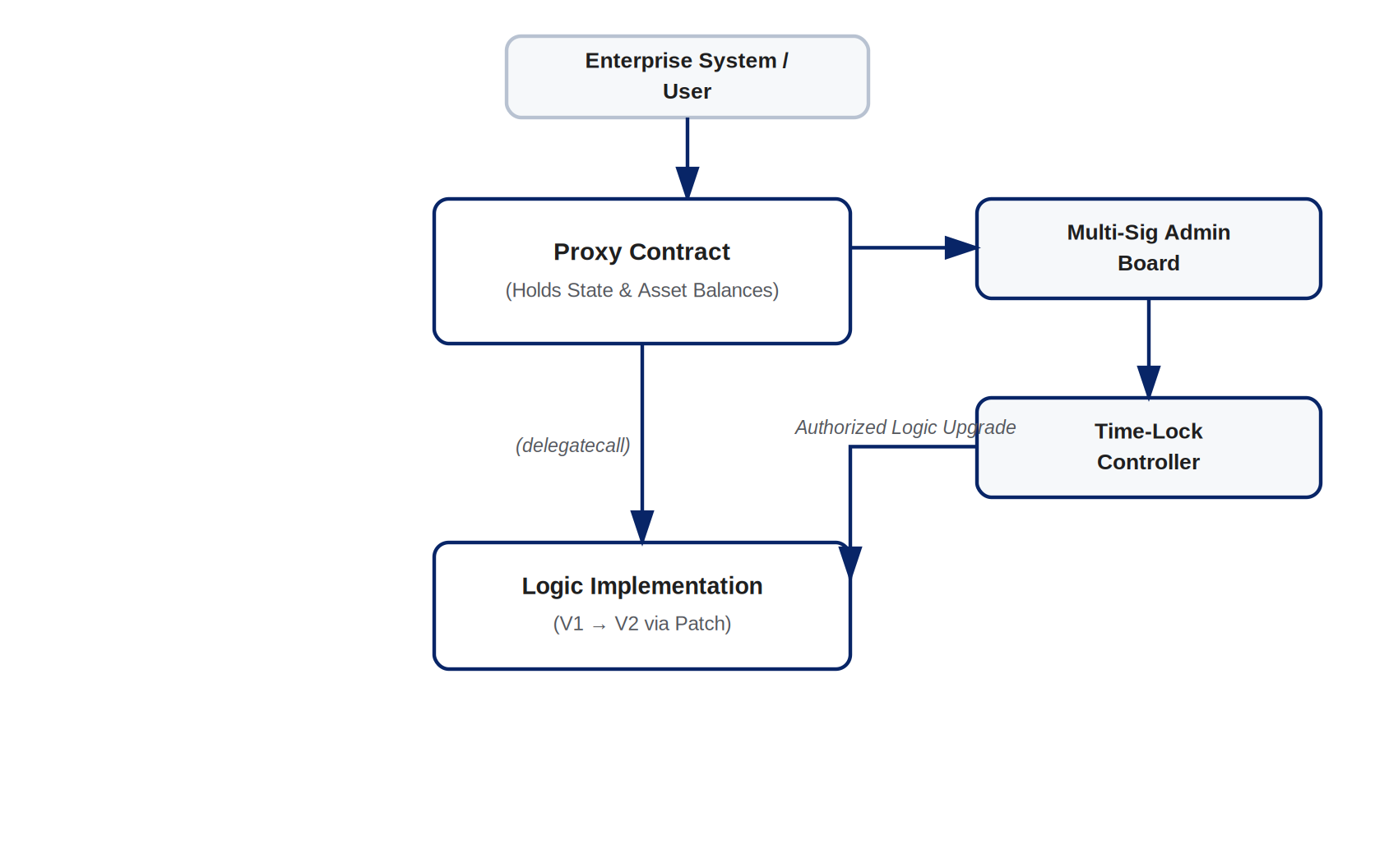
Standardized Upgradeable Proxies: We implement EIP-1822 Universal Upgradeable Proxy Standards (UUPS) and Transparent Proxy patterns. By isolating operational state (storage variables and ledger balances) inside the proxy contract and executing business rules via dynamic delegatecall routines into logic contracts, business rules can be updated via cryptographic transactions without state migration or data loss.
Institutional Governance & Time-Locks: Privileged administrative hooks are never assigned to individual operator keys. Critical system functions are governed by multi-signature vaults requiring M-of-N executive sign-offs and enforced by cryptographic Time-Locks, ensuring that any proposed logic modification undergoes a mandatory, unskippable review window.
Dynamic Circuit Breakers: Contracts are constructed with granular emergency controls (pause() and unpause()), allowing authorized controllers or automated anomaly-detection sentinels to immediately freeze state transitions if unexpected volume patterns or oracle deviations breach established safety parameters.
Need This Architecture Built for Your Enterprise?
Vinova designs, builds, and audits institutional-grade smart contracts for Singapore enterprises — the same ISO 27001-certified security practice, upgrade-safe architecture, and platform-agnostic engineering covered in this piece, applied to your project.
5. High-Impact Enterprise Use Cases in Singapore’s Key Sectors
By anchoring smart contract logic in the operational realities of Singapore’s economy, distributed automation resolves long-standing multi-party coordination bottlenecks.
1. Maritime Trade & Port Logistics: Eliminating Demurrage and Title Friction
As one of the world’s busiest transshipment hubs, Singapore’s maritime and supply chain ecosystem coordinates dozens of independent commercial entities—ocean carriers, freight forwarders, terminal operators, customs agencies, and trade financiers.
The Operational Bleeding Point: Paper or semi-digital Bills of Lading (BL) require manual title transfer, causing administrative latency, title forgery risks, and costly demurrage penalties when cargo sits at terminal berths awaiting documentation release.
The Smart Contract Architecture: Electronic Bills of Lading (eBL) are deployed as cryptographic dynamic assets linked to trade participants. Contract logic synchronizes title transitions directly against customs clearances and verified terminal gate-in events. Demurrage fees are computed and settled deterministically based on tamper-proof physical telemetry, removing multi-party dispute cycles.
The Production Edge Case (The Telemetry Ingestion Gap): In real-world port operations, vessel Automatic Identification System (AIS) feeds and container terminal RFID gates experience network jitter, propagation delays, or temporary sensor dropouts. Naive smart contracts that assume instant oracle feeds risk executing premature demurrage penalties or rejecting valid cargo releases during micro-outages. Hardened delivery introduces dynamic sliding challenge windows—state-machine grace periods that require corroborating sensor attestations across multiple independent checkpoints before financial penalties become irrevocable.
For the IoT integration architecture behind this — sensor networks, real-world deployment results, and broader supply chain applications beyond maritime — see Blockchain in Supply Chain.
2. Institutional Banking & Trade Finance: Zero-Counterparty Milestone Escrow
Singapore’s financial sector is establishing the global benchmark for asset tokenization and institutional settlement rails.
The Operational Bleeding Point: Traditional corporate escrow relies on manual administrative intervention, prolonged legal reconciliations, and high intermediary costs. In multi-stage infrastructure financing or trade tranches, capital remains locked unnecessarily while counterparties verify paper completions.
The Smart Contract Architecture: Capital reserves are secured within programmatic escrow contracts aligned with MAS Project Guardian standards. Tranche releases execute automatically upon the cryptographic presentation of multi-party milestone attestations. If contractual prerequisites fail or formal dispute windows lapse, deterministic refund logic executes automatically, eliminating counterparty default exposure.
The Production Edge Case (Upgrade Context Preservation): Escrow protocols securing multi-million-dollar tranches frequently require feature additions or regulatory logic updates over a multi-year lifecycle. In proxy architectures, unvetted storage layouts in updated implementation contracts can cause silent storage-slot collisions, accidentally overwriting beneficiary addresses or allocated balance variables. Production-grade delivery enforces automated storage-layout verification in CI/CD pipelines, mathematically guaranteeing that new contract iterations preserve historical storage slot alignments before multi-sig signers execute upgrade transactions.
3. Regulated & Parametric Insurance: Instant Non-Discretionary Claims
Traditional corporate underwriting and commercial claims processing require weeks of manual loss adjustment, paper documentation, and administrative verification.
The Operational Bleeding Point: Insured enterprises face balance-sheet and cash-flow drag awaiting claim investigations, while insurers incur significant overhead investigating fraudulent or disputed incident claims.
The Smart Contract Architecture: Commercial policies are written as deterministic parametric smart contracts connected directly to authorized, independent oracle data feeds (e.g., port vessel logs, flight status repositories, or regional weather telemetry). If a verified operational disruption crosses predefined contract boundaries (e.g., vessel berth delay > 48 hours), claims disburse directly to policyholders without manual dispute adjustment.
The Production Edge Case (The Loop-Execution Bottleneck): When a parametric event triggers payouts across hundreds of corporate policyholders simultaneously, naive implementations attempt to iterate through dynamic arrays of beneficiary addresses in a single transaction. This introduces two fatal landmines: transaction gas limits will revert the entire batch if the array grows too large, and a single malicious or malfunctioning recipient contract that reverts upon receiving funds will lock up the entire settlement pipeline. Resilient architecture mandates Pull-over-Push distribution patterns: the parametric trigger updates internal claimable state balances, and policyholders execute isolated individual withdrawals, shielding the broader protocol from third-party execution failures.
6. Threat Modeling & Verification Standards: Why Linters Fail in Production
Standard automated linters and static analysis scanners are necessary baseline hygiene, but they flag only syntax errors, standard compiler bugs, and textbook reentrancy flaws. Enterprise state machines rarely fail from basic syntax mistakes.
They fail when complex, multi-party business logic breaks under mempool congestion, unexpected transaction ordering, or asynchronous state transitions.
When evaluating audit rigor, enterprise architects must demand more than passive automated scans. Hardened institutional delivery requires formal invariant testing and threat modeling tailored directly to the operational workflows of the target industry.
The same discipline applies outside smart contracts too. For a breakdown of how these two testing approaches differ and when each one is warranted, see our infrastructure security comparison.
| Target Workflow | Primary Threat Vectors Defended |
|---|---|
| Maritime Logistics & Port Telematics | Oracle Ingestion Spoofing & Telemetry Latency Gaps; eBL State Inversion & Concurrency Double-Spend; Out-of-Order Terminal Custody Transfers |
| Institutional Escrow & Trade Tranches | Role-Based Privilege Escalation & Context Confusion; Mempool Front-Running & Transaction Sequencing Abuse; Balance Truncation & Rounding-Error Siphoning |
| Parametric Corporate Claims Automation | Microsecond Boundary Condition Exploits (T ± 1); Stale / Malicious External Oracle Feed Injections; Gas-Limit Denial of Service (DoS) Loop Freezes |
1. Hardening Maritime Trade & Logistics Contracts
Multi-Source Consensus Oracles: To protect against falsified terminal telemetry or spoofed AIS transponder data designed to trigger early cargo releases, the contract architecture demands threshold attestations across multiple independent sources (e.g., terminal operator telemetry, vessel transponder feeds, and digital customs sign-offs) before transitioning container custody states.
Preventing State Inversion & Race Conditions: Custody handoff logic undergoes formal state-machine modeling to ensure an electronic title cannot be assigned, transferred, or liquidated concurrently across overlapping asynchronous transaction calls.
2. Hardening Institutional Financial Escrow
Access-Control & Storage Context Audits: Corporate escrow suites utilize granular role hierarchies (PAYER, BENEFICIARY, REGULATORY_AUDITOR, DISPUTE_ARBITRATOR). Through static analysis and manual line-by-line inspection, contracts are hardened to ensure role variables cannot be overwritten via uninitialized storage pointers or unverified delegatecall entrypoints.
Arithmetic Precision & Rounding Protections: In large-scale capital disbursements, small rounding discrepancies in fee splits or interest accruals can accumulate or be siphoned by malicious actors. Logic modules are engineered using fixed-point arithmetic libraries and tested against precision truncation across high-volume fractional calculations.
3. Hardening Parametric Insurance Logic
Invariant & Boundary Fuzz Testing: Parametric payouts trigger on discrete numeric thresholds (e.g., wind speed ≥ k, delay time > t). Attackers frequently target edge conditions where minor boundary discrepancies (T ± 1) trigger unwarranted liquidations. We apply invariant testing frameworks to simulate millions of randomized operational scenarios, mathematically proving that payout logic triggers only under intended parametric conditions.
Denial of Service (DoS) Prevention via Pull-over-Push Patterns: As detailed in our production edge cases, isolated withdrawal functions insulate the protocol from individual counterparty contract failures, guaranteeing that one entity’s gas constraints or fallback errors cannot halt systemic liquidity.
7. The Enterprise S-SDLC: From Inception to Production Telemetry
To ensure enterprise consortia, statutory boards, and financial institutions achieve compliance and audit readiness, Vinova embeds smart contract verification into an established Secure Software Development Life Cycle (S-SDLC):
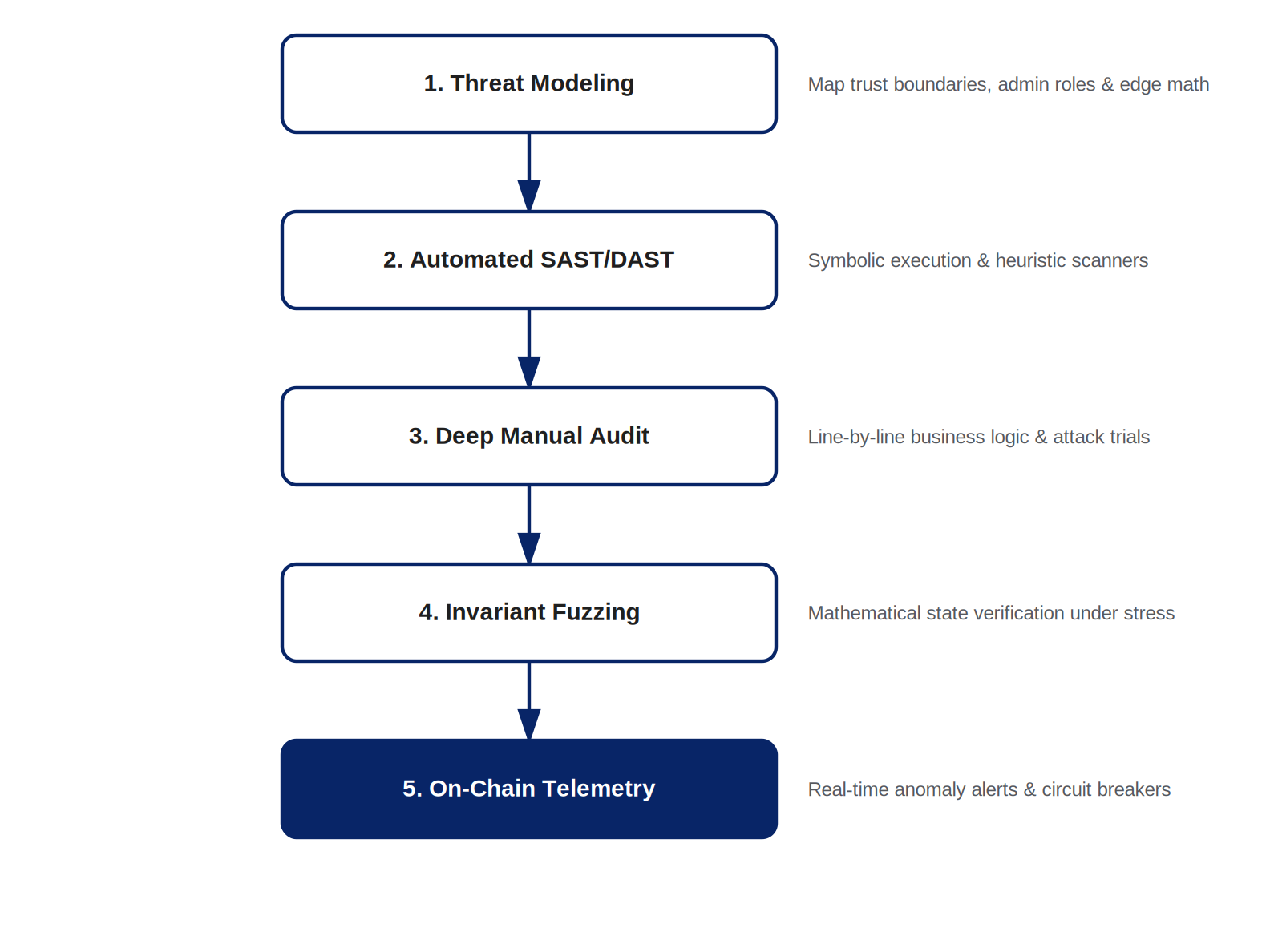
Architectural Threat Modeling: Formulating complete state-machine specifications, administrative privilege hierarchies, and external oracle dependencies prior to bytecode compilation.
Automated Static & Dynamic Analysis: Utilizing symbolic execution frameworks and static analysis tooling (e.g., Slither, Mythril) to identify known compiler vulnerabilities, gas inefficiencies, and standard attack patterns.
Manual Code Review: Experienced senior blockchain architects conduct line-by-line manual code audits focused on high-level business logic, edge-case math, and unexpected cross-contract interaction patterns.
Invariant & Property-Based Fuzzing: Running millions of automated computational test sequences to mathematically verify that protocol invariants (such as continuous contract solvency and strict access boundaries) hold true across all possible execution paths.
Real-Time On-Chain Monitoring: Configuring continuous monitoring sentinels post-deployment to track unusual transaction volume spikes, flag anomalous state updates, and alert multi-signature guardians in real time.
8. Automate Securely with Vinova
Smart contracts represent a structural evolution in how multi-party agreements, commercial operations, and institutional settlements are executed across Singapore’s digital economy. However, replacing administrative discretion with deterministic, immutable code requires an engineering methodology founded on accountability, security-by-design, and zero tolerance for logic vulnerabilities.
Vinova brings over 16 years of proven enterprise software delivery in Singapore, an ISO 27001-certified governance infrastructure, and deep technical proficiency across enterprise blockchain ecosystems. Whether your organization is evaluating distributed ledger feasibility, designing a multi-party trade settlement rail, or requiring a formal security audit of production contracts, we engineer the resilient foundations your business demands.
Before you sign with any partner, it’s also worth knowing the regulatory and procurement pitfalls specific to Singapore — MAS licensing myths, IP ownership defaults, GST treatment. See our guide to these hiring traps.
Advance Your Distributed Architecture
Evaluating your workflow’s technical feasibility? Request our Enterprise Smart Contract Threat-Modeling & Architecture Worksheet to benchmark your system readiness against industry standards.
Ready to design or audit your production contracts? Schedule an Architectural Scoping Session with Vinova’s Singapore Engineering Practice.
About the Authors
Enterprise Architecture & Blockchain Practice, Vinova Singapore
Vinova is a Financial Times Top 500 High-Growth Company (Asia-Pacific, 2026) and a Straits Times Fastest-Growing Company (2024, 2025, 2026), headquartered in Singapore and operating under verified ISO/IEC 27001 Information Security Management Systems. Backed by a 16+ year track record collaborating with Singapore statutory boards, government-linked entities, and multinational enterprises, Vinova’s blockchain engineering practice designs, hardens, and audits mission-critical distributed state machines, smart contract suites, and regulatory-aligned digital infrastructure across the Asia-Pacific region.
Vinova: Singapore’s blockchain and enterprise engineering partner since 2010. ISO 27001:2022 and ISO 9001:2015 certified.
300+ in-house engineers across Singapore, Hanoi, Da Nang, and Ho Chi Minh City — including the architects behind the upgrade-safe proxy patterns, multi-oracle consensus designs, and S-SDLC audit pipeline covered in this piece.
Financial Times Top 500 High-Growth Companies Asia-Pacific 2026. The Straits Times Singapore’s Fastest-Growing Companies 2024, 2025, and 2026.
Schedule an Architectural Scoping Session with Vinova’s Singapore Team →