How much is your AI actually costing you? This month, V-Techtips will examine AI inference costs, more specifically cloud AI cost management, and examine how it is inflating your AI bills this month.
While unit prices dropped up to 900x this year, total enterprise spending is still climbing in 2026. High usage volumes often lead to monthly cloud bills in the millions. Effective Cloud AI cost management is crucial as this “Inference Economics Reckoning” is driven by physical power limits and cooling needs in standard data centers. Many leaders are now moving steady workloads to specialized on-premises hardware to control these expenses.
This hybrid model combines local stability with cloud flexibility. Have you evaluated if your cloud costs are currently outperforming your results?
Table of Contents
Key Takeaways:
- Inference has replaced training as the main expense, now accounting for 80% to 90% of an AI model’s total lifetime cost.
- Agentic AI workflows are rapidly depleting budgets, using 10 to 100 times more tokens than simple chatbots for complex tasks.
- Adopting a hybrid cloud model can reduce compute expenses by 45% to 50% by moving stable, high-volume workloads to owned on-premises hardware.
- Strategic hardware choices are key: one major company cut monthly cloud bills by 65% by switching from GPUs to Google TPUs.
How Did AI’s Main Cost Shift From Training To Inference?
In the early stages of generative AI, businesses focused on training costs. Training a model like GPT-4 required $100 million in compute resources. Today, the economic reality has flipped. The main expense is now inference. This is the process of running data through a model to get an answer.
Inference accounts for 80% to 90% of an AI model’s lifetime cost. Training happens once. Inference is a constant operating expense. It scales with every user and every query. Serving a major model to a global audience costs approximately $700,000 per day. This translates to more than $250 million every year.
The Token Cost Paradox
The cost of a single token is falling. Analysts predict that inference costs for large models will drop by 90% by 2030. Better chips and smarter model designs make this possible. However, total enterprise spending is rising.
This is the Token Cost Paradox. When a technology becomes more efficient, people use it more. This is known as Jevons Paradox. As AI tokens become cheaper, businesses launch more AI projects. This increases the total amount of data processed.
The Cost of Agentic AI
Modern AI uses more tokens than early chatbots. New “Agentic AI” performs multi-step tasks and solves complex problems. This requires much more compute power.
| Metric | Simple Chatbot | Agentic AI Workflow |
| Token Use | ~500 Tokens | 5,000 – 50,000 Tokens |
| Compute Pattern | Single request | Multi-step loops |
| Cost Impact | Low cost per user | Rapid budget depletion |
An agentic workflow uses 10 to 100 times more tokens than a simple chat. This shift moves AI from occasional use to a steady, heavy workload underscoring the challenge of cloud AI cost management.
Real-World Budget Impact
AI breaks the traditional software business model. Standard software costs very little for each additional user. AI requires expensive compute resources for every single output.
Companies moving from testing to production see massive price jumps. A monthly cloud bill can grow from $200 during development to $10,000 in production. Large enterprises now face monthly AI charges that challenge their entire infrastructure budgets. In many cases, actual AI bills exceed original forecasts by 10 times making proactive Cloud AI cost management an immediate necessity. Single AI initiatives now approach $250 million in annual serving costs.
Why Are Cloud AI Costs Still Surging Despite Falling Token Prices?
Cloud AI costs are rising as projects move from testing to full production. Public clouds provide speed, but that flexibility comes at a premium price. These costs are now a significant financial burden for many companies. Addressing these growing expenses requires diligent cloud AI cost management.
The Agentic Multiplier
The total number of tokens processed drives the cost of AI. Artificial intelligence now powers search, customer support, and coding tools. This increases the number of inference calls. Agentic AI further increases the expense. These systems use “reasoning loops” to generate tokens for internal thoughts and self-corrections, not just the final answer. By 2026, inference will account for 70% to 80% of all AI compute cycles.
Hidden Fees and Memory Limits
Cloud bills contain several hidden costs. AI inference relies heavily on memory speed. Companies pay for expensive GPUs that often sit idle while waiting for data to move. This leads to low efficiency.
Other infrastructure fees increase the total bill:
- Data Egress: Moving data between regions costs $0.09 per GB.
- Storage: Fast storage for models costs $0.10 per GB every month.
- Overprovisioning: Many organizations only use 15% to 30% of their rented GPU power.
High-frequency calls also create extra network and gateway fees. Ignoring these hidden costs prevents effective cloud AI cost management. These costs add hundreds of thousands of dollars to annual budgets.
GPU Rental Costs
Renting high-end GPUs is expensive. A single unit costs between $2 and $10 per hour. In contrast, purchasing an H100 GPU costs between $25,000 and $40,000. For systems that run 24/7, renting becomes more expensive than buying in less than one year. Supply shortages also force businesses into long, rigid contracts. These agreements prevent companies from switching to newer, more efficient hardware as it becomes available.
What Physical Limits Are Slowing AI Expansion And Raising Costs?
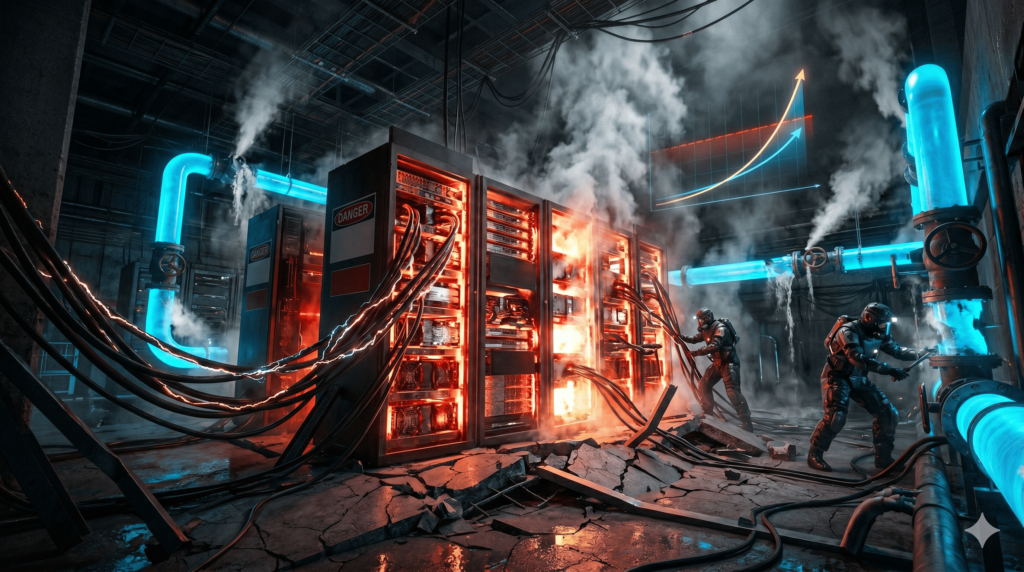
AI expansion faces physical barriers in power and cooling. These limits stall new projects and change how companies build infrastructure. Understanding these limits is critical for comprehensive cloud AI cost management.
The Power Demand
Older server racks drew 5 to 10 kilowatts of power. Modern AI racks draw over 100 kilowatts. This massive increase strains local power grids. By 2028, data centers will consume 12% of all electricity in the US.
Because grids are overtaxed, power availability now dictates where companies build data centers. Major tech firms report delays because the grid cannot support their expansion. To manage this, some organizations move non-critical tasks to different time zones. This “carbon-aware” scheduling balances the energy load across the grid.
Cooling and Weight Challenges
Standard air cooling cannot handle the heat from AI accelerators. Companies are switching to liquid cooling systems. These systems use water or special fluids to remove heat. Adding liquid cooling to existing buildings is expensive.
New hardware is also much heavier. An AI rack can weigh 7,000 pounds, while traditional racks weigh about 2,000 pounds. Standard data center floors require structural reinforcement to hold this weight.
| Component | Traditional Standard | AI-Optimized Standard |
| Power per Rack | 5 – 10 kW | 100+ kW |
| Cooling Method | Air | Direct Liquid or Immersion |
| Network Speed | 10 – 40 Gbps | 400 – 800 Gbps |
| Rack Weight | 1,500 – 2,000 lbs | 7,000 lbs |
How Can A Strategic Hybrid Cloud Model Control Long-term AI Expenses?
Businesses are adopting a Strategic Hybrid Cloud model which is a core strategy for cloud AI cost management. This architecture moves away from using the public cloud for every task. Instead, you divide work between private hardware and cloud services based on the size and predictability of the workload.
Moving Stable Work On-Premises
Stable, high-volume AI tasks are cheaper to run on your own hardware. When a workload runs consistently 24 hours a day, cloud markups become a financial burden. Owning your hardware can reduce compute costs by 45% to 50%.
Follow the 60-70% rule. If your cloud bill exceeds 70% of the cost to buy and run your own system, invest in hardware. Tasks that run for more than 10 hours each day usually deliver long-term savings when moved on-site.
The Cost of Ownership
Building your own infrastructure requires upfront capital. One system with eight H100 GPUs costs $500,000. This includes the necessary power and networking equipment. Despite the initial cost, this infrastructure pays for itself in 18 months. Over five years, on-premises systems cost 65% less than cloud equivalents proving its value in effective cloud AI cost management.
| Cost Category | Cloud (Annual) | On-Premises (3-Year Total) |
| Hardware Cluster | $4.2M (100 GPUs) | $3.0M (Upfront) |
| Power and Cooling | Included | ~$45,000 / year |
| Maintenance | Included | 10% – 15% of hardware cost |
| Data Transfer Fees | $92,000+ per PB | $0 |
Where to Place Your Workloads
Effective management requires placing tasks in the right environment:
- Stable Tasks (On-Premises): High-volume, predictable work belongs on your own hardware. This includes daily data processing and baseline chatbot operations.
- Variable Tasks (Public Cloud): Use the cloud for work that peaks suddenly. This is best for seasonal traffic or new feature launches.
- Experimental Tasks (Public Cloud): Use the cloud for testing. If a project fails, you avoid owning expensive, depreciating hardware.
- Fast Response Tasks (Edge): Place tasks that need millisecond responses on local hardware. This supports autonomous robotics and medical imaging.
What Are The Best Tactics For Optimizing AI Inference Spending?
Optimization is the best way to scale AI. Small efficiency gains create large savings because inference runs constantly a core tenet of effective cloud AI cost management.
Optimizing the AI Model
Quantization is a primary tactic for saving money. It reduces the precision of model data, which shrinks the model size by 50% to 75%. On modern GPUs, this doubles speed with almost no loss in quality. This often cuts monthly bills by 30% to 40%.
Distillation creates a smaller “student” model from a large “teacher” model. Using a smaller model for specific tasks reduces hardware needs by four to eight times.
Improving Runtime and Infrastructure
Efficiency determines how many tokens a GPU produces per second.
- Continuous Batching: Traditional systems process data in chunks. This leaves hardware idle. Continuous batching processes requests as they arrive. This increases GPU use from 20% to 80%.
- Speculative Decoding: This uses a small model to predict tokens while a large model verifies them. It speeds up output by two to four times.
- Semantic Caching: You store the results of common prompts in a database. The system answers without running a full AI cycle. This saves 85% on repeat questions.
- Model Routing: A router checks the complexity of each prompt. It sends simple tasks to cheap models. It only uses expensive models for complex reasoning.
Summary of Optimization Tactics
| Tactic | Benefit | Best Use Case |
| Quantization | 2x Speed Gain | General AI serving |
| Speculative Decoding | 2-4x Speed Gain | Conversational AI |
| Continuous Batching | 3-4x Use Increase | Multi-user platforms |
| Semantic Caching | 80-90% Cost Saving | Frequent questions |
| Model Distillation | 4-8x Lower Memory Needs | Task-specific agents |

Which AI Hardware Offers The Best Return On Investment Today?
In 2026, businesses no longer rely solely on the NVIDIA H100. While powerful, it is often not the most cost-effective choice for running AI models. Companies now choose hardware based on the specific task.
Google TPUs vs. NVIDIA GPUs
For massive operations, Google’s Tensor Processing Units (TPUs) provide a cheaper alternative to general-purpose GPUs. A three-year cost comparison for a 1,000-chip cluster shows that the Google TPU v7 delivers significant savings.
- NVIDIA H100 Cluster: ~$177 million over three years.
- Google TPU v7 Cluster: ~$78.5 million over three years.
TPUs are built specifically for AI. They use less power and cost less upfront. Large organizations can reduce their total costs by 50% by switching to TPUs for scale.
Mid-Tier and Alternative Chips
For many daily tasks, mid-tier chips offer better value. The NVIDIA L4 produces AI results for $0.17 per million tokens. The H100 costs $0.30 for the same work. The L4 is more efficient for these tasks because it uses less power and matches the memory needs of smaller models.
AMD’s MI300X is another strong challenger. It features 192GB of memory—more than double the H100. This extra memory allows it to run large models on a single chip. This removes the need for multiple GPUs to talk to each other, which saves time and money. The MI300X currently costs about $15,000, roughly half the price of an H100.
2026 AI Hardware Comparison
| Accelerator | Memory (VRAM) | Primary Advantage | Best Use Case |
| NVIDIA B300 | 288GB HBM3e | 35x lower cost-per-token than H100 | High-end enterprise AI |
| AMD MI300X | 192GB HBM3 | Large memory at 50% lower cost | Large language models |
| NVIDIA L4 | 24GB GDDR6 | Low power and low cost | Mid-tier/small tasks |
| Google TPU v7 | 192GB HBM | 2x cheaper than GPUs at scale | Massive custom workloads |
| Vera Rubin (New) | 288GB HBM4 | 22TB/s bandwidth | Next-gen AI frontier |
NVIDIA’s new Blackwell (B300) series now offers the lowest cost-per-token in the market. However, organizations with fixed, massive workloads find the most value in specialized chips like the TPU v7. Choosing the right hardware is a fundamental aspect of cloud AI cost management and depends on whether you need raw power or high-volume efficiency.
How Are Leading Companies Cutting Their AI Cloud Bills By 65% Or More?
Leaders in the field use these strategies to manage high AI costs. Here is how they transitioned to more efficient systems.
Midjourney: Cutting Costs by 65%
Midjourney, a major AI image company, moved its operations to save money quickly. In 2025, the company shifted its work from expensive NVIDIA GPU clusters to Google Cloud TPU pods. The transition took only six weeks.
This move reduced their monthly spending from $2.1 million to less than $700,000. They saved 65% on their monthly bill. The company recovered the cost of the engineering work in just 11 days. This shows how choosing the right hardware can deliver massive savings at scale.
Finance: Reducing Variable Risk
In the financial sector, security and cost control are top priorities. One large finance firm moved its back-office tasks, such as invoice processing, from the public cloud to its own internal servers.
By running these tasks on local hardware, the firm avoided the unpredictable fees of the cloud. They achieved a clear return on their investment during the testing phase. Now, they can expand their AI tools without worrying about rising monthly bills.
Healthcare: Starting Small and Scaling
A healthcare information firm used a “land and expand” strategy. They started with local AI PCs and on-premises servers rather than the cloud. This allowed them to start with small pilots that cost less than $100 per user.
By avoiding large upfront cloud fees, the firm avoided “infrastructure sticker shock.” As they measured real productivity gains, they grew their system to 65 dedicated devices. This allowed them to scale their AI tools safely as they proved their value.
What Major Trends Will Define AI Cost Management By 2029?
The current shift in AI spending marks a permanent change in how businesses use technology. By 2029, running AI models will account for 65% of all AI infrastructure spending. This is a significant increase from 33% in 2023.
Several key trends define this next phase:
- Inference Leads Spending: Spending on running AI applications will reach $20.6 billion in 2026. This now outpaces the cost of training new models. For the first time, the cost to use AI exceeds the cost to build it.
- The Rise of Custom Chips: Standard GPUs remain popular for training models. However, custom chips from Google, Amazon, Meta, and Microsoft will capture the majority of the high-volume market. These specialized chips provide better efficiency for daily operations.
- Outcome-Based Value: Pricing models are shifting away from monthly fees per user. Companies will soon pay “per result” for the specific work an AI performs. This requires businesses to track their computing costs with more discipline.
- Energy and Cooling Bottlenecks: Physical limits will slow the growth of AI. By the end of 2026, many new data centers will face delays. Existing power grids cannot keep up with the electricity and cooling needs of massive AI clusters.
What Are The Critical First Steps To Mastering AI Cost Management?
The era of unlimited cloud spending for AI has ended. Success now depends on how you manage hardware and software costs. Audit your total spending to identify waste. Move stable, daily tasks to your own hardware to reduce long-term bills.
Improve software efficiency to get more work from your current budget. Use multiple chip suppliers to stay flexible and keep prices competitive. Tracking costs by the token makes your budget predictable. Companies that master these economics lead the market.
How much of your current AI budget is dedicated to ongoing inference costs, including cloud AI cost management, versus initial model training? Follow Vinova’s monthly V-Techtips for the latest hardware and cost strategies.
Frequently Asked Questions (FAQs)
- Why is AI inference more expensive than training for enterprises? While training happens once, inference is a constant operating expense that scales with every user query. It accounts for 80% to 90% of an AI model’s lifetime cost.
- What is the Token Cost Paradox? It refers to the phenomenon where total enterprise spending rises despite falling unit prices per token. As tokens become cheaper and more efficient, businesses launch more projects, increasing the total volume of data processed.
- When should a company move AI workloads from the cloud to on-premises? Following the 60-70% rule, if your cloud bill exceeds 70% of the cost to own and operate your own system, you should invest in hardware. Tasks running more than 10 hours a day usually deliver better long-term savings on-site.
- How do specialized chips like Google TPUs compare to NVIDIA GPUs? For massive, custom operations, Google TPUs can be significantly more cost-effective. For example, a TPU v7 cluster can cost roughly $78.5 million over three years compared to $177 million for an equivalent NVIDIA H100 cluster.
- What are the most effective software tactics for reducing inference costs? Key tactics include quantization (shrinking model size), distillation (creating smaller “student” models), continuous batching to increase GPU utilization, and semantic caching to answer repeat questions without full AI cycles.