Custom software development has shifted from a premium option to the default strategic choice for Singapore businesses that treat their systems as intellectual property, not overhead. Off-the-shelf SaaS was a reasonable shortcut when software was a support function. In 2026, it’s a liability: generic platforms can’t carry proprietary workflows, can’t meet PDPA and MAS TRM data residency requirements, and hand your roadmap control to a vendor’s release calendar. This guide covers the build-vs-buy decision, real cost comparisons, industry use cases, and what to look for in custom software development services in Singapore.
Table of Contents
Key Takeaways:
- Custom software development is a strategic choice for businesses where proprietary workflows provide a competitive advantage, especially when off-the-shelf SaaS solutions cannot support specific operational needs.
- Custom solutions often cross the total cost of ownership threshold against SaaS within 18 to 30 months, avoiding compounding annual subscription price escalations of 12.2%.
- Regulatory environments like PDPA and MAS TRM often necessitate custom software, as it allows for secure, compliant, single-tenant data residency that standard multi-tenant SaaS environments cannot guarantee.
- Effective development partnerships, such as the hybrid model, utilize dedicated, cross-functional squads to ensure architectural quality, security compliance, and long-term scalability, rather than just delivering code on time.
When Does Custom Software Development Make Sense? A 4-Point Framework
Custom software development is not always the right answer. Before committing, run through these four filters:
1. Is this system a core differentiator?
Custom software development earns its cost when the system directly powers your competitive advantage. When Navig8 Group needed to manage global maritime logistics across real-time vessel tracking and 20+ distinct operational modules, no commercial ERP could handle it. Vinova engineered Navig8 Connect, a custom Marine Shipping ERP that increased their development velocity by 60%. Conversely, when Porsche Experience Centre (PEC) Singapore needed back-office workflow management, Vinova recommended deploying Odoo Enterprise off-the-shelf. Not every problem needs a custom software solution.
2. Does the 5-year TCO math work in your favour?
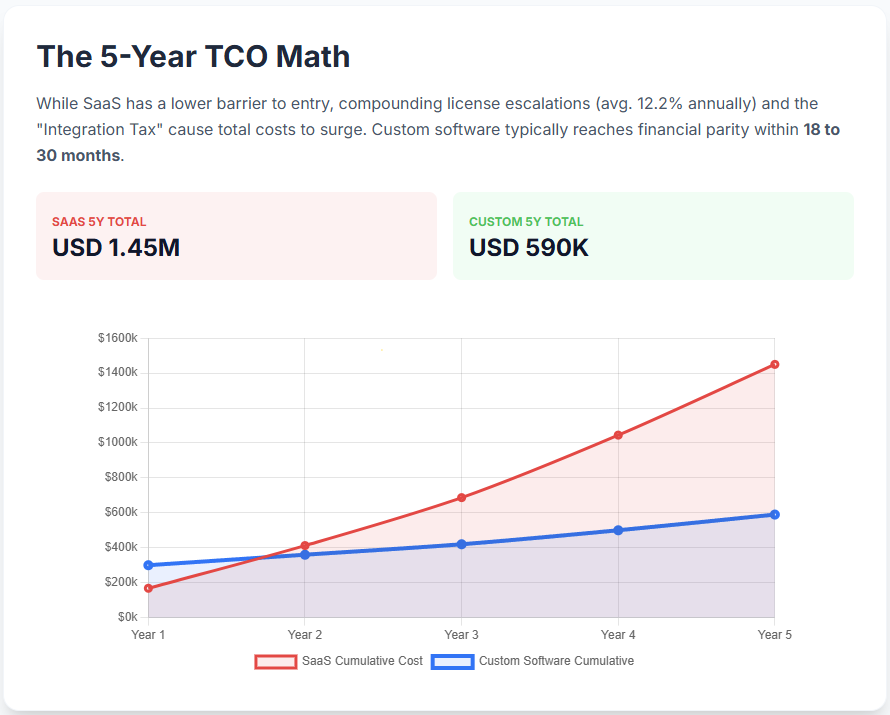
SaaS vendors escalate subscription pricing at an average of 12.2% annually. The average enterprise spends USD 9,100 per employee per year on SaaS. Add integration middleware, connector fees, and the hidden cost of employees doing manual data reconciliation between platforms, and the numbers flip fast. For a mid-sized company with 150 users, the 5-year comparison looks like this:
| Cost Category (5-Year) | SaaS Stack | Custom Software |
| Year 1 Licensing / Build | USD 168,000 | USD 300,000 |
| Annual Licensing (Years 2-5) | USD 812,000 (at 12.2% annual escalation) | USD 0 |
| Integration Tax | USD 120,000 (middleware + connectors) | USD 0 (native internal APIs) |
| Manual Workaround Labor | USD 300,000 | USD 40,000 |
| Maintenance and Cloud OpEx | USD 0 (included in subscription) | USD 225,000 (15% of build + hosting) |
| Cumulative 5-Year Total | USD 1,450,000 | USD 590,000 |
For most mid-to-large deployments, custom software crosses the SaaS TCO line within 18 to 30 months.
3. Do you operate in a regulated sector?
If your system touches personal data, financial transactions, or patient records, PDPA Section 26, MAS TRM guidelines, or HIPAA requirements govern where that data can live and who can access it. Custom software lets you architect data residency, field-level encryption, and audit logging from the ground up. SaaS stores your data in multi-tenant environments you don’t control.
4. Is your integration matrix too complex for connectors?
When your operations span legacy mainframes, proprietary IoT hardware, Sybase or Oracle databases, and external partner networks, third-party middleware breaks down. Custom software is built to communicate natively with these interfaces, eliminating data silos without paying for Workato or Tray.io licenses on top of your SaaS stack.
Custom Software Development vs. Off-the-Shelf SaaS: Side-by-Side

| Dimension | Custom Software Development | Off-the-Shelf SaaS |
| Initial Cost | High upfront (SGD 70K to SGD 700K+, depending on scope) | Low monthly subscription (SGD 15 to SGD 280/user/month) |
| 5-Year TCO | Lower. Flat maintenance fee, typically 15% of build cost annually. No per-seat licensing. | Higher. SaaS vendors escalate pricing 8% to 15% annually. Integration middleware adds SGD 2,000+/month. |
| Workflow Fit | 100% fit. Engineered around your exact processes. | 70% to 80% fit. You adapt your workflows to the vendor’s schema. |
| Data Sovereignty | Full control. Single-tenant, local data residency. PDPA and MAS TRM aligned. | Restricted. Data sits in vendor-controlled multi-tenant environments. |
| Roadmap Control | Unlimited. You set the priorities and release schedule. | Locked. Dependent on the vendor’s product roadmap and deprecation cycles. |
How Much Does Custom Software Development Cost in Singapore?
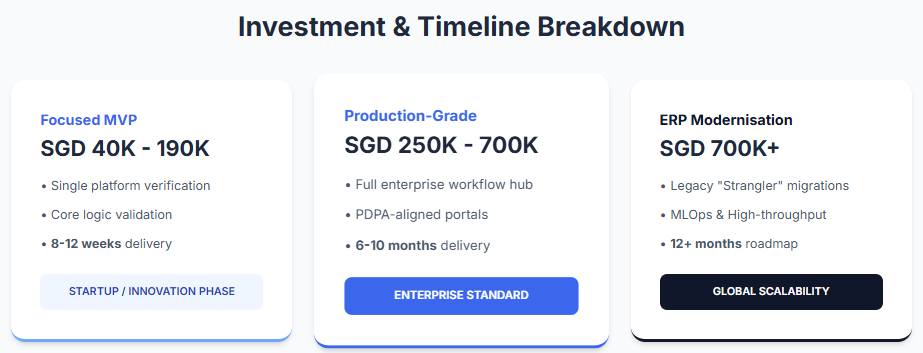
Custom software development costs in Singapore vary significantly based on scope, compliance requirements, and the engagement model. As a Singapore-headquartered company with engineering delivery in Vietnam, Vinova operates at rates 40% to 60% below equivalent Singapore or Australian engineering teams, without compromising on ISO 9001 or ISO 27001 certified delivery standards.
- Focused MVP (single platform, core features validated): SGD 40,000 to SGD 190,000, delivered in 8 to 12 weeks
- Production-grade system (PDPA-aligned portal, enterprise workflow hub): SGD 250,000 to SGD 700,000, 6 to 10 months
- Large-scale ERP modernisation or MLOps platform: SGD 700,000+, 12 months or more
Annual maintenance runs at approximately 15% of the initial build cost. On a SGD 300,000 system, that’s SGD 45,000 per year for bug fixes, security patches, performance optimisation, and minor feature releases. Compare that to what compounding SaaS licensing costs you by year three.
Custom Software Development by Industry: Where It Delivers the Highest ROI
Custom software development delivers its highest return when it resolves complex, sector-specific operational problems that no generic platform was designed to solve.
Financial Services and Fintech
Enterprise software development for financial institutions requires transactional precision, immutable audit trails, and strict MAS TRM compliance. Trading, wealth management, and banking systems can’t run on generic SaaS when data residency, audit logging, and sub-100ms pipeline consistency are non-negotiable. Vinova deploys dedicated squads of 20 to 30+ engineers for clients like SBI Digital Markets, maintaining high-throughput custom data pipelines with full MAS regulatory alignment.
Enterprise ERP Modernisation
Enterprise software development for ERP modernisation rarely means a clean-slate rewrite. Most enterprises can’t afford a full “Big Bang” approach. Vinova executes risk-mitigated legacy modernisation using a Strangler Fig pattern: new cloud-native microservices are built around the edges of the existing monolith, replacing modules one at a time. Traffic routing shifts transparently, so end users experience zero disruption. This is how Vinova architected the Navig8 Connect migration without halting Navig8’s live shipping operations.
Government and Public Sector
Singapore’s public sector demands the highest standards of data security, accessibility, and uptime. Vinova has delivered a multi-million dollar whole-of-government GRC platform with GovTech Singapore, and co-designed the IPOS Digital Workbench for the Intellectual Property Office of Singapore, allowing examiners to manipulate complex patent datasets with interactive data visualisations.
Manufacturing and Industrial IoT
Smart manufacturing plants need real-time ingestion of sensor telemetry for predictive maintenance and OEE tracking. Vinova engineers custom edge-fog-cloud pipelines and human-machine interface (HMI) applications for industrial clients including Delta Electronics, deploying directly on proprietary hardware platforms.
Healthcare
Custom software development for clinical networks requires unified patient portals that pull from fragmented sources (labs, imaging, external clinics) while enforcing PDPA and HIPAA compliance at the field level. Custom application development built on FHIR R4-compliant data models with AES-256 encryption and non-bypassable audit logging gives healthcare providers full control over patient data from day one.
The Custom Software Development Process: Vinova’s 5-Stage Lifecycle
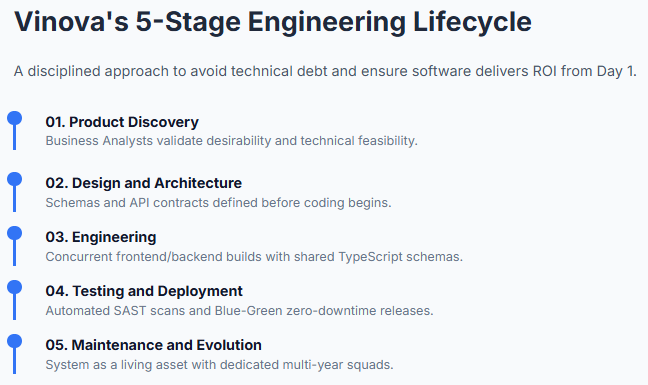
Most custom software development failures trace back to skipping the early stages. Here’s how Vinova structures every engagement:
| Stage | Name | What Happens |
| 1 | Product Discovery | Business Analysts validate every requirement against desirability, feasibility, and viability. No code written until this is locked. |
| 2 | Design and Architecture | Database schemas, API contracts, and clickable prototypes are built before a single line of code is written. |
| 3 | Engineering | Frontend and backend teams build concurrently using containerised environments and shared TypeScript schemas to prevent integration mismatches. |
| 4 | Testing and Deployment | Every commit triggers automated tests, SAST scans, and dependency checks. Production deployment runs via Blue-Green pipelines for zero downtime. |
| 5 | Maintenance and Evolution | The system is treated as a living asset. Vinova’s long-term retainer clients include Navig8 Asia and SBI Digital Markets, with dedicated squads maintaining platforms for 2 to 3+ years. |
Learn more how Vinova’s solution on building your custom software in Singapore here.
Who Should Build Your Custom Software? In-House vs. Outsourced vs. Strategic Partner
The execution model for custom software development determines your delivery speed, architectural quality, and long-term cost structure as much as any technical decision.
Building in-house
High IP control and deep context, but constrained by Singapore’s hiring bottleneck (10 to 18 weeks to onboard a senior engineer under COMPASS) and the fixed overhead of salaries, CPF, benefits, and office space. Works well when you have an established engineering team and a stable roadmap.
Commodity outsourcing shop
Fast to spin up, cheap hourly rates (USD 15 to USD 25/hr), but high failure rates. These vendors optimise for “on-time, on-budget” code delivery, not architectural quality. The technical debt they leave behind typically costs more to fix than the initial project.
Strategic hybrid partner (the Vinova model)
Pre-assembled, cross-functional squads available in 2 to 4 weeks. Senior architects deploying modular, secure, scalable systems. Milestone-gated capital allocation so you’re not paying for open-ended research. Vinova maintains 20 to 30+ member dedicated squads for enterprise clients over multi-year engagements, with local Singapore-based architects coordinating directly with delivery teams in Hanoi, Da Nang, and Ho Chi Minh City.
| See How Vinova Builds Custom Software for Singapore Businesses Book a complimentary 2-hour consultation with Vinova’s engineering leads. We’ll review your current architecture, identify build-vs-buy inflection points, and map a custom software development roadmap to your specific business objectives. No commitment required. Schedule Your Free 2-Hour Consultation with Vinova |
How to Choose a Custom Software Development Company in Singapore

Audit their architecture, not their marketing
Ask for an anonymised walkthrough of a complex system they’ve delivered. Evaluate repository structure, test coverage, use of microservices and event-driven patterns, and CI/CD pipeline maturity. Any custom software development partner worth engaging can show you this without hesitation.
Check security credentials independently
Demand proof of active, independently audited certifications: ISO 9001:2015 and ISO/IEC 27001. For fintech or public sector work, confirm alignment with MAS TRM guidelines and PDPA requirements. Vinova holds both certifications and has delivered to MAS-regulated institutions and sovereign-grade agencies.
Verify Singapore or SEA reference clients
Evaluating software development services without local reference clients is a blind bet. A partner who has delivered for Singapore enterprises understands PDPA obligations, MAS compliance requirements, and the local regulatory environment. Ask for peer CTOs you can call, not just case study PDFs.
Run a milestone-gated pilot first
Before signing a multi-quarter contract, structure a defined 2 to 4 week pilot: an API integration layer, a lightweight proof-of-concept, or a Sprint 0 architecture review. Vinova’s pilot engagement with Singapore Institute of Technology (SIT) on their AdventureLEARN platform and the IPOS Digital Workbench both started as scoped pilots before scaling into full production engagements.
FAQ: Custom Software Development in Singapore
How long does custom software development typically take?
A focused MVP takes 3 to 5 months. A production-grade custom software solution with compliance requirements (PDPA, HIPAA, MAS TRM) runs 6 to 10 months. Large-scale ERP modernisations or MLOps platforms require 12 months or more. Timelines are driven by integration complexity, compliance depth, and how well-defined the requirements are before engineering begins.
How do we protect our IP when working with a custom software development company?
The Master Service Agreement must explicitly state that 100% of source code, database structures, documentation, and assets are client-owned, transferred upon creation. All development must occur within client-owned cloud repositories with MFA and SSO enforced. No code or binaries should reside on vendor machines. Vinova builds entirely within client-controlled environments as standard practice.
When does custom software development beat SaaS on total cost?
For most mid-to-large deployments (100+ users), custom software development typically crosses the SaaS TCO line within 18 to 30 months, driven by compounding SaaS licence escalation (8 to 15% annually), integration middleware costs, and the labour overhead of manual workarounds. The larger and longer the deployment, the stronger the case for custom.
What role does AI play in custom software development in 2026?
AI is embedded in both the product and the development process. In the product, it means predictive models built directly into the system’s core architecture, not bolted on as API wrappers. In the custom software development process itself, Vinova mandates GitHub Copilot and Claude as pair programmers across all squads, and deploys a proprietary Agentic AI Framework in CI/CD pipelines that autonomously analyses test failures and suggests precise code fixes, cutting QA debugging time from hours to minutes.
Why choose bespoke software development over patching a legacy system?
Legacy systems running outdated runtimes accumulate unpatched vulnerabilities, require increasingly rare specialist developers, and can’t connect to modern cloud APIs, data streaming platforms, or AI infrastructure. Patching delays the problem and increases the eventual migration cost. Vinova’s Strangler Fig approach to bespoke software development modernises legacy systems module by module, with zero downtime and no Big Bang rewrite risk.
| Vinova: Singapore-headquartered. Vietnam-powered. ISO 27001 and ISO 9001 certified.300+ engineers across Hanoi, Da Nang, and Ho Chi Minh City. 300+ projects delivered. Trusted by GovTech, OCBC Bank, Prudential, Samsung, and Singapore Power Group. Schedule a 2-hour consultation: |