Australia has shifted decisively from consumer AI adoption toward industrial-grade AI development. The AI ecosystem Australia has built operates as a genuine dual-track economy: a mature AI-taker integrating global foundation models at enterprise scale, and a specialised, high-margin AI-maker exporting deep vertical AI in mining, healthcare, and energy infrastructure. This guide maps the market size, the technology stack, the regional hubs, and the investment gaps that define where the real opportunity sits.
Table of Contents
Key Takeaways
- The AI ecosystem Australia has built runs on two tracks at once: a mature AI-taker integrating global foundation models at enterprise scale, and a specialised AI-maker exporting genuine vertical depth in mining, healthcare, and energy infrastructure
- Capital is flowing (AU$5.48B in 2025) but concentrating hard, the top 20 rounds absorbed 58% of all volume, and the real structural gap sits at Series B+, not seed stage
- The commercialisation chasm is severe: 93,302 academic AI papers versus just 4,075 patents between 2015 and 2024, a 23:1 ratio that’s costing the AI ecosystem Australia’s universities have built real commercial translation
- The highest-conviction opportunities aren’t in horizontal model wars, they’re in autonomous heavy industry, regulated clinical SaMD, grid digital twins, and neuromorphic edge hardware, verticals with genuine data and physical moats
1. The Current State: Growth Metrics and Ecosystem Health
Before diving into the value chain and regional hubs, the AI ecosystem Australia is running on right now needs a clear baseline: how big, how fast, and where the capital is actually going.
Market Size, Startup Density, and Capital Inflows
Australia hosts over 1,500 dedicated AI companies. Macroeconomic modelling from the Tech Council of Australia and Microsoft projects generative and applied AI will contribute between AU$45 billion and AU$115 billion annually to the economy by 2030, a labour productivity uplift equivalent to 2-5% of GDP. Through 2034, broader multi-sector integration could lift real GDP by up to AU$235 billion. Australia AI growth has moved from experimental prototypes toward genuinely revenue-generating operational tools, and venture financing rebounded to AU$5.48 billion across 390 transactions in 2025, a 31% increase in deployed capital year-on-year, even as capital concentrated sharply: the top 20 rounds absorbed 58% of all volume.
| Indicator | Current Baseline | 2030-2035 Target |
| Economic contribution | AU$21.0B (current) | AU$115.0B by 2030 |
| Venture capital allocation | AU$5.48B (2025, 390 deals) | AU$7.5B+ run-rate |
| Enterprise adoption (large vs micro) | 82% vs 33% | 90%+ vs 60%+ |
| SME embedded AI products | 7.0% of SMEs | 25%+ embedded |
| Academic-to-patent ratio | 22.89 : 1 (93,302 papers, 4,075 patents) | Under 10 : 1 |
| Superannuation private capital share | 13% (down from 48% in 2020) | 30%+ via YFYS reform |
The “Taker vs. Maker” Dynamic
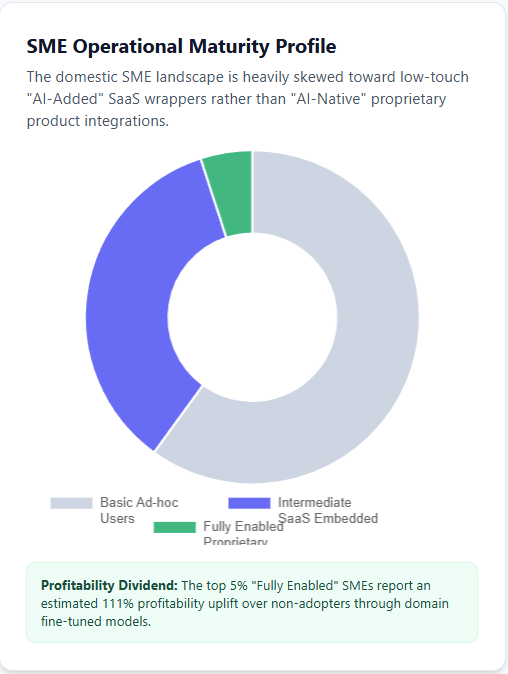
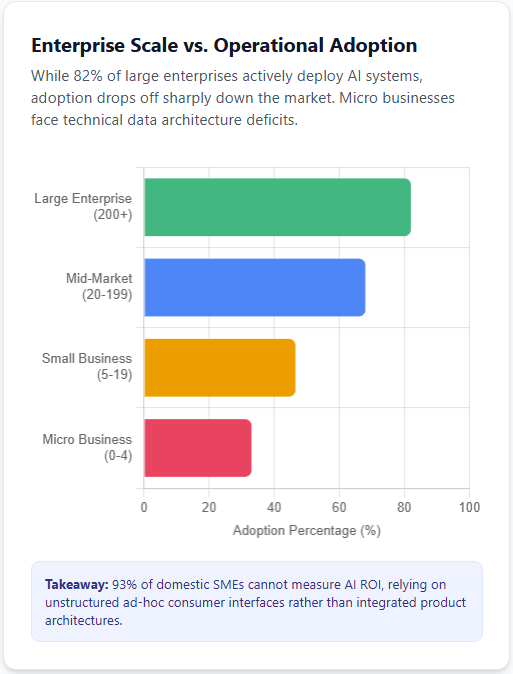
Enterprise AI adoption is bifurcated by company size: large enterprises (200+ staff) run at 82% implementation, mid-market firms at 68%, and micro-businesses at just 33%, mostly via free consumer interfaces rather than integrated systems. Only 7% of Australian SMEs have embedded AI into actual revenue-generating products. On the “maker” side, Australia’s genuine strength is domain-specific vertical models rather than general-purpose foundation models, Canva’s design AI, Harrison.ai’s diagnostic imaging, and Heidi Health’s clinical documentation all compete globally by going deep into one vertical rather than wide across many.
Why ‘AI-Added’ Fails Where ‘AI-Native’ Succeeds
A recurring pattern across the AI ecosystem Australia is watching mature in real time: enterprise adoption failures frequently stem from the “AI-Added” trap, bolting a generic LLM chat interface onto disjointed legacy systems. Market leaders instead run an “AI-Native” strategy, where language models act as deterministic reasoning engines inside formal state machines, not unmonitored text generators. Structured mitigation patterns that address the 93% ROI-measurement gap most consistently: rapid MVP cycles (8-12 weeks) that isolate non-deterministic workflows before committing serious capital, upfront product discovery (2-4 weeks) that eliminates scope creep and can lift execution velocity by up to 60%, and disciplined build-vs-buy TCO evaluation that reserves bespoke engineering budget strictly for domain-differentiating IP rather than reinventing standard back-office tooling.
2. Mapping Australia’s AI Value Chain (The 5-Layer Stack)
Understanding the AI ecosystem Australia operates within means mapping where genuine value gets created, not just where activity is loudest. The value chain shows clear asymmetric strength in vertical application engineering, physical asset digital twins, and neuromorphic silicon, and structural vulnerability in compute hardware supply chains and foundation model pre-training capital.
| Layer | Functional Scope | Domestic Champions | Structural Gaps |
| Vertical Applications & Enterprise SaaS | Domain-native stacks: computer vision, predictive telemetry, workflow automation | Neara, Harrison.ai/Annalise.ai, Canva, SafetyCulture | Horizontal foundation vendors integrating downstream; reliance on US VC for go-to-market |
| Foundational & Domain-Specific Models | SLM pre-training, parameter-efficient fine-tuning, proprietary vision-generative architecture | Leonardo.ai (Canva), CSIRO Data61 | High pre-training compute deficit; reliance on US open/closed weights |
| Data Infrastructure & Synthetic Pipelines | Enterprise data orchestration, privacy enclaves, automated labelling, synthetic environments | Redactive AI, Appen, university spatial data enclaves | Fragmented data silos across state jurisdictions; no unified sovereign data standard |
| Compute Infrastructure & Sovereign Cloud | High-density data centres, green-energy colocation, sovereign defence clouds | NEXTDC, CDC Data Centres, AirTrunk | ~AU$300M public compute spend over 5 years vs AU$5B+ in peer economies |
| Edge AI, Neuromorphic & Bio-Hardware | Spiking neural networks, event-based low-power silicon, biological-silicon hybrids | BrainChip (Akida), Cortical Labs (CL1), Baraja | No domestic sub-7nm fabrication; full reliance on offshore foundries (TSMC) |
Layer 1: Industry-Specific Applications and Vertical SaaS
Sydney-based Neara exemplifies the vertical-depth approach in critical electrical infrastructure. In late 2024, Neara closed a US$31 million Series C round led by EQT, Partners Group, and Square Peg. Its platform ingests LiDAR, satellite, and geospatial data to build physics-informed 3D digital twins of entire power grid networks, modelling windstorm stress, wildfire corridors, and conductor thermal sag so utilities can evaluate grid resilience without manual field surveys. In healthcare, Harrison.ai’s joint venture Annalise.ai with I-MED Radiology Network has built global-leading diagnostic imaging software, a chest X-ray tool detecting up to 124 clinical findings, trained on clinical feedback loops across millions of scans inside Australia’s single-payer healthcare system.
A recurring bottleneck for vertical AI in heavy industry and logistics is rigid legacy backends. In mission-critical deployments, a maritime shipping platform unifying 20+ disparate operational modules and a Singapore energy and utilities provider’s operational systems, engineering teams apply the Strangler Fig Pattern rather than a high-risk, all-at-once migration: incrementally replacing legacy monolith services with native microservices and containerised APIs, ensuring zero downtime and preparing telemetry for predictive intelligence layers without interrupting daily operations.
Layer 2: Foundation Models and Fine-Tuned Platforms
Australia hosts no domestic developer of broad-spectrum frontier models capable of rivalling OpenAI, Anthropic, or Google DeepMind, frontier pre-training runs exceeding US$100 million in GPU allocation have steered domestic firms toward open-source adaptation and parameter-efficient fine-tuning instead. Canva’s 2024 acquisition of Sydney-based Leonardo.ai illustrates this: Leonardo’s Phoenix architecture, tuned specifically for style consistency and rapid rendering, now powers Canva’s Magic Studio and Dream Lab for hundreds of millions of users, capturing substantial software value without the cost of a general-purpose LLM built from scratch.
Layer 3: Data Infrastructure and Data Governance
As deployments move from experiments into production-grade RAG and autonomous agents, data governance has become critical infrastructure. Sydney-based Redactive AI connects enterprise environments (Microsoft 365, Google Workspace, Jira) to generative models while mirroring underlying access-control permissions in real time, preventing unauthorised retrieval and mitigating leakage liability under the Privacy Act. Scaling RAG reliably in production also demands specific engineering discipline: hierarchical chunking that preserves document structure rather than arbitrary token splitting, high-throughput vector indexing (Qdrant, pgvector with HNSW), and deterministic agentic orchestration wrapping LLMs inside directed acyclic graphs or finite state machines so every state mutation validates against an explicit transition function.
Layer 4: Compute Infrastructure and Sovereign AI Cloud
Australia’s compute footprint relies on commercial data centres (CDC Data Centres for sovereign defence workloads, NEXTDC’s Tier III/IV portfolio supporting up to 100kW-per-rack liquid cooling, and AirTrunk, acquired by Blackstone in 2024 for over AU$24 billion) alongside foreign hyperscalers. The sovereign gap is real: the government invested roughly AU$300 million in public AI compute over five years, well behind multi-billion-dollar programmes in Singapore, Canada, and the UK, forcing researchers and early-stage startups onto commercial hyperscaler credits that route valuable IP through foreign cloud infrastructure by default.
Layer 5: Edge AI and Industrial Hardware Integration
Australia holds a genuinely asymmetric global position in non-von Neumann computing. BrainChip’s Akida neuromorphic processor runs Spiking Neural Network inference at milliwatt power budgets, deployed across automotive (Mercedes-Benz), industrial defect detection, and defence programmes (Raytheon). Melbourne’s Cortical Labs has commercialised biological computing through its CL1 system, roughly 800,000 live human cortical neurons on silicon microelectrode arrays, priced at US$35,000 per unit, running a full server rack on under 1 kilowatt. In heavy industry specifically, edge inference already runs remote mining haulage (Rio Tinto AutoHaul’s 2.4km trains through the Pilbara) and offshore maritime monitoring.
3. Regional Hubs and Ecosystem Enablers
The AI ecosystem Australia has built isn’t concentrated in one city, it spans 25 distinct clusters, with 1,533 dedicated AI organisations. Inner-city districts across Sydney, Melbourne, Brisbane, and Perth account for 64% of all AI-related employment, and 85% of private AI companies operate with fewer than 50 staff, an early-stage profile across every state.
| State | 2025 VC Funding | Primary Hubs | Specialisation |
| Victoria (Melbourne) | AU$2.20B (134 deals) | Cremorne Digital Hub, Parkville Biomedical Precinct | Clinical diagnostics, digital health SaMD, biological computing |
| New South Wales (Sydney) | AU$1.70B (160 deals) | Tech Central (Eveleigh) | Enterprise SaaS, FinTech, legal automation, predictive grid twins |
| Queensland (Brisbane) | AU$504M (61 deals) | Fortitude Valley, Maroochydore | AgTech, computer vision, spatial bio-modelling, media optimisation |
| South Australia (Adelaide) | Part of ~AU$490M regional share | Lot Fourteen, Tonsley | Computer vision research, defence autonomy, space systems |
| Western Australia (Perth) | Part of ~AU$490M regional share | CORE Innovation Hub | Heavy industry, autonomous mining, subsea vision |
Western Australia deserves a specific note: Perth operates the world’s most extensive, commercially deployed testbed for heavy-asset autonomous systems, Rio Tinto’s autonomous long-haul rail network and BHP’s Integrated Remote Operations Centre run entirely real production workloads, not pilots, giving WA a genuinely defensible data and operational moat that’s hard to replicate anywhere else globally.
Institutional Anchors and Government Initiatives
Government programmes are the connective tissue holding the AI ecosystem Australia together at the policy level:
- National Reconstruction Fund: a AU$15 billion statutory financing corporation with a AU$1.0 billion earmark for Critical Technologies, providing commercial debt, equity, and loan guarantees for AI hardware and advanced robotics
- Reshaped National AI Centre (NAIC): transitioned into DISR with AU$21.6 million in federal funding, coordinating SME adoption resources and national metrics tracking
- AI Adopt Program: AU$17 million funding four specialised SME AI Adopt Centres providing practical, industry-specific integration workflows
- Next Generation AI Graduates Program: CSIRO Data61-administered grants co-funding PhD and Master’s students in machine learning engineering and algorithmic governance
AI Sandboxes, Safety Standards, and Responsible AI Frameworks
The regulatory posture pivoted decisively between 2024 and 2026. DISR’s September 2024 Proposals Paper outlined 10 Mandatory Guardrails and an overarching Australian AI Act; the National AI Plan Australia published in December 2025 instead committed to a decentralised model, existing regulators (ACCC, ASIC, OAIC, TGA) enforcing sectoral rules, supplemented by NAIC’s voluntary Guidance for AI Adoption and its 6 Essential Practices. The Australian AI Safety Institute, operational in 2026, functions as a technical testing and advisory body rather than an enforcement agency, coordinating with equivalent institutes in the US, UK, and Japan. The one binding compliance deadline every enterprise needs on its calendar: from 10 December 2026, the Privacy and Other Legislation Amendment Act 2024 requires disclosure of automated decision-making that significantly affects individual rights, with penalties scaling to the greater of AU$50 million, 3x the benefit obtained, or 30% of annual turnover.
4. The Growth Bottlenecks: Bridging the “Commercialization Gap”
Every strength in the AI ecosystem Australia has built sits alongside a specific structural friction point, and the three below are the ones actually limiting how fast the whole system can scale.
High Research Output vs. Low Patent and Exit Conversion
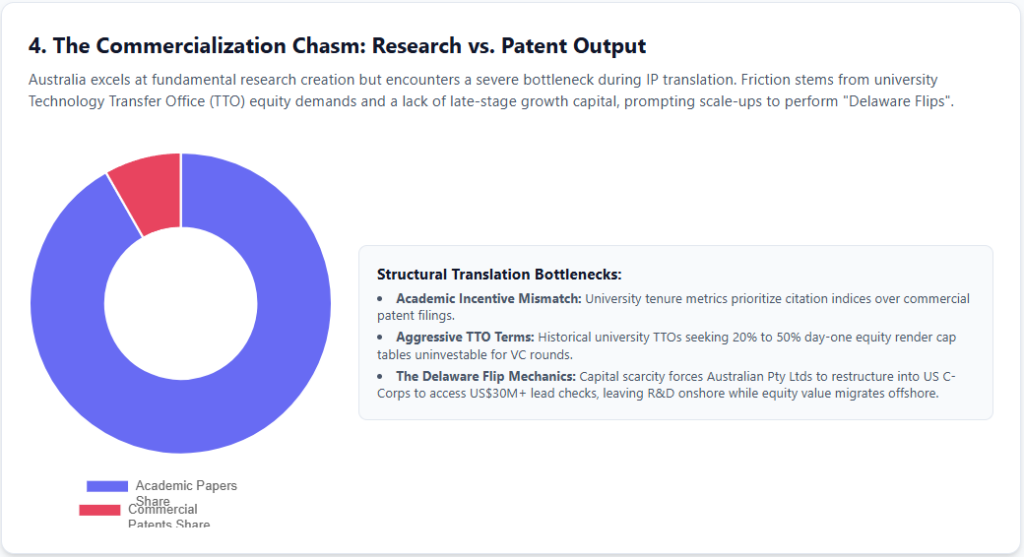
Between 2015 and 2024, Australian researchers produced 93,302 AI publications (roughly 2.0% of global academic AI output) but registered only 4,075 patents (just 0.18% of global AI patent inventions), a ratio of nearly 23 papers for every patent filed. Three institutional factors drive this specifically: academic tenure evaluations reward citation count over patent filing or spinout formation; university Technology Transfer Offices frequently demand 20-50% non-dilutable equity in early spinouts, producing uninvestable cap tables before a company even raises its first round; and with 85% of AI companies employing fewer than 50 people, most early-stage startups simply lack the legal resources for multi-jurisdictional patent filing across the US, Europe, and Asia.
Growth Capital and Series B+ Funding Shortfalls
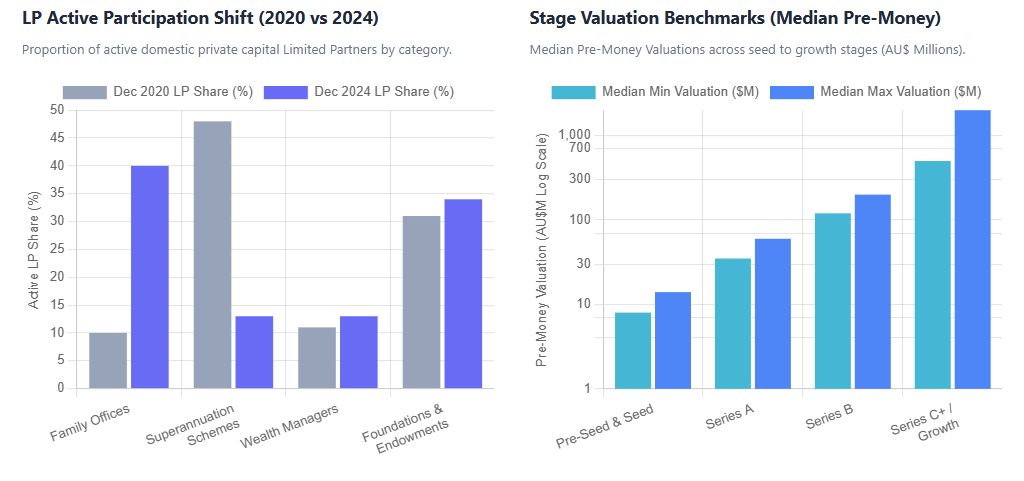
Early-stage capital (pre-seed through Series A) is genuinely healthy via funds like Blackbird, AirTree, and Square Peg. The gap opens at growth stage: few domestic institutional investors can regularly underwrite AU$30-100 million Series B/C checks, so scale-ups reaching that point routinely execute a “Delaware Flip,” a newly formed Delaware C-Corporation acquires 100% of the Australian Pty Ltd’s shares, with founders relying on statutory CGT rollover relief (Subdivision 124-M or Division 615 of ITAA 1997) to avoid an immediate tax hit on the swap. Engineering and R&D teams often stay in Sydney or Melbourne to keep accessing the R&D Tax Incentive, but corporate ownership, high-margin software revenue, and terminal exit value migrate offshore with the holding company. This is compounded structurally: APRA’s Your Future, Your Super performance test penalises the tracking-error volatility of illiquid venture assets, which is exactly why superannuation’s share of active domestic LPs fell from 48% to 13% in four years, with family offices (now 40% of the LP base) filling seed and Series A gaps but rarely writing growth-stage lead checks.
The Specialized Talent Squeeze
AI-specific job postings rose from 0.2% to 0.9% of all national postings between 2015 and 2024, but demand concentrates sharply: 100 companies account for 58% of all AI-related job postings nationally, pushing compensation benchmarks up and making early-stage hiring genuinely difficult, particularly for production-grade MLOps engineering, distributed GPU infrastructure management, and technical AI product leadership. To navigate this without burning cash on wage inflation, scaling enterprises increasingly pair onshore product architecture with offshore development centres, structured “Shadow Bench” protocols (pre-trained backup engineers maintaining continuity against key-person risk) paired with ISO 27001-certified governance are what make this model hold up under public-sector-grade scrutiny rather than just being cheaper labour.
5. High-Conviction Market Opportunities for Founders and Investors
Where the AI ecosystem Australia has built actually has defensible, exportable moats, not just activity:
Industrial and Asset-Heavy AI Automation
Australia’s global position in heavy resource extraction and export logistics creates an unusually strong proving ground for autonomous haulage, edge computer vision, subsea robotics, and predictive maintenance, backed by multi-decade operational telemetry and established deployments like Rio Tinto AutoHaul and BHP’s IROC that de-risk the technology for the next buyer.
Mid-Market Enterprise Workflows
Custom copilot integration into legacy ERP/CRM software for mid-tier Australian companies remains genuinely underserved, the 68% mid-market adoption figure reflects surface-level SaaS copilot usage, not the deep workflow integration that actually changes a P&L, which is exactly the gap a properly engineered legacy modernisation and integration partner fills.
Sovereign AI and Secure Regulated Sectors
Government, defence, and healthcare procurement increasingly mandates domestic data residency and audited inference, a structural tailwind for any team that’s already built to that compliance bar elsewhere rather than trying to retrofit it under deadline pressure.
| Vertical | 2030 Global TAM | Domestic Data Moat | Export Rating |
| Autonomous Heavy Mining & Remote Logistics | US$24.5B | 9.5/10 | 9.8/10 |
| Clinical Diagnostic SaMD & Digital Pathology | US$38.2B | 8.5/10 | 9.2/10 |
| Grid Digital Twins & Utility Simulation | US$19.8B | 9.0/10 | 9.5/10 |
| Precision AgTech & Environmental Vision | US$12.4B | 8.0/10 | 8.4/10 |
| Neuromorphic Edge & Bio-Silicon Computing | US$14.1B | 9.0/10 | 8.9/10 |
Why Singapore and APAC AI Engineering Experience Applies Directly Here
For any team building inside the AI ecosystem Australia now demands real execution from, not just capital, the engineering partner question matters as much as the funding question. Vinova doesn’t have an Australian office or an Australian client roster yet, and it would be dishonest to pretend otherwise. What Vinova does have is direct production experience solving exactly the structural bottlenecks this guide has covered, legacy system modernisation via the Strangler Fig Pattern, hybrid delivery models built specifically to solve the talent-scarcity problem, and ISO 27001-certified governance built for regulators (MAS TRM in Singapore) that are, in substance, close cousins of what Australia’s own AI Safety Institute and Privacy Act ADM mandate are converging toward.
- Legacy modernisation without the downtime: the same Strangler Fig approach applied to real Singapore enterprise clients is directly transferable to the rigid legacy backends holding back mid-market AI adoption in Australia
- A hybrid delivery model built for the exact problem Australia’s talent squeeze creates: Singapore-based governance paired with a Vietnam engineering base cuts development cost by 30% to 50% versus fully onshore delivery, without the key-person risk of a small in-house team
- Regulatory discipline that transfers directly: ISO 27001 certification and MAS TRM-aligned engineering discipline (audit trails, incident response, access governance) map closely onto what Australia’s own tightening AI governance regime is now asking enterprises to demonstrate
That’s the honest pitch: not “we already know the Australian market,” but that the engineering discipline behind solving legacy integration debt, talent scarcity, and regulatory compliance has already been proven under a comparably demanding regulatory regime in Singapore, a considerably shorter learning curve than a vendor starting from zero, and a timezone that overlaps far more workably with Australia’s eastern states than a US or European engineering partner ever will.
| Building for Australia’s AI Ecosystem? Get Engineering That’s Already Solved These Bottlenecks Vinova brings Singapore and APAC AI engineering experience, real production delivery under strict regulatory regimes, directly to Australian founders and enterprise teams navigating talent shortages and legacy integration debt. Book a free architecture consultation with our engineering team. Book Your Free AI Ecosystem Australia Engineering Consultation with Vinova |
Conclusion: The Road Ahead for Australia’s AI Landscape
The AI ecosystem Australia has built has real advantages: high-impact academic research, a resilient early-stage venture market, and established leadership in applied heavy-asset automation, clinical SaMD, grid-scale digital twins, and neuromorphic edge computing. Capturing the projected AU$115 billion annual dividend by 2030 depends on fixing structural friction across the capital and talent stack, reforming YFYS to unlock superannuation growth capital, capping university TTO equity demands to preserve investability, expanding sovereign compute, and building genuine algorithmic compliance readiness ahead of the December 2026 deadline.
For AI commercialization Australia founders, enterprise buyers, and venture capital evaluating Australian AI market opportunities, the winning strategy isn’t competing head-on in horizontal foundation model wars, it’s vertical depth, ethical AI standards, and resource-sector dominance, and building or partnering with the engineering discipline that can actually execute against that.
| Vinova: Singapore and APAC AI and enterprise engineering partner since 2010. ISO 27001:2022 and ISO 9001:2015 certified. 300+ projects delivered. Legacy modernisation (Strangler Fig Pattern), Hybrid Delivery Model, and MAS TRM-aligned engineering governance built for regulated Singapore and APAC enterprises. Financial Times Top 500 High-Growth Companies Asia-Pacific 2026. The Straits Times Singapore’s Fastest-Growing Companies 2024, 2025, and 2026. Contact Vinova to Discuss Your AI Engineering Roadmap |