By Vinova Systems Practice · 15-minute read
Every IT proposal sent to a fund promises “institutional-grade”. Then 9:02 AM on a Monday arrives, regional markets are spiking, and a long/short equity fund finds that its firewall has started throttling the market data feed. An unmonitored core switch is dropping order packets, and the traders are watching a screen that is a few seconds behind the market. By the time engineers find the bottleneck, the fund has been trading on stale prices, and the slippage is already booked.
Quick Answer: IT support for financial services in Singapore combines low-latency network engineering for market data and order routing, secured enclaves for investor and deal records, and 24/7 monitoring that produces the audit trail regulators and investors ask for. A good provider supports your obligations under the Monetary Authority of Singapore (MAS) Technology Risk Management (TRM) Notices and Cyber Hygiene Notices, including one-hour incident notification, and holds up under an investor’s Operational Due Diligence (ODD) review. Your licensed entity stays accountable for all of it.
Table of Contents
Key Takeaways
- Financial IT Is Not General Corporate Computing: An office network tolerates a little jitter and a late email. A trading environment pays for the same delay in execution slippage and awkward questions from the regulator.
- MAS Obligations Are Specific and Binding: The Cyber Hygiene Notices and TRM Notices are legally binding. The TRM Guidelines are guidance. Between them they cover patching, multi-factor authentication (MFA), one-hour incident notification and a four-hour limit on unscheduled downtime for critical systems.
- Due Diligence Decides Who Gets Capital: Institutional allocators screen managers on IT controls. Shared administrative passwords and unencrypted backups can end a conversation before performance is discussed.
- Secure Enclaves Protect High-Stakes Records: Investor files, deal rooms and trade allocations belong in isolated zero-trust environments with hardware-backed authentication.
1. The High-Stakes Reality: Financial IT Is Not General Corporate Computing
IT support for financial services is judged on the balance sheet, because an infrastructure failure lands there.
Teams outside capital markets often assume IT support means password resets, desktop printers and email. That picture breaks the first time market data stops. Financial infrastructure works under three constraints that office IT never faces:
1. Predictable Execution Paths: Market data and order routing need low, stable latency. Bloomberg, LSEG real-time feeds and direct market access (DMA) Financial Information eXchange (FIX) gateways all depend on a clean path. Packet loss and bufferbloat show up as failed fills and trading losses.
2. Capital Call and Wire Integrity: Investment managers, private equity partners and family offices send large capital calls and foreign exchange settlements. One compromised endpoint or one spoofed partner mailbox can redirect a wire.
3. Institutional Due Diligence Scrutiny: Sovereign wealth funds, endowments and funds of funds audit a manager’s operations before committing capital. A setup with shared administrator passwords or unencrypted local backups can trigger an immediate veto.
| Dimension | Commodity office IT | Institutional financial IT |
|---|---|---|
| Response | Best-effort ticket queues with four-to-eight-hour targets | Written severity tiers with a 15-minute triage target |
| Access | Shared administrative passwords and basic commercial antivirus | Zero-trust enclaves, hardware FIDO2 MFA and just-in-time (JIT) tokens |
| Network | Unsegmented office LAN and unmonitored comms room access | Segmented zones, with market data on its own path |
| Evidence | Whatever the engineer remembers | Write-once audit logs mapped to MAS requirements |
The Rule: If an IT provider cannot explain, in sixty seconds, how it keeps market data apart from the corporate network, it should not manage capital infrastructure.
Specialized financial IT support moves infrastructure from reactive desktop troubleshooting to deterministic systems engineering. By isolating execution pipelines, hardening trading workstations and monitoring compliance continuously, it protects both trading performance and the firm’s licence.
2. Hedge Fund IT Infrastructure in Singapore: Anatomy of a Financial Services Stack
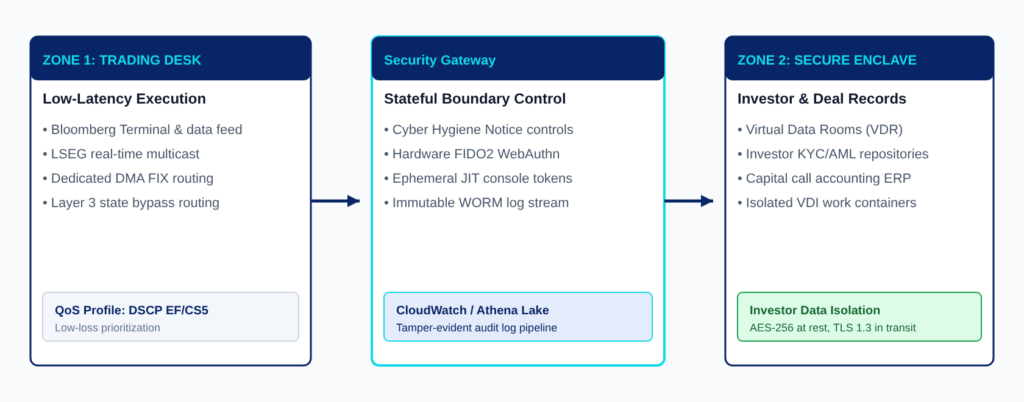
A reliable financial technology stack combines high throughput with strict zero-trust access, across three tiers.
2.1 Low-Latency Market Data and Execution Networks
Trading floors cannot run on standard office network settings:
- Multicast Handling for Market Data: Feeds such as LSEG real-time data are commonly delivered by User Datagram Protocol (UDP) multicast, and firewalls that apply deep stateful inspection to that traffic can exhaust their connection state tables and start dropping packets. Hardened designs route market feeds through Layer 3 switches with hardware-based access control lists (ACLs) and explicit Quality of Service (QoS) markings such as Differentiated Services Code Point (DSCP) Expedited Forwarding (EF). Other feeds, including Bloomberg’s, run over TCP and need a clean, uncongested path with predictable failover.
- Reliable FIX Connectivity: Order routing engines talk to prime brokers and exchanges over FIX, so they need careful buffer management. Vinova deploys containerized proxy gateways on hardened Linux hosts, so trade messages are acknowledged, sequenced and staged locally if the upstream broker circuit jitters.
2.2 Family Office IT Security in Singapore: Zero-Trust Enclaves and Virtual Desktops
Material non-public information (MNPI), proprietary trading algorithms and investor Know Your Customer (KYC) documents should sit apart from ordinary desktops:
- Conditional-Access Virtual Desktop Enclaves: Core fund operations run in secure enclaves on AWS or Microsoft Azure. Remote analysts reach them through hardened Virtual Desktop Infrastructure (VDI), such as Azure Virtual Desktop or Amazon WorkSpaces, with clipboard redirection disabled, local drives blocked and screen capture restricted.
- Hardware-Backed Identity (FIDO2): SMS codes and push approvals are open to SIM swapping and adversary-in-the-middle (AiTM) phishing proxies. Administrative portals and banking gateways should require hardware security keys, such as YubiKeys, using WebAuthn.
2.3 Immutable Telemetry and Audit Trails
Financial institutions need to show what happened, who did it and when:
- Write-Once-Read-Many (WORM) Storage: Telemetry, firewall traffic logs, flow logs and privileged session records are forwarded continuously to tamper-resistant cloud storage with object lock retention enabled.
- Automated Log Correlation: With centralized ingestion through Amazon CloudWatch and Amazon Athena, analysts can query months of access logs in seconds when an inspector or an allocator asks.
3. MAS TRM Compliant Managed IT Services: What Singapore’s Rules Actually Require
Financial compliance in Singapore is an operating discipline, and the rules differ by licence type.
MAS publishes two kinds of instruments. The TRM Guidelines of January 2021 describe good practice and are not legally binding. The Notices on Technology Risk Management and on Cyber Hygiene are legally binding on the institutions they cover. Both sets of Notices were renumbered on 10 May 2024, so older material may quote old numbers. Notice 655, for example, is now FSM-N06.
3.1 Which Notice Applies to You
| Institution type | Cyber Hygiene Notice | Technology Risk Management Notice |
|---|---|---|
| Insurers and insurance agents | FSM-N04 | FSM-N03 |
| Banks | FSM-N06 (formerly 655) | FSM-N05 (formerly 644) |
| Capital markets financial institutions, including capital markets services licence holders | FSM-N22 | FSM-N21 |
| Licensed financial advisers | FSM-N24 | FSM-N23 |
| Insurance brokers | FSM-N20 | FSM-N19 |
Single-family offices are generally not licensed and so sit outside these Notices, but the banks and allocators that deal with them often ask for the same controls. Multi-family offices that hold a capital markets services licence are inside the framework. Check the Notice for your own licence. The Notices are issued under the Financial Services and Markets Act 2022.
3.2 The Six Cyber Hygiene Measures
The Cyber Hygiene Notices set six baseline measures:
| Measure | What the Notice requires | How it is typically met |
|---|---|---|
| Administrative accounts | Secure every administrative account against unauthorized access | Zero standing privileges, with ephemeral JIT access |
| Security patches | Apply patches within a timeframe that matches the risk | Staged Canary, Pilot and Fleet rings with a defined deployment window |
| Security standards | Set and enforce security standards for each system | Hardened baselines, such as Center for Internet Security (CIS) benchmarks, pushed centrally |
| Network perimeter defence | Restrict unauthorized network traffic at the perimeter | Next-generation firewalls, with a market data bypass and no exposed management ports |
| Malware protection | Run malware protection on every system where it is available | Behavioral Endpoint Detection and Response (EDR) agents |
| Multi-factor authentication | MFA on administrative accounts of critical systems and on accounts used to access customer information | Hardware-backed FIDO2 security keys |
The scope of the MFA requirement has detail in the Notice, so read the exact wording for your licence.
3.3 Incident and Availability Duties Under the TRM Notices
| Duty | Requirement |
|---|---|
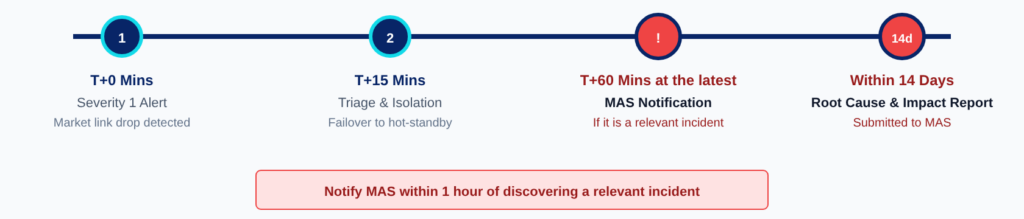
| Incident notification | Notify MAS as soon as possible, and no later than 1 hour after discovering a relevant incident |
| Root cause and impact analysis | Submit to MAS within 14 days of discovering the relevant incident |
| Critical system availability | Make all reasonable efforts to maintain high availability, with unscheduled downtime of no more than 4 hours in any 12 months |
| Recovery | A recovery time objective of no more than 4 hours for each critical system |
A “relevant incident” is a system malfunction or IT security incident with a severe and widespread impact on operations, or a material impact on service to customers. Confirm the thresholds in the Notice that applies to you, because your IT provider’s escalation plan has to match them.
Your investors’ personal data also falls under the Personal Data Protection Act 2012 (PDPA). KYC files and investor records need reasonable security arrangements under Section 24. MNPI is a different matter: it is governed by the insider trading provisions of the Securities and Futures Act, not the PDPA.
3.4 Sizing the Cost of a Trading Outage
An IT outage costs an investment manager across execution slippage, opportunity cost, regulatory exposure and investor redemptions:
Where:
- ΔtHalt is the number of hours that market data or trading systems are unresponsive.
- RExecution_Slip is the realized slippage per hour from unhedged exposures, broken limit orders or delayed fills.
- VOpportunity is the gross profit margin forgone per hour during volatile market windows.
- FMAS is the regulatory penalties and external investigation costs.
- PODD_Redemption is the long-term revenue lost if allocators redeem after a technology governance failure.
Institutional allocators score managers across IT domains, and a simple model shows how a weak control becomes a veto:
Here wj is the allocator’s weighting for IT domain j (the weights sum to 1.0), and SControl,j is the normalized audit maturity score, from 0.0 to 1.0. Allocators reject firms whose aggregate score RODD exceeds the investment committee’s threshold, whatever the track record.
The Rule: In institutional finance, an unlogged administrative session is an unexplained one, and regulators and allocators treat it that way.
4. Five Catastrophic Landmines in Financial Sector IT Operations
Financial IT disasters come from consumer-grade shortcuts and loose access policies.
4.1 Unmonitored Shadow Messaging
Traders, analysts and wealth advisers discuss recommendations, orders and deal allocations on consumer apps such as WhatsApp, WeChat and Telegram, on personal phones. Many licensed firms have record-keeping duties that reach business communications, and allocators expect the same discipline. A conversation that lives only on a personal phone cannot be captured, searched or produced.
4.2 Capital Call Spoofing and Business Email Compromise (BEC)
Attackers target private equity firms, venture funds and family offices around capital call windows. They compromise a partner’s mailbox, or register a look-alike domain, and insert fraudulent bank details into a pending wire instruction. Without enforced Sender Policy Framework (SPF), DomainKeys Identified Mail (DKIM) and Domain-based Message Authentication, Reporting and Conformance (DMARC), out-of-band verification between several people, and conditional-access rules on the email tenant, a single convincing email can divert a large wire.
4.3 Comms Room Sprawl and Shared Breakers
In multi-tenant towers across Raffles Place and Shenton Way, boutique financial firms often keep edge networking equipment in a shared comms closet. A maintenance worker, an electrical contractor or a cleaner can disconnect a power cable, pinch a fragile fiber jumper or trip a breaker, and the result is a midday trading disruption.
4.4 The Sync Illusion in Deal Rooms
Analysts set up ad-hoc shared folders on personal cloud storage such as Google Drive, Dropbox or Box to review deal models, audited balance sheets and cap tables. Consumer sync has no access controls, no data loss prevention (DLP) tagging and no geographic boundary enforcement. If one analyst’s laptop is compromised, MNPI and investor data walk out with it.
4.5 The Single-Circuit Internet Failure Mode
Boutique investment offices often run on one commercial broadband circuit with no automatic failover. When a contractor cuts an underground fiber bundle during roadworks, trading stops. A resilient design uses two carriers, plus software-defined wide area networking (SD-WAN) and bonded 5G failover that keeps live sessions up without dropping broker connections.
Explore Vinova’s Managed IT Services
Vinova can map your current setup against the MAS Notices and a typical ODD questionnaire, and show you where the gaps are.
5. Lessons From Singapore Financial Desks: Real Production Disasters
Technical debt on a trading desk turns into capital loss quickly.
Friction point we hit: the firewall that inspected market data. A boutique quantitative hedge fund in Singapore’s financial district had a secondary firewall crash during a market-open cascade. An uncalibrated security appliance was set to perform deep stateful inspection on raw UDP multicast market data. The packet volume exhausted its state table, the firewall froze, and order execution was delayed for 42 minutes during a volatility spike.
Resolution: We rebuilt the edge topology with a dedicated Layer 3 bypass for authorized market data feeds, strict hardware ACLs and automated DSCP QoS prioritization, and separated market data channels from the corporate inspection boundary.
Friction point we hit: the unannounced ODD review. An established private equity firm lost time on a sovereign fund allocation when the allocator’s ODD team ran an unannounced cybersecurity review. The reviewers found external software contractors reaching the investment modeling servers with shared credentials and no hardware MFA, and client KYC documents stored on an unencrypted on-premise Network-Attached Storage (NAS) device.
Resolution: We moved all user and contractor access into zero-trust cloud enclaves on AWS, issued hardware FIDO2 keys, set up role-based access control (RBAC) and enabled WORM logging across file interactions. The firm passed its next ODD review without findings.
Vinova Field Insight: Infrastructure Hardening and MAS Alignment for a Singapore Family Office
The Challenge: A Singapore family office running private equity and public market assets had recurring remote access drops, unencrypted local file backups and uncoordinated laptop patching that disrupted investment committee meetings. It had no central view of its digital estate, which left it open to regulatory questions and data protection risk under the PDPA.
The Approach: Vinova deployed a hybrid infrastructure framework run by a named Incident Manager and Service Delivery Manager. Core databases moved into an isolated AWS enclave behind a Web Application Firewall (WAF) with immutable CloudWatch and Athena log streaming, hardware FIDO2 keys went onto every endpoint, and every change passed functional, integration and security testing first.
The Result:
| Metric | Result |
|---|---|
| Uptime of critical systems | 99.99% |
| Institutional ODD review | Passed without findings |
| Monthly support ticket resolution time | 55% faster |
6. The Evaluation Matrix: Choosing Your Financial IT Operating Model
Financial institutions have three structural options for running technology: a generalist office Managed Service Provider (MSP), a solo in-house engineer or a specialized financial systems partner. The right one depends on your size, and many boutique firms start with Option B and grow into Option C.
| Operational Dimension | Generalist office MSP | Solo in-house IT engineer | Specialized financial systems partner |
|---|---|---|---|
| MAS Notice literacy | Low: generic corporate focus, unfamiliar with MAS Notices | Variable: one person’s knowledge, prone to gaps | High: prepared compliance runbooks and a continuous audit posture |
| Market data application know-how | Low: treats Bloomberg and LSEG as ordinary office apps | Medium: can configure software, may lack network tuning skills | High: multicast handling, QoS tuning and DMA broker routing |
| Investor ODD defensibility | Weak: may not meet institutional checklists | Weak: depends on one key person | High: structured documentation, WORM logs and tested changes |
| 24/7 market hours coverage | Business hours, with out-of-hours surcharges | Exposed to sick leave, holidays and burnout | Continuous 24/7/365 monitoring aligned to trading sessions |
| Enclave security architecture | Basic antivirus on unsegmented networks | Ad-hoc point tools without unified zero-trust controls | Conditional VDI, FIDO2 keys and AWS enclaves |
| Monthly cost | Fixed fee baseline, with frequent variable project add-ons | High fixed overhead: salary, up to 17% employer Central Provident Fund (CPF) contributions and recruiting | Predictable flat retainer covering operations and compliance |
Option A: The Generalist Office MSP
- Where It Works: Micro-advisory firms with fewer than five staff, running only on commodity SaaS tools with no direct capital market connections.
- The Catch: Real exposure. Generic helpdesks rarely know financial protocols, may treat a Bloomberg feed like web traffic and may not stand up to an institutional investor’s audit.
- Best for: Small unregulated entities with little technological complexity.
Practitioner Verdict: Good at desks and printers. Out of its depth once a market data feed is involved.
Option B: The Solo In-House IT Engineer
- Where It Works: Mid-sized financial institutions with over 150 endpoints and a dedicated internal infrastructure team.
- The Catch: Single point of failure. When the engineer is on leave or resigns, the knowledge leaves too, and one person rarely covers firewalls, market feeds, cloud and compliance all at once.
- Best for: Large firms that can support an internal team of three or more specialized engineers.
Practitioner Verdict: Fine for a firm that can afford a bench. A risk for a firm that has one person.
Option C: A Specialized Financial Systems Partner
- Where It Works: Boutique hedge funds, private equity firms, asset managers, family offices and insurance brokerages with 10 to 150 endpoints that need institutional stability and regulatory defensibility. Singapore fintech managed IT services follow the same pattern for payment institutions and digital financial firms, with extra weight on availability and incident reporting.
- The Catch: It needs disciplined maintenance windows, formal change control and strict access governance on your side.
- Best for: Regulated financial firms that want resilience, predictable budgets and audit-ready operations without a full-time internal engineering team.
Practitioner Verdict: The practical choice for a boutique firm that must answer to a regulator and an allocator.
7. Financial Services IT Support in Singapore: Negotiating Enforceable SLAs
Vague IT contracts guarantee extended downtime during market volatility. Service agreements should set clear milestones, remedies and legal mechanics.
7.1 A Severity Matrix Built for Trading Operations
| Severity | What it covers | Response | Next commitment |
|---|---|---|---|
| 1: Critical trading halt or data breach | Complete outage of market data feeds, failure of order routing during market hours, or a suspected intrusion in a financial enclave | Remote triage within 15 minutes | Active mitigation within 1 hour, executive updates every 30 minutes, on-site dispatch within 2 hours if hardware recovery is needed |
| 2: Degraded performance | Non-blocking latency on market data, failure of a single redundant switch or power supply, or slow portfolio accounting software | Within 30 minutes | Diagnosis and remediation plan within 2 hours |
| 3: Routine maintenance | Standard desktop requests, peripheral adjustments and scheduled onboarding | Acknowledgment within 2 hours | Resolution within 1 business day |
Your provider’s Severity 1 clock must be shorter than your regulator’s: if a relevant incident has to reach MAS within 1 hour of discovery, an hour-long triage queue is too slow.
7.2 Governing Law, IP Ownership and Dispute Resolution
- Governing Law: The contract is governed by and interpreted under the laws of the Republic of Singapore.
- Intellectual Property: Custom scripts, cloud deployment templates, network blueprints and infrastructure configurations should be assigned to you as they are created, using an assignment of future copyright under Section 140 of the Copyright Act 2021. You should own all operational configurations outright once you have paid.
- Dispute Resolution: If amicable resolution fails, the contract should provide for arbitration administered by the Singapore International Arbitration Centre (SIAC) under its Arbitration Rules, with Singapore as the seat. Awards are then enforceable internationally under the 1958 New York Convention.
- Outsourcing and Accountability: Handing IT to a provider does not move your regulatory accountability. Where MAS outsourcing rules apply to your licence, check what they require of the contract.
Have your legal counsel review the final wording of any clause before signing.
8. A 90-Day Plan to Reach ODD and MAS Readiness
Modernization has to run without interrupting live trading.
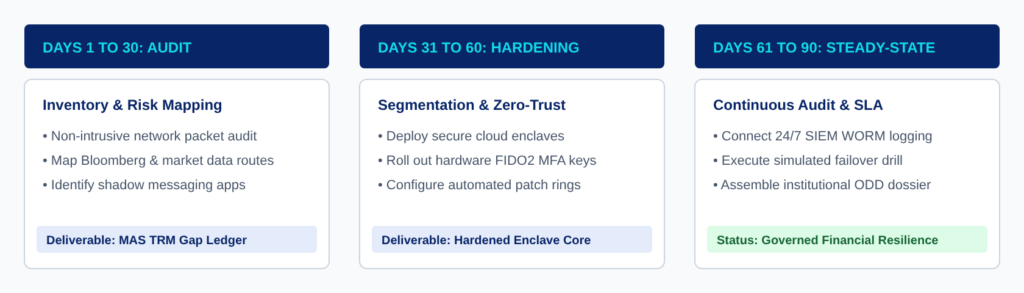
- Days 1 to 30, Audit, Discovery and Risk Baselines: Field engineers run non-intrusive discovery of physical switches, market data connections, software licenses and shadow cloud storage. We map data paths against the MAS requirements and build a risk ledger of the priority gaps. Deliverable: a MAS TRM gap ledger.
- Days 31 to 60, Enclave Hardening and Identity Consolidation: Deploy SD-WAN gateways with automatic carrier failover, set QoS priority routing for the market data feeds, roll out hardware FIDO2 keys, and isolate investor KYC and Anti-Money Laundering (AML) data in encrypted, conditional-access cloud enclaves. Deliverable: a hardened enclave core.
- Days 61 to 90, Drills, Audit Dossier and Steady State: Run cord-pull failover drills outside trading hours, connect network logs to an immutable WORM data lake, assemble an ODD documentation package and activate 15-minute response SLAs. Status: governed financial resilience.
9. Frequently Asked Questions
What is included in specialized IT support for financial services?
Low-latency network engineering for market data, micro-segmented cloud enclaves, hardware-backed multi-factor authentication, trade routing resilience, 24/7 security monitoring with a Security Information and Event Management (SIEM) platform, and continuous compliance governance aligned with the MAS TRM Guidelines, the Cyber Hygiene Notice and the TRM Notice that apply to your licence.
How does specialized IT support help meet MAS technology requirements?
By building controls that map to specific requirements: locked-down administrative access, staged patching with rollback triggers, comms room access controls, tamper-resistant audit logs, and an incident response playbook timed to the 1-hour notification and 14-day root cause duties. Your firm remains accountable to MAS, so the provider’s job is to give you the controls and the evidence.
How do engineers support trading platforms such as Bloomberg, FactSet and LSEG Workspace?
By engineering the network underneath them: dedicated Layer 3 routing bypasses for raw UDP multicast market data, QoS queues to reduce packet jitter, tuned switch buffers to prevent bufferbloat, and carrier-diverse internet backhaul with automatic SD-WAN failover.
How does IT infrastructure influence investor Operational Due Diligence (ODD)?
Allocators judge operational risk before they deploy capital. A firm with consumer-grade antivirus, shared administrator passwords, unencrypted backups or unmonitored shadow messaging apps gets poor ODD scores, and allocators can veto an investment however strong the fund’s returns.
Can a boutique hedge fund or family office outsource its IT operations in Singapore?
Largely, yes, but accountability stays with you. A specialized partner can provide management, round-the-clock monitoring and rapid on-site dispatch across Singapore’s financial districts, without the cost and key-person risk of a solo internal technician. Regulatory responsibility cannot be outsourced, so keep oversight of the provider.
The Takeaway
The Takeaway: Financial infrastructure cannot absorb execution delays, loose security settings or compliance failures, so build the controls and the evidence before an allocator or MAS asks for them.
Vinova brings government-grade engineering standards to regulated financial firms: written severity tiers, hardened enclaves and an audit trail that is ready before the question is asked.
Vinova: Singapore’s mobile and web application development partner since 2010. ISO 27001:2022 and ISO 9001:2015 certified.
300+ in-house engineers across Singapore, Hanoi, Da Nang, and Ho Chi Minh City, including teams who build image-heavy mobile and web applications for enterprise and government clients.
Financial Times Top 500 High-Growth Companies Asia-Pacific 2026. The Straits Times Singapore’s Fastest-Growing Companies 2024, 2025, and 2026.