By Vinova Systems Practice · 15-minute read
Every provider pitch promises a unified property portfolio: smart building analytics, cloud-hosted leasing, touchless tenant check-in. The reality arrives on a Sunday at 11 pm. The showflat fiber link has dropped two hours before a priority launch, the concierge turnstiles have stopped syncing with the access directory, and an external broker has just exported unencrypted National Registration Identity Card (NRIC) numbers to a personal Dropbox.
Quick Answer: Managed IT services for real estate in Singapore cover infrastructure, cybersecurity and day-to-day support across corporate offices, sales showflats and operating properties. A good provider keeps your Property Management Software (PMS), such as Yardi or MRI, available. It separates building automation networks from tenant data, meets your Personal Data Protection Act (PDPA) obligations, and gives brokers and contractors only the access they need through Zero-Trust controls.
Table of Contents
Key Takeaways
- Hybrid and Physical: Real estate IT is not office IT with a nicer lobby. Workloads span cloud Enterprise Resource Planning (ERP) systems, temporary showflats and building systems, so one office-style network design cannot cover all three.
- Separate Networks: If smart building telemetry shares a network with leasing records, you will struggle to show the reasonable security arrangements that PDPA Section 24 requires.
- Turnover-Linked Penalties: Under PDPA Section 48J, an organization with annual turnover in Singapore above S$10 million faces a maximum penalty of 10% of that turnover.
- Property Software Needs Specialists: A generalist helpdesk has no runbook for a Yardi database lockout, a broken payment reconciliation or a stalled lease generation in MRI Software or RealPage.
1. Real Estate IT Works Differently From Office IT
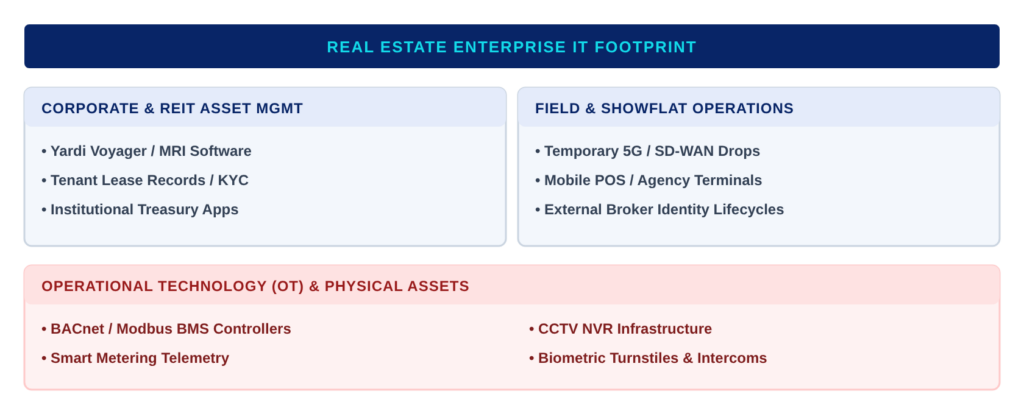
Standard office IT supports fixed desks, clean Software-as-a-Service (SaaS) tools and nine-to-five hours. Property IT, whether at a Real Estate Investment Trust (REIT), a developer or a managing agent, runs three environments at once:
- The Corporate Headquarters: Finance teams, asset managers and investment committees run transactions inside enterprise property software.
- The Temporary Sales Gallery or Showflat: These sites go up on short lead times, with temporary backhaul circuits, mobile point-of-sale hardware and third-party sales brokers.
- The Built Physical Asset: Operational Technology (OT) networks control elevators, Closed-Circuit Television (CCTV) storage, smart power metering and Building Management Systems (BMS).
That is not one network in three locations. It is three operating environments with three different failure modes, and a provider that treats them as one office network will find all three at the worst possible moment.
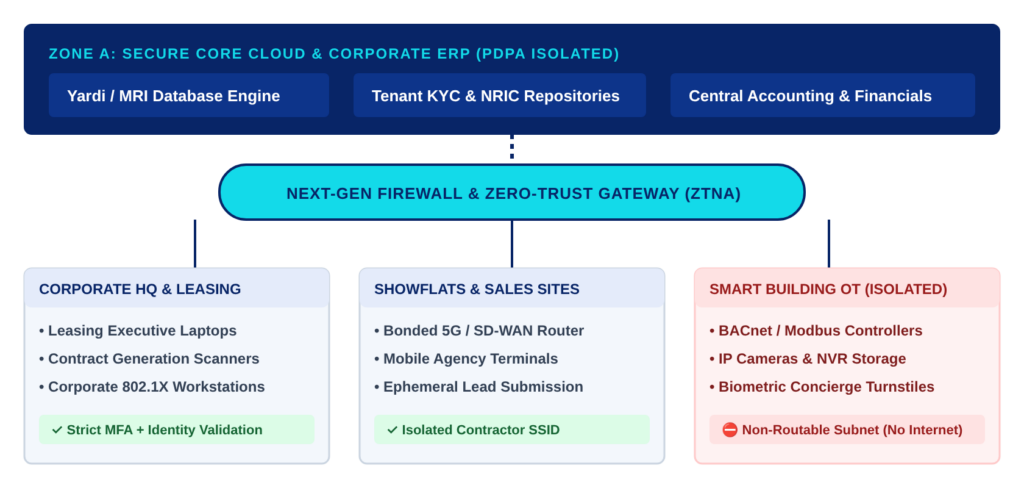
The Rule: Operational technology and tenant databases never share an unsegmented network.
The collision between OT and Information Technology (IT) is where property networks fail brutally. Facilities teams install smart sub-meters, Heating, Ventilation and Air Conditioning (HVAC) controllers and cameras that speak older field protocols: Building Automation and Control Networks (BACnet), Modbus or plain Real-Time Streaming Protocol (RTSP) video. Those protocols were built for closed serial loops, not for Transmission Control Protocol/Internet Protocol (TCP/IP) networks. In many installations they lack mutual Transport Layer Security (TLS) authentication, rarely receive security patches, and come from hardware vendors with thin security engineering.
If those devices share a subnet with your ERP, a compromised Internet Protocol (IP) camera becomes an entry point into your tenant lease files. If a faulty device floods an unsegmented Virtual Local Area Network (VLAN) with broadcast traffic, door controllers go down at the same moment as corporate file access, and your tenants stand outside a locked lobby while finance loses the lease ledger. Isolation is not an optional extra. It is the core design requirement.
2. Three Pillars of Managed Real Estate Infrastructure
Managed IT services for real estate rest on three pillars, because system uptime decides whether leases get signed and whether you stay compliant.
2.1 PropTech IT Infrastructure Management: Keep Core Systems Available
A ticket that says “the server is up” is useless to a leasing team that cannot generate a contract. Good monitoring starts with business transactions, not just processor and memory load:
- PMS Transaction Integrity: Yardi Voyager, MRI Software, RealPage or a custom ERP wrapper returns the right ledger balance after every lease, deposit and refund.
- Tenant Experience Platforms: Stable Application Programming Interface (API) connections tie tenant mobile apps and amenity bookings to back-office billing tables.
- Financial Ledger Sync: No database deadlocks or silent sync failures during month-end billing, maintenance fee runs and deposit returns.
The Rule: Managing real estate IT means engineering the integration layer, not resetting passwords.
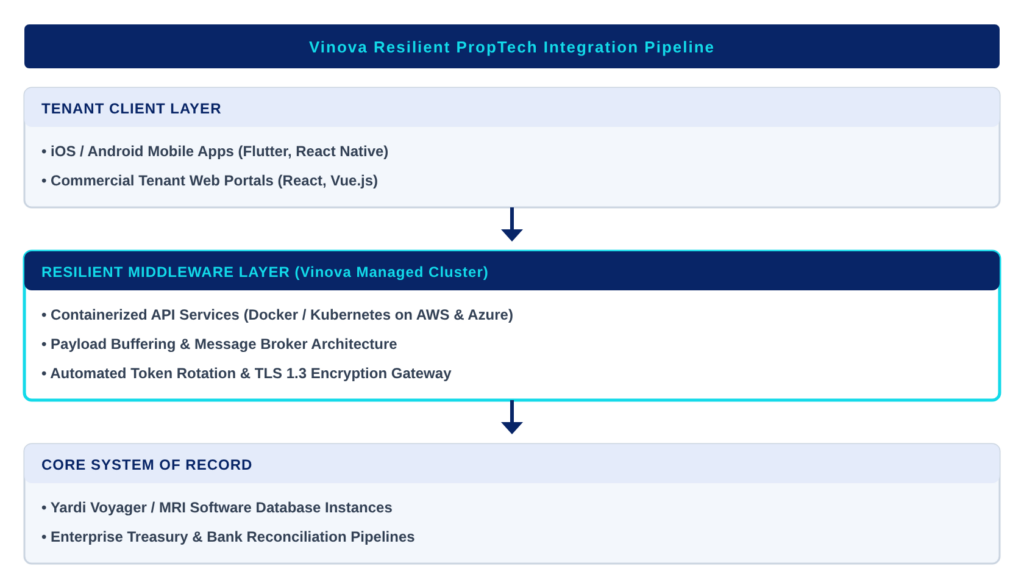
When tenant apps built on React Native or Flutter call legacy ERPs such as Yardi Voyager or MRI Software, failures usually trace to upstream API rate limits or unhandled schema drift. If the app has no buffer, a tenant’s rent payment fails on the due date and lands on your front desk as a complaint.
Vinova builds containerized middleware in Python and Node.js on Docker and Kubernetes, deployed across Amazon Web Services (AWS) and Microsoft Azure. Message queues sit between tenant apps and property databases, so payments and bookings wait safely and post even while the ERP is in a scheduled batch window.
2.2 Site Connectivity and Software-Defined WAN (SD-WAN) Failover
Showflats run on marketing deadlines. A commercial fiber drop can take twelve weeks, and a launch date will not wait for it.
SD-WAN with multi-carrier cellular backhaul, such as bonded 5G and Long-Term Evolution (LTE) links, carries the site while it is being built. Once fiber is terminated, the cellular link stays on as an active backup. If utility trenching severs the fiber, the gateway is configured to fail over immediately, so payments, Customer Relationship Management (CRM) syncs and biometric gate sessions carry on and your sales team keeps closing.
2.3 Zero-Trust Network Access (ZTNA) and Internet of Things (IoT) Boundary Defense
Property operations involve more kinds of user than most industries: employees, broker agencies, on-site mechanical and electrical (M&E) contractors and facilities vendors. Handing an air-conditioning vendor a broad Virtual Private Network (VPN) login gives them a key to rooms they never need to enter.
A managed service replaces that login with identity-centric ZTNA and micro-segmentation:
- Context-Aware Broker Access: External leasing brokers get authenticated, browser-isolated sessions limited to lead submission forms, with no route to wider file shares.
- Just-in-Time (JIT) Vendor Credentials: Facilities contractors sign in with temporary, auto-expiring tokens tied to scheduled maintenance tickets, so a finished job leaves no live account behind.
- Physical OT Hardening: Vinova places smart sub-meters, turnstiles and environmental sensors in micro-segmented subnets. API gateway proxies on Linux edge gateways translate BACnet and Modbus telemetry into encrypted JavaScript Object Notation (JSON) over TLS 1.3 before it reaches cloud analytics. A compromised sensor then has no path to your financial ledgers.
3. Real Estate Cybersecurity in Singapore: PDPA Obligations for Property Teams
A tenancy file is not just a lease. It is a bundle of NRIC numbers, passport copies for foreign tenants, corporate balance sheets, personal financial references, and biometric or CCTV logs. In Singapore, that bundle is a statutory liability.
The PDPA puts direct accountability on property organizations and on the data intermediaries they appoint. Three provisions matter most:
- Section 24 (Protection Obligation): Organizations must make reasonable security arrangements to prevent unauthorized access, collection, use, disclosure, copying, modification or disposal of personal data. Unencrypted tenancy agreements on an open internal share are very difficult to defend as reasonable.
- Section 26 (Transfer Limitation Obligation): Tenant records sent outside Singapore need a recipient that provides a standard of protection comparable to the PDPA. Unaudited offsite cloud sync, or an overseas outsourcing desk without enforceable contractual safeguards such as standard contractual clauses (SCCs), puts you at risk under this section.
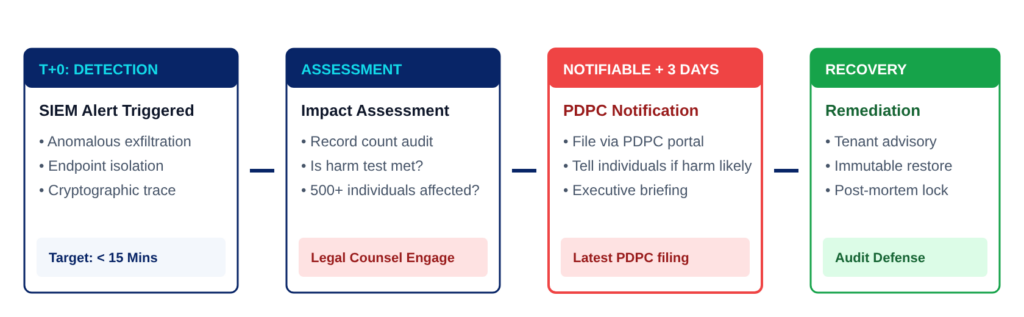
- Mandatory Data Breach Notification: A breach is notifiable if it results in, or is likely to result in, significant harm to individuals, or if it is of significant scale (500 or more individuals). You must notify the Personal Data Protection Commission (PDPC) as soon as practicable, and no later than 3 calendar days after you assess the breach as notifiable. Affected individuals must also be told as soon as practicable where significant harm is likely. The 3-day clock starts at that assessment, so the assessment itself has to be prompt and documented.
The financial consequences of weak technical safeguards are concrete. Under Section 48J of the PDPA, the maximum penalty for an organization with annual turnover in Singapore above S$10 million is up to 10% of that turnover. For all other organizations, the maximum is S$1 million. These are statutory ceilings, not predictions, but they show what is at stake.
Sizing Your Exposure
A simple way to size the total risk for a Singapore property firm without audited technical controls:
Where:
- P(Breach) is the annual probability of a data exfiltration event or malicious compromise.
- FPDPC is the statutory penalty ceiling under Section 48J:
- CForensics is third-party incident response, forensic triage and external legal advisory retainers.
- LDisruption is direct operational revenue lost to downtime during forensic seizure or recovery.
- EBrand is the loss of institutional value and tenant churn that follow published PDPC enforcement and media exposure.
The Rule: If you cannot show who opened which tenant file and when, you cannot show reasonable security under Section 24. Ask every provider how they log file access.
4. Five Landmines in Real Estate IT Operations
Property IT failures rarely start with a sophisticated zero-day exploit. They start with small procedural gaps that pile up across distributed sites.
4.1 Contractor Access Creep
Marketing campaigns, renovations and architectural audits bring a steady flow of contractors. Credentials for agencies, brokers and freelance surveyors get created in a rush to hit launch dates, then stay active long after the campaign ends. If one of those dormant accounts sits on a compromised agency laptop, the attacker walks straight into your tenant databases with a valid login.
4.2 Property Software Blame-Shifting
At a generalist helpdesk, Singapore property management IT support often ends at the laptop. A leasing agent clicks “Generate Lease” and the system deadlocks. The tier-1 technician confirms the laptop has internet, declares it healthy, closes the ticket and tells the agent to call the software vendor. Leasing stalls while the two companies trade emails. Property infrastructure needs engineers who understand database connection pools, API middleware and transactional dependencies.
4.3 Backup Decoupling and the Sync Illusion
OneDrive, Google Drive and Dropbox are not a business continuity plan. If a property manager overwrites a critical lease schedule, or ransomware encrypts it, the sync engine copies the damage to every linked device within minutes. An airtight recovery plan needs immutable, air-gapped, point-in-time snapshots held under strict access separation.
4.4 Wire Fraud and Payment Diversion
Booking fees, rental deposits, construction progress claims and escrow transfers move large sums fast. Attackers target property finance teams with executive spoofing and Business Email Compromise (BEC). Without hardened Sender Policy Framework (SPF), DomainKeys Identified Mail (DKIM) and Domain-based Message Authentication, Reporting and Conformance (DMARC) authentication, plus out-of-band confirmation of every payment detail change, a convincing fake email can redirect a deposit to the wrong account.
4.5 The Weekend Support Void
Showroom events and retail foot traffic peak on Saturdays and Sundays, while typical managed services run Monday to Friday, 9:00 AM to 6:00 PM. If the gallery network fails on Saturday morning, you lose sales momentum and fall back to paper forms before any support desk opens.
Explore Vinova’s IT Staff Augmentation and Outsourcing Services
If you need extra engineers or a dedicated team to run the integration, network and security work described above, see how Vinova’s staff augmentation and outsourcing teams work.
5. The Unvarnished Operating Model Comparison
Property leaders have three structural options for running technology: a small internal team, a generalist office Managed Service Provider (MSP), or a domain-specialized systems partner. If you are also weighing staff augmentation or an offshore team, our guides to IT outsourcing in Singapore, in-house vs outsourcing IT and IT staff augmentation vs IT outsourcing cover that decision.
| Dimension | Internal IT team (1 to 2 people) | Generalist office MSP | Domain-specialized systems partner |
|---|---|---|---|
| PMS and workflow expertise | Medium: knows daily use, limited time to optimize | Low: treats the PMS as a third-party black box | High: database-level troubleshooting and API integration |
| Network and OT segmentation | Low: rarely trained in BMS field protocols | Low: focused on office switching and Wi-Fi | High: VLAN and ZTNA isolation between BMS, CCTV and ERP |
| Coverage window | Business hours; single point of failure during leave | Business hours; evening and weekend calls at a surcharge | 24/7/365 monitoring |
| PDPA audit readiness | Ad hoc: limited continuous log monitoring | Reactive: basic antivirus reports, manual evidence gathering | Proactive: audit logging and prepared PDPC runbooks |
| Showflat deployment speed | Slow: limited bandwidth for concurrent builds | Moderate: standard branch-office playbook | Fast: pre-configured SD-WAN and bonded 5G |
| Cost model | Variable: recruiting, training and retention costs | Low fixed fee, plus variable out-of-scope project invoices | Fixed Service Level Agreement (SLA) baseline with defined service commitments |
Option A: The In-House Team of One or Two
- Where It Works: Small single-asset property offices with simple, static environments and fewer than 30 corporate seats.
- The Catch: Key-person risk. When the lead engineer takes leave, falls ill or resigns, the documentation often leaves with them, and two concurrent site rollouts can swamp the whole team.
- Best for: Small family holdings with few integrations and low transaction volume.
Practitioner Verdict: Fine until the one person who knows the system takes a holiday.
Option B: The Generalist Office MSP
- Where It Works: Standard corporate headquarters that need desktop support, email accounts and office printing.
- The Catch: Specialized property platforms get treated as someone else’s problem, OT network engineering sits outside the service, and weekend coverage for active sales galleries is rare or costly.
- Best for: Commercial tenants with no property operating assets to manage.
Practitioner Verdict: Solid for desks and printers. Out of its depth the moment a turnstile or a ledger is involved.
Option C: The Domain-Specialized Systems Partner
- Where It Works: Multi-property portfolios, institutional landlords, REIT asset managers and developers who need high availability across offices, field showflats and building networks.
- The Catch: It takes upfront architectural alignment, standard change management and disciplined role-based access governance on your side.
- Best for: Organizations whose downtime directly hurts leasing revenue, regulatory standing and tenant satisfaction.
Practitioner Verdict: The right fit when an outage costs you leases, not just inconvenience. It asks more of you at the start.
6. Lessons From the Field: Real Failures in Property IT
Architectural debt builds quietly in unmonitored comms rooms.
Friction point we hit: the showflat broadcast storm. During a weekend launch for a residential showroom, the sales terminal network crashed within fifteen minutes of the doors opening. A contractor had plugged an unmanaged consumer switch into a wall jack to power decorative smart lighting. That one switch caused a broadcast storm, exhausted the local Dynamic Host Configuration Protocol (DHCP) pool and knocked every credit card terminal and sales agent offline.
Resolution: We enforced hardware-level 802.1X port authentication across all gallery switches, limited DHCP leases to authenticated Media Access Control (MAC) addresses, and moved smart facility accessories onto a segregated, rate-limited IoT VLAN.
Friction point we hit: tenant passports on the open internet. A property agency found that scanned passports and employment passes belonging to foreign tenants were publicly reachable. An administrator had set a legacy cloud storage bucket to skip authentication so field brokers could download tenant files on personal phones.
Resolution: We deployed cloud security posture management (CSPM) automation to block public bucket exposure continuously, revoked every open link, and moved brokers to conditional-access mobile containers with copy/paste and screenshot prevention.
Vinova Field Insight: Modernizing a Multi-Property ASEAN Portfolio
The Challenge: A Southeast Asian commercial real estate operator faced recurring tenant billing outages, fragile point-to-point links between legacy on-premise PMS servers, and growing PDPA Section 24 concerns over unencrypted tenant records. Facilities teams at each property ran disconnected local servers without standard backups.
The Approach: Vinova moved scattered Structured Query Language (SQL) databases into managed relational clusters on AWS and Microsoft Azure with automated point-in-time recovery, containerized the integration middleware on Docker and Kubernetes, and hardened on-site networks with SD-WAN, 5G failover and micro-segmentation that separates BACnet and Modbus from the leasing subnet.
The Result:
| Metric | Result |
|---|---|
| Uptime across tenant digital services | 99.98% |
| Reduction in reactive on-site IT tickets | 80% within the first 120 days of steady-state operation |
| PDPA compliance audits | Passed without findings |
7. The Executive SLA Playbook for Singapore Service Contracts
A vague SLA guarantees long outages. Tie every managed service contract to concrete metrics and enforceable governance.
7.1 A Severity Matrix That Reflects Real Estate
A broken printer in the leasing office is an inconvenience. A dead payment terminal on launch day or a failed building access system is an emergency. If your SLA gives both the same severity label, the dead turnstile waits in the same queue as the printer. Classify severity by business impact:
| Severity | What it covers | Response | Next commitment |
|---|---|---|---|
| 1: Critical outage | Core PMS (Yardi/MRI) down, showflat network outage during sales events, building access system failure, or verified data exfiltration | Within 15 minutes | Active mitigation within 1 hour, with hourly executive briefings |
| 2: Major degradation | Slow database performance affecting contract generation, a single showroom terminal failure with a workaround, or tenant mobile app latency | Within 30 minutes | Triage and resolution plan within 4 hours |
| 3: Routine maintenance | Individual desktop troubleshooting, user onboarding, minor configuration changes | Within 4 business hours | Resolution within 24 business hours |
7.2 Legal Governance, IP Ownership and Dispute Resolution
Service contracts should match Singapore’s legal and statutory setting:
- Governing Law: The contract is governed by and interpreted under the laws of the Republic of Singapore.
- Intellectual Property: To avoid disputes over custom scripts, workflow automations or tenant integration middleware, work product should be assigned to you as it is created, using an assignment of future copyright under Section 140 of the Copyright Act 2021. You should own all configuration files, network schematics and automation routines outright once you have paid.
- Dispute Resolution: If executive negotiation fails, the contract should provide for arbitration administered by the Singapore International Arbitration Centre (SIAC) under its Arbitration Rules, with Singapore as the seat. Awards are then enforceable internationally under the 1958 New York Convention.
Have your legal counsel review the final wording of any clause before signing.
8. A 90-Day Transition Plan
A provider change should never interrupt active leasing cycles. A stage-gated plan keeps the handover orderly.
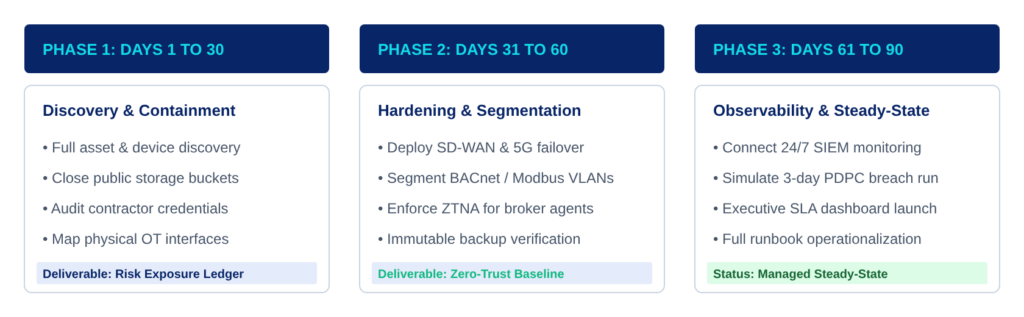
- Days 1 to 30, Discovery, Audit and Rapid Remediation: Non-intrusive discovery maps every physical and logical asset across your properties. We surface shadow IT, inventory software licenses, close exposed cloud repositories and document network topologies without disrupting daily business. Deliverable: a risk exposure ledger.
- Days 31 to 60, Infrastructure Hardening and Identity Consolidation: Deploy SD-WAN gateways with multi-carrier failover. Put multi-factor authentication (MFA) and Zero-Trust identity controls across corporate and contractor user groups. Confirm that backups for core property databases are point-in-time, tested and stored immutably offsite. Deliverable: a Zero-Trust baseline.
- Days 61 to 90, Observability and Steady-State Handover: Connect endpoints and network hardware to 24/7 monitoring. Run tabletop breach drills to test the 3-calendar-day PDPC notification timeline. Move the portfolio into managed steady-state operations. Status: managed steady state.
9. How Vinova Supports Real Estate Companies in Singapore
Vinova provides specialized IT and digital transformation services tailored for real estate companies, property developers and agencies in Singapore.
Key Managed and IT Services for Real Estate
- Custom PropTech and Web/Mobile Apps: Data-driven tools, client portals, and property management or listing apps. See Vinova’s real estate IT services.
- Co-Managed IT and Helpdesk Support: 24/7 technical helpdesk and automated monitoring that works alongside internal IT teams without replacing them. See Vinova’s managed IT services in Singapore.
- Cloud and Infrastructure Management: Secure cloud deployments, migration strategies, and DevOps and DevSecOps maintenance. See Vinova’s cloud services.
- Cybersecurity and PDPA Compliance: Protection of sensitive client and tenant data in alignment with Singapore’s Personal Data Protection Act (PDPA), plus security audits. See Vinova’s cybersecurity services.
- IT Staff Augmentation and Outsourcing: Access to dedicated software engineers and low-code and no-code developers through hybrid local and offshore models. See Vinova’s IT staff augmentation and outsourcing services.
You can explore the industry-specific offerings on the Vinova Real Estate IT Services page, or read the general scope on the Vinova Managed IT Services page.
10. Frequently Asked Questions
What is the typical scope of managed IT services for real estate firms?
Managed IT services for real estate cover a centralized IT service desk, infrastructure management for corporate offices and sales showflats, PMS support for Yardi and MRI, network micro-segmentation between BMS and business applications, continuous cybersecurity monitoring, and Singapore PDPA compliance support.
How do managed service providers support PDPA compliance for tenant data?
They put technical and organizational controls in place under Section 24 of the PDPA. These include encryption in transit and at rest, MFA, role-based access control, audit logging of file access, automated detection of unauthorized data exfiltration, and runbooks built around the PDPA’s mandatory breach notification rules, including the 3-calendar-day PDPC deadline that starts once a breach is assessed as notifiable.
Can an MSP support specialized property software like Yardi Voyager or MRI Software?
Yes. A specialized systems partner keeps engineering runbooks for enterprise property suites. That covers troubleshooting database lockouts, resolving API payload sync errors between the core PMS and third-party tenant apps, and coordinating with the software vendor’s engineers on deep application-layer issues.
How are temporary sales galleries and showflats connected securely?
Through enterprise SD-WAN appliances with bonded 5G and LTE cellular links. This gives encrypted connectivity back to corporate cloud environments from day one, without waiting for a commercial fiber installation.
How do building management systems (BMS) and IoT connect safely to IT infrastructure?
Through isolation. Smart building systems (HVAC, CCTV, smart meters, turnstiles) sit in dedicated OT VLANs behind stateful firewall rules. They cannot route directly to corporate subnets or the public internet, and every connection passes through an identity-verified gateway proxy.
The Takeaway
The Takeaway: Property portfolios cannot afford surprise downtime, disconnected platforms or compliance gaps, so move from ad hoc break-fix support to an engineered, secure and compliant baseline before the next Sunday-night incident chooses the timing for you.
Vinova: Singapore’s mobile and web application development partner since 2010. ISO 27001:2022 and ISO 9001:2015 certified.
300+ in-house engineers across Singapore, Hanoi, Da Nang, and Ho Chi Minh City, including teams who build image-heavy mobile and web applications for enterprise and government clients.
Financial Times Top 500 High-Growth Companies Asia-Pacific 2026. The Straits Times Singapore’s Fastest-Growing Companies 2024, 2025, and 2026.