You just ran an automated vulnerability scan. The report came back mostly clean, save for a few minor patching alerts. You’ve checked the compliance boxes for the quarter. Your data is secure, right?
Not necessarily.
For enterprise leaders in Singapore and the broader ASEAN region, this assumption is creating a dangerous false sense of security. While automated pentesting tools are excellent for basic hygiene, they operate within rigid, predefined rules. They cannot think, adapt, or improvise.
Cybercriminals do all three.
In an era where the average cost of a data breach for a Singapore SME is SGD 120,000, and enterprise breach costs regularly climb into the millions, relying on a scanner as your primary defense is like locking your front door but leaving the keys under the mat.
In this guide, we will break down the fundamental differences between basic vulnerability scanning and comprehensive IT security penetration testing, explaining why human-led assessment is no longer optional for meeting strict regulatory frameworks like the PDPA, MAS TRM, and GovTech guidelines.
Table of Contents
Key takeaways:
- Automation has significant blind spots: While automated scanners are useful for basic hygiene and compliance, they cannot interpret business logic, understand human behavior, or “chain” multiple minor vulnerabilities together, leaving systems exposed to sophisticated attackers.
- Regulatory non-compliance is costly: In Singapore, regulations such as the PDPA and MAS guidelines carry severe financial consequences for data breaches—including potential fines of up to 10% of local annual turnover—making deep, independent security verification mandatory rather than optional.
- Human-led testing is the corrective: To proactively defend assets, enterprises must adopt a human-led penetration testing model that mimics real-world adversary tactics, mapping user journeys and testing complex integrations that automated tools cannot evaluate.
- A balanced security posture is required: A resilient strategy requires a hybrid approach: continuous automated guardrails to catch standard errors, supplemented by periodic, deep-dive manual penetration testing to identify and remediate critical, logical system weaknesses.
The Cost of Cutting Corners: Regulations and Real-World Fines in Singapore & ASEAN
For organizations in Singapore and the broader ASEAN region, cybersecurity isn’t just an IT headache anymore—it is a bottom-line business reality. The days of treating security guidelines as voluntary “nice-to-haves” are over. Regulators are stepping up, and the financial penalties for falling behind are severe.
- The PDPA Reality Check: Under the Singapore Personal Data Protection Act (PDPA), a data breach caused by weak security isn’t just embarrassing; it’s incredibly expensive. Organizations face massive fines of up to 10% of their annual local turnover or SGD 1 million—whichever hurts more.
- Strict Rules for Finance and Government: If you are a financial institution, a fintech player, or if you partner with the public sector, the rules are even tighter. Both the MAS Technology Risk Management (TRM) Guidelines and GovTech Standards explicitly require regular, independent IT security penetration testing. They want concrete proof that your systems can withstand a targeted attack, not just a passing grade from a scanner.
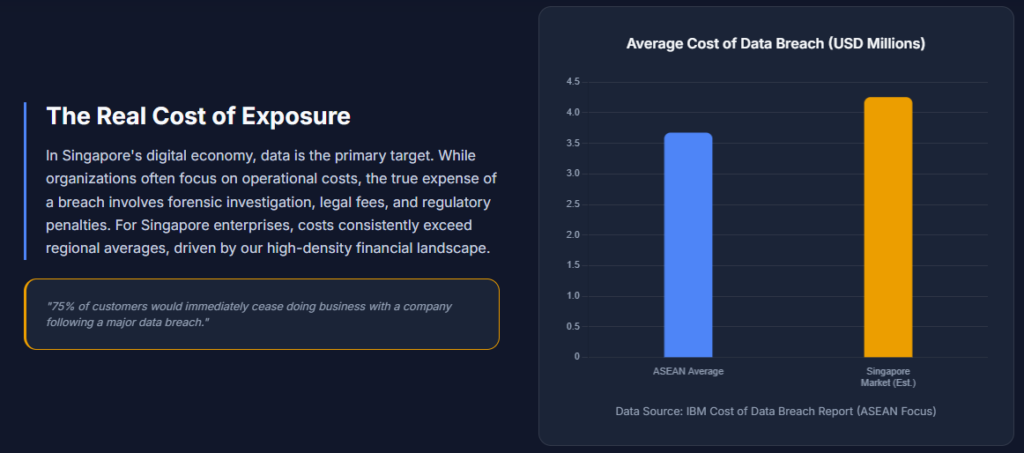
The financial math of a breach is terrifying. For a Singapore SME, a single breach now costs around SGD 120,000 on average—yet many companies spend less than SGD 10,000 a year trying to prevent it. That gap represents a massive, dangerous exposure. For larger enterprises, IBM’s 2026 report puts the average cost of a data breach in ASEAN at a staggering USD 3.67 million, driven by operational downtime, forensic investigations, and legal fees.
But the most devastating cost? Reputational damage. Industry surveys show that over 75% of customers will immediately walk away from a company following a major data breach. In a market where trust is your ultimate currency, protecting data is your biggest competitive advantage.
These aren’t abstract, “someday” risks. Just look at the headlines. In 2025, the PDPC slapped Marina Bay Sands with a S$315,000 fine after a system migration left the personal data of more than 665,000 patrons exposed. Even more tellingly, in January 2026, the PDPC fined People Central Pte Ltd specifically for failing to conduct periodic penetration testing.
The message from regulators is loud and clear: human-led testing is an enforceable expectation, not optional due diligence.
Automated Vulnerability Scans: The Illusion of Absolute Security
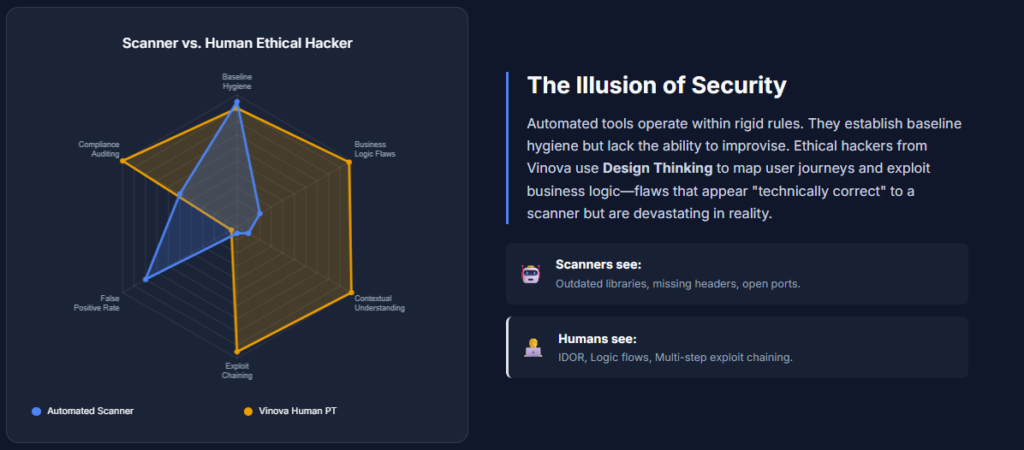
Automated vulnerability scanners are a necessary part of a defense-in-depth strategy. They are rapid, scalable, and highly useful for continuous monitoring. However, relying on them as a standalone security audit creates a dangerous illusion of security.
Where Scanners Excel:
- High-Frequency Baselines: They can rapidly scan thousands of assets to identify missing patches, outdated software versions, and standard misconfigurations.
- Known Signature Matching: They query extensive databases of Common Vulnerabilities and Exposures (CVEs) to flag known security flaws.
- CI/CD Pipeline Integration: They can be embedded directly into automated development pipelines to ensure basic code hygiene before deployment.
The Inherent Blind Spots:
Despite these benefits, automated scanners are fundamentally limited by their programming. They cannot interpret context, evaluate human behavior, or understand the “business logic” of an application.
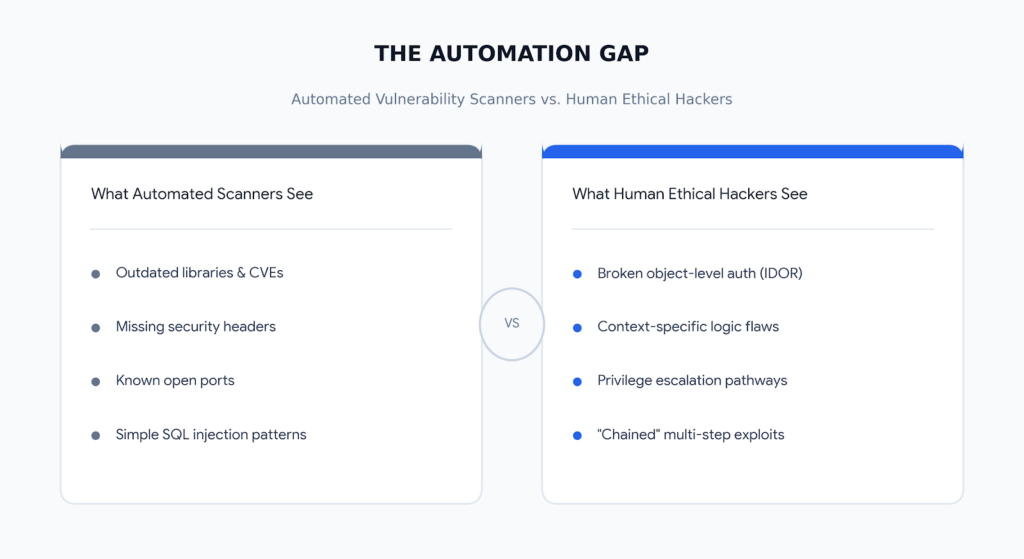
The blind spots cluster around three patterns. Business logic flaws happen when an application’s legitimate features are manipulated in ways developers never intended; the app is technically functioning exactly as coded, so a scanner sees no error. An e-commerce system that lets a user submit a negative quantity in the API payload, resulting in a negative total that credits the attacker’s card, will pass a scan with a clean report. A human tester spots the logical inconsistency immediately.
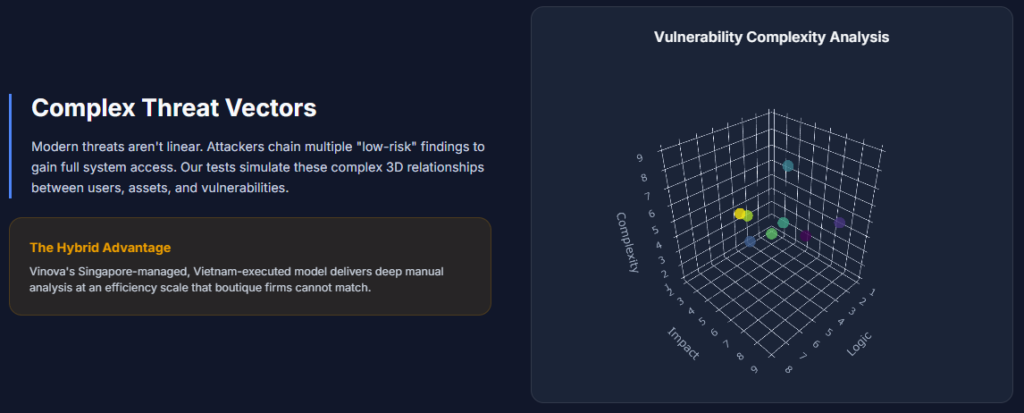
- Scanners also assess vulnerabilities in isolation, rating each on a standard CVSS scale, while real attackers rarely rely on one high-severity flaw. They chain three or four low-severity or informational findings together, a directory listing here, an API disclosure there, into a full authentication bypass. And because scanners can’t distinguish real exploitability from surface-level pattern matches, they generate high volumes of false positives that cost development teams hours to investigate, while missing custom-built features and proprietary integrations entirely.
How Vinova Closes the Automation Gap
A robust security posture does not mean abandoning your automated tools. It means balancing daily automated hygiene with deep-dive, human-led assurance.
At Vinova, we don’t just build cutting-edge software; we build resilient digital ecosystems. With over 16 years of experience securing systems for government agencies and multinational enterprises, we approach IT security penetration testing differently.
The Hybrid Delivery Model: We deliver our services through a highly efficient, ISO-compliant hybrid model. Singapore-based Project Managers govern every engagement in your timezone, ensuring strict adherence to PDPA, MAS TRM, and GovTech requirements, while our certified ethical hackers in our Vietnam Center of Excellence execute the testing.
The Design Thinking Mindset: We don’t just run scripts; we map the entire user journey. By understanding how users are supposed to interact with your system, our ethical hackers can intuitively predict where developers might have made logical assumptions, uncovering deeply hidden vulnerabilities that scanners miss.
Expertise in Complex Integrations: Data breaches often happen where different systems talk to each other. We heavily test the integration layers between your custom apps and complex enterprise backends (like SAP or Salesforce) to ensure third-party middleware can’t be used as a backdoor.
Our Hybrid Security Delivery Model: Local Assurance, Global Talent
Vinova delivers penetration testing through an ISO-compliant hybrid model. Singapore-based Project and Account Managers govern every engagement in your timezone, aligning methodology, data-handling, and reporting with PDPA, MAS TRM, and GovTech requirements, while manual testing execution runs through our Vietnam Center of Excellence. Our testers hold industry-recognized credentials including OSCP, CEH, and CISSP, and every engagement is bound by strict local NDAs and ISO-compliant data handling. This structure lets us dedicate significantly more hours to painstaking manual analysis and creative exploitation than a purely local boutique firm can, at a more efficient cost.
The Comparative Blueprint: Automation vs. Vinova Manual Testing
Still wondering how to justify the budget for a manual test? Here is a quick scorecard of where automated tools fall short, and how Vinova’s human-led approach fills the gap:
| What Automated Scanners Do | What Vinova’s Human Ethical Hackers Do |
|---|---|
| Find known typos & syntax errors | Discover complex logic flaws & business loopholes |
| Flag theoretical risks | Prove real-world impact through safe, controlled exploitation |
| Look at issues one-by-one | “Chain” minor flaws together to demonstrate a full breach |
| Generate a high rate of false alarms | Deliver zero false positives (only validated, real threats) |
| Meet basic hygiene checklists | Satisfy deep, rigorous audits for MAS, GovTech, and PDPA |
| Spit out generic PDF reports | Provide executive briefs and the actual code snippets to fix the issues |
Actionable Roadmap: Implementing a Resilient Security Strategy
A robust security posture does not mean abandoning automated tools. Instead, it requires a balanced, highly strategic approach that combines continuous automation with periodic, deep-dive human expertise.
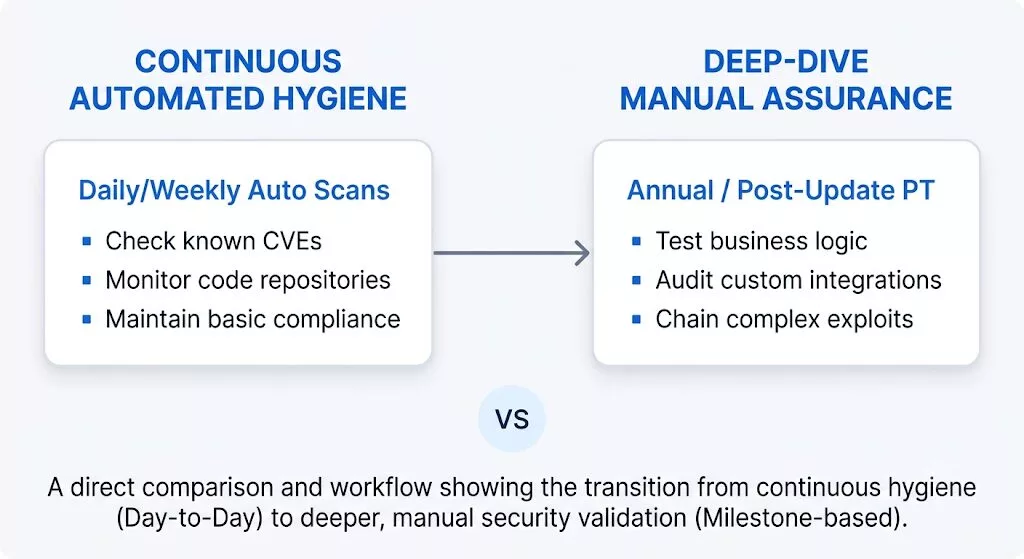
- Deploy Continuous Automated Guardrails: Use automated scanners within your CI/CD pipelines to catch standard syntax errors, outdated libraries, and basic misconfigurations during daily development.
- Schedule Regular Human-Led Penetration Tests: Conduct comprehensive, manual penetration testing by Vinova’s certified ethical hackers at least once or twice a year, or immediately following any major application release, platform integration, or architectural change.
- Validate Secure Integrations: Pay special attention to enterprise integrations (APIs, third-party middleware, cloud databases) to ensure data flowing between platforms is completely protected against intercept and manipulation.
- Remediate and Re-Test: Do not simply patch individual bugs. Partner with Vinova’s development and security teams to implement structural code fixes, utilize our AI-Assisted QA Framework to prevent regressions, and conduct validation testing to verify that vulnerabilities have been completely eradicated.
Conclusion: Partner with Vinova to Build Unshakable Trust
In the modern digital landscape, a single security breach can undo years of brand equity and permanently destroy customer loyalty.
Automated scanners are a good starting point, but they cannot replace the creative, adaptive problem-solving of a human ethical hacker.
Ready to move beyond the scanner? Contact the Vinova team today to schedule a consultation regarding our comprehensive QA assurance, including security penetration testing services and secure your digital future.