Written by Vinova’s Offshore Delivery & IT Outsourcing Practice. Reviewed by Senior Delivery Director. ISO 27001:2022 & ISO 9001:2015 Certified. APRA CPS 234-Aligned Delivery Framework.
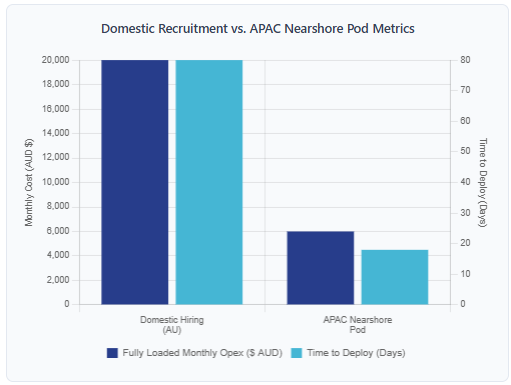
A senior cloud engineer in Sydney now costs upwards of AUD $1,800 a day, if you can find one. Hiring a permanent replacement takes 70 to 90 days on average. For a CTO staring down a delivery deadline, that’s not a budget line item, it’s a roadmap that’s already slipping.
The old fix, quietly shipping work to whichever offshore team quoted the lowest rate, doesn’t survive contact with 2026’s Australia anymore. APRA’s CPS 230 and CPS 234 standards are tighter, the OAIC is paying closer attention, and boards are asking pointed questions about who’s actually touching your data. An outsourcing partner has to earn that trust now, not just undercut on price.
So this guide is built around the questions that actually matter: what IT outsourcing means today, how nearshore delivery from Vietnam and the Philippines stacks up against onshore and offshore alternatives, which compliance obligations follow you offshore whether you like it or not, and a realistic 60-day path to a production-ready engineering pod.
Table of Contents
Key Takeaways
- Capability over arbitrage: high-performing Australian organizations outsource to close technical capacity gaps that take 60-90 days to fill domestically. Cost isn’t the primary driver, though nearshore engagements typically run 45-65% below onshore rates anyway.
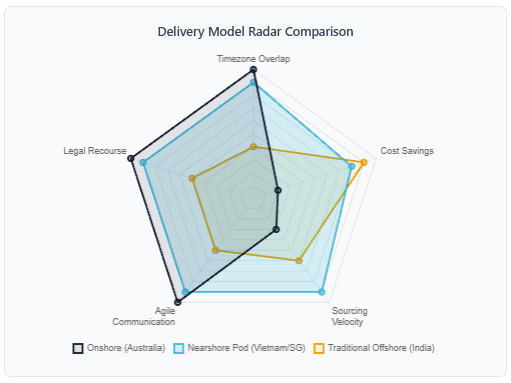
- The nearshore timezone advantage: Vietnam and the Philippines sit 0-3 hours behind AEST/AWST, letting Australian product owners run standups, sprint planning, and architecture reviews in normal business hours, unlike the 8-12 hour deltas US and European firms manage.
- Regulatory accountability doesn’t transfer: under Australian Privacy Principle 8 (APP 8), Australian principals stay legally responsible for how an overseas partner handles data (Privacy Act 1988, s.16C). APRA-regulated entities must additionally maintain supply-chain traceability under CPS 230 and CPS 234.
- A production-ready pod deploys in under 3 weeks through mature nearshore hubs, versus 70-90 days for an equivalent domestic senior hire.
- Zero Trust is now the baseline, not a differentiator: credible delivery partners operate inside ZTNA perimeters and synthetic-data sandboxes rather than shipping unmanaged laptops or raw production data offshore.
What Is IT Outsourcing in 2026, and How Does It Differ From Staff Augmentation and Managed Services?
Strip away the sales language and IT outsourcing is simple: you bring in a specialized external team to design, build, deploy, or maintain your technology instead of hiring for it directly. What’s changed by 2026 is how invisible the seams have gotten: outsourced squads now sit inside the same Jira boards, GitHub repos, and Slack channels as your internal team, running the same sprint rituals, to the point where “internal” and “outsourced” is often a distinction only HR still cares about.
Clearing up the terminology
For a deeper breakdown of when each model actually makes sense, Vinova’s ultimate guide to scaling with staff augmentation is a useful companion to the summary below.
| Model | Who Manages Day-to-Day | Commercial Structure | Best For |
|---|---|---|---|
| Staff Augmentation | You manage the individual directly | Hourly / Time & Materials | Filling individual skill gaps |
| Dedicated Squads (ODC) | Co-managed, full squad ownership | Monthly fixed rate per specialist / sprint retainer | Continuous product engineering |
| Managed Services (MSP) | Vendor manages against SLA | Ticket-based / uptime SLA | Maintenance, SecOps, helpdesk |
IT Outsourcing vs. Managed IT Services (MSP): IT outsourcing covers custom software development, cloud modernization, mobile applications, and dedicated engineering pods. An MSP focuses primarily on operational maintenance, network reliability, help desk support (L1-L3), and ongoing endpoint security.
Staff Augmentation vs. Dedicated Engineering Teams (Pods): staff augmentation inserts individual contractors directly into your internal team under your day-to-day supervision. Dedicated teams, or Offshore Development Centers (ODCs), provide an integrated, cross-functional unit (Tech Lead, Senior Developers, QA Automation, Scrum Master) delivering against defined backlogs and sprint milestones.
What services are actually outsourced in 2026
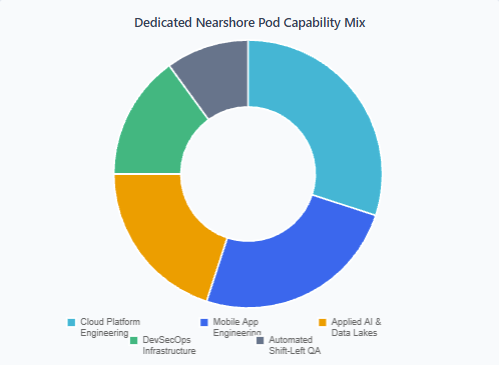
- Custom Software Development & Modernization: greenfield web and enterprise applications, decomposing legacy monolithic systems into microservices, and API integrations.
- Mobile Engineering: high-performance native iOS/Android applications and cross-platform builds (Flutter, React Native).
- Data Engineering, RPA & Applied AI: retrieval-augmented generation (RAG) pipelines, data warehouse architectures (Snowflake, Databricks), robotic process automation, and enterprise workflow automation.
- DevOps & Cloud Platform Engineering: designing, provisioning, and securing multi-cloud platforms across AWS, Azure, and Google Cloud Platform.
- Automated QA & Shift-Left Testing: test-driven development, continuous integration test automation, and security regression gates.
The State of IT Outsourcing in Australia: 2026 Landscape
The domestic talent crunch and escalating day rates
Domestic contractor day rates for senior engineers across Sydney, Melbourne, and Brisbane sit between AUD $1,200 and $1,800+ for specialized cloud, data, and full-stack capabilities. Hiring cycles for permanent senior software engineers average 70 to 90 days. Partnering with mature nearshore hubs allows companies to assemble and deploy production-ready pods in under 3 weeks, the exact dynamic Vinova breaks down in why staff augmentation has become a game changer for tech companies facing the same crunch.
The strategic nearshore corridor
Unlike US or European firms managing 8-12 hour time deltas with overseas teams, Australian businesses share geographic proximity with the Asia-Pacific region:
- Perth (AWST / UTC+8): synchronous with Singapore, Malaysia, and the Philippines; 1 hour ahead of Vietnam.
- Sydney/Melbourne (AEST / UTC+10): 2 hours ahead of the Philippines and Singapore; 3 hours ahead of Vietnam.
This temporal alignment lets product owners and solution architects hold synchronous standups, sprint planning, and architecture reviews during normal business hours without requiring remote teams to work off-hours. A 09:00 AEST Sydney start maps to 06:00 ICT in Hanoi / 07:00 SGT in Singapore; an 11:00 AEST standup lands at 08:00 ICT, a natural morning standup window; 13:00–17:00 AEST is a fully synchronous collaborative engineering window.
From cost arbitrage to Total Cost of Ownership (TCO)
Australian CTOs and CFOs have largely abandoned the search for the cheapest hourly labor. The focus in 2026 is Total Cost of Ownership: code maintainability and rework costs, English communication proficiency and architectural comprehension, and low attrition within the partner’s engineering bench to protect institutional domain knowledge. Vinova’s own breakdown of the trade-offs in IT staff hiring covers this calculation in more depth for teams still weighing it internally.
IT Outsourcing Services and Capabilities
Vinova deploys dedicated squads across the full modern development toolchain, mapped directly to the services outlined above:
Custom software development and modernization
Modern web architectures, microservices, containerization (Docker, Kubernetes), and cloud-native backends across AWS, Azure, and Google Cloud.
Mobile engineering
Native iOS (Swift), Android (Kotlin), and cross-platform frameworks (Flutter, React Native).
Data engineering, RPA, and applied AI
End-to-end data pipelines, custom LLM and RAG integrations, and robotic process automation (RPA).
DevOps and cloud platform engineering
Multi-cloud provisioning and security across AWS, Azure, and Google Cloud Platform, with CI/CD pipelines built for the DORA benchmarks covered later in this guide.
Automated QA and shift-left testing
Comprehensive test engineering embedded directly into client CI/CD pipelines from day one.
Industry Use Cases: Regulated and Public-Sector Delivery
Government and public sector
Vinova has delivered software partnerships with GovTech Singapore, the Monetary Authority of Singapore (MAS), the Ministry of Education (MOE), the Ministry of Culture, Community and Youth (MCCY), the Singapore Police Force, IPOS International, and the Singapore Institute of Technology (SIT), the kind of regulated, security-audited delivery environment that translates directly to APRA- and ACSC-governed Australian engagements.
Financial services and regulated enterprise
Vinova’s work with the Monetary Authority of Singapore is the same discipline APRA CPS 234 asks of Australian financial services suppliers: audited security controls, documented supply-chain risk, and ISO/IEC 27001:2022 as a starting point, not a box ticked after the contract’s signed.
Healthcare and utilities
Long-standing engineering engagements with SP Group (SP Digital) and SingHealth demonstrate delivery inside utilities and healthcare environments where data sensitivity and uptime requirements leave no room for informal engagement models.
IT Outsourcing Models: Geographic and Commercial Comparison
Geographic delivery comparison
| Metric | Onshore (Australia) | Nearshore (Vietnam, Philippines) | Offshore (India, Eastern Europe) |
|---|---|---|---|
| Timezone variance | 0 hours | 0-3 hours behind AEST | 4.5-9 hours behind AEST |
| Cost savings | Baseline (0%) | 45-65% | 55-75% |
| Communication cadence | Native context | High business fluency; aligned Agile cadence | Process-driven; asynchronous handoffs |
| Best suited for | Sensitive sovereign data, executive advisory, on-site requirements | Modern cloud applications, mobile engineering, dedicated product pods | Large enterprise legacy support, mass back-office migrations |
Nearshore hub breakdown: Vietnam leads in pure software engineering, data science, and mobile development, with STEM-heavy training producing engineers strong in cloud architectures, microservices, and Flutter/React Native. The Philippines pairs strong English proficiency with cultural alignment to Australia, excelling in technical customer support and mainstream web development (.NET, PHP, Java). India offers unmatched scale for multi-thousand-seat enterprise transformations involving SAP, Salesforce, and legacy core banking infrastructure.
Commercial structures
- Dedicated Engineering Pods (ODC): monthly fixed rate per specialist or sprint retainer. Best for continuous product engineering and long-term roadmap scaling.
- Staff Augmentation: hourly / Time & Materials (T&M). Best for short-term capacity bottlenecks and niche legacy skills.
- Project-Based Delivery: milestone-based fixed price. Best for MVPs, isolated integrations, and clearly specified builds.
For a closer look at how these models compare against a fully managed service specifically, Vinova’s guide to flexible staffing solutions breaks down the control, responsibility, and integration trade-offs in more depth.
Compliance, Security, and Governance (The Australian Framework)
Operating with a distributed team does not absolve Australian directors and technical executives from statutory liability. Contracts and delivery processes need to align with domestic frameworks from sprint zero.
The Privacy Act 1988 and APP 8
Under Australian Privacy Principle 8 (APP 8), an Australian organization disclosing personal information to an overseas recipient remains legally responsible for any act or practice by that recipient that breaches the APPs (Privacy Act 1988, s.16C). Mitigation requires robust Data Processing Agreements (DPAs) with model contractual clauses, plus strict data masking and synthetic data seeding in staging so external developers never touch live Australian production PII.
APRA CPS 230 and CPS 234
For APRA-regulated institutions (banking, insurance, superannuation) and tier-1 fintech suppliers: CPS 234 mandates that third-party service providers maintain security controls commensurate with asset criticality, with audited credentials such as ISO/IEC 27001:2022 and SOC 2 Type II as baseline requirements, not nice-to-haves. CPS 230 requires regulated institutions to audit material supply-chain dependencies and maintain operational resilience plans across external technology partners.
The ACSC Essential Eight
Distributed engineering squads accessing Australian infrastructure need to contractually adhere to the Australian Cyber Security Centre’s Essential Eight baseline, including phishing-resistant, hardware-backed or FIDO2-compliant MFA across all repositories and cloud consoles, and least-privilege access. External developers should never hold direct write permissions to production databases, routed instead through role-based access control (RBAC) and secure ZTNA jump hosts.
IP assignment under common law
Agreements should stipulate that all IP, documentation, architectural designs, and source code assign automatically and exclusively to the Australian principal upon creation and payment, under Master Service Agreements governed by Australian state law (NSW or Victoria) or a neutral arbitration jurisdiction such as Singapore.
| Looking for an IT Outsourcing Partner That Already Works This Way? APP 8, APRA CPS 234, and the ACSC Essential Eight aren’t paperwork Vinova bolts on after the fact. They’re built into how our Vietnam ODCs already operate for regulated Singapore government and financial-sector clients, the same delivery discipline you’d be bringing into an Australian engagement, not a compliance exercise starting from zero. See How Vinova’s IT Staff Augmentation & Outsourcing Services Work |
Technical Risk and Engineering Quality Controls
| DORA Metric | Target Standard |
|---|---|
| Deployment Frequency | Multiple production runs per week |
| Lead Time for Changes | Under 48 hours, commit to staging |
| Change Failure Rate | Under 5% of deployments |
| Mean Time to Restore | Under 1 hour in production |
Technical debt and architectural drift. A team paid to move fast on tickets will, left unchecked, quietly skip documentation and cut corners on architecture. The fix isn’t a lecture about best practices. It’s branch protection that forces internal tech lead review on core components, and static analysis (SonarQube, Snyk) that simply won’t let a merge through below an 80% test coverage threshold. Make the guardrail automatic and the discipline stops depending on goodwill.
Knowledge silos and vendor dependency. The real risk here shows up later, not now: system knowledge quietly concentrates in a handful of external heads, and offboarding becomes painful precisely when you’d want it to be easy. Require living architectural documentation (Confluence or Notion, whatever you already use) as an explicit sprint deliverable, and keep every repository and CI/CD pipeline in your own cloud tenancy, not theirs.
Communication and team culture. The quietest risk of all is a partner who just says yes. A team that nods along instead of flagging a bad spec will let technical debt pile up until it’s expensive to unwind. Open sprint retrospectives, where external tech leads are genuinely expected to push back on ambiguous requirements, are the difference between a vendor and a partner.
The Engineering Lifecycle: A 60-Day Ramp-Up
Phase 1: Scope definition and technical audit (Weeks 1-2)
Audit internal toolchains, environments, and repositories. Establish core metrics: sprint velocity, coverage targets, DORA KPIs. Configure secure ZTNA environments and repository access controls.
Phase 2: Partner vetting and candidate interviews (Weeks 3-4)
Review technical credentials (ISO 27001, enterprise case studies). Conduct live coding and systems design interviews with candidate engineers. Finalize DPAs, cross-border privacy terms, and commercial MSAs.
Phase 3: The paid pilot sprint (Weeks 5-8)
Deploy a 2-4 engineer pod on an isolated, non-critical backlog. Evaluate PR cycle times, code coverage, and communication cadence. Test timezone handoffs and joint sprint ceremonies.
Phase 4: Full operational integration and scaling (Week 9+)
Embed the nearshore squad into daily ceremonies: standups, planning, retros. Transition critical feature backlogs to joint ownership. Run monthly SLA, DORA, and governance reviews.
What Defines a Top IT Outsourcing Partner?
Choosing the right IT outsourcing partner in Australia is a risk decision as much as a capability one. Vinova’s own 10-point checklist for choosing an augmentation partner is a useful companion for working through this internally before a single vendor call.
Core evaluation criteria
- Total Cost of Ownership discipline, not just day-rate arbitrage: a credible partner talks about code maintainability, rework cost, and attrition, not just hourly savings.
- Regulatory fluency specific to Australia: working knowledge of APP 8, APRA CPS 230/234 (where relevant), and the ACSC Essential Eight, evidenced by actual delivery experience in audited, regulated environments.
- Timezone-synchronous delivery: genuine 0-3 hour overlap with AEST/AWST for real-time standups and architecture reviews, not asynchronous handoffs marketed as “collaboration.”
- Engineering quality controls that are visible, not promised: branch protection, enforced test-coverage thresholds, and DORA-benchmarked delivery metrics you can actually see in the contract.
Questions to ask before hiring
- What’s your typical timeline from signed MSA to a production-ready pod, and can you evidence a sub-3-week deployment?
- How do you structure Data Processing Agreements for APP 8 compliance, and how is production PII kept out of staging environments?
- What’s your enforced test coverage threshold, and what tooling blocks a merge that falls below it?
- Where does IP assign under the contract, and which jurisdiction governs the MSA?
- Can you show DORA metrics (deployment frequency, lead time, change failure rate) from a comparable live engagement?
Frequently Asked Questions
What does IT outsourcing cost for an Australian business in 2026?
Rates vary by engagement model, seniority, and specialization. A dedicated senior software engineer in Vietnam typically costs between AUD $4,500 and $7,500 per month, fully loaded with infrastructure, hardware, and benefits. Equivalent domestic full-time contractors or employees cost AUD $12,000 to $20,000+ per month once superannuation, payroll taxes, and recruitment margins are factored in.
Does transferring development offshore breach Australian privacy laws?
No, provided your organization complies with Australian Privacy Principle 8 (APP 8). This requires taking reasonable steps to ensure the overseas recipient upholds privacy protections equivalent to the APPs, achieved through binding Data Processing Agreements, strict confidentiality covenants, and data masking to keep production PII isolated from staging environments.
How do we protect our intellectual property when working across borders?
Execute contracts governed by Australian state law or an established common-law jurisdiction such as Singapore, with clear, immediate IP assignment clauses upon payment. Require all engineering work inside your organization’s cloud tenancy, VDI, and GitHub/GitLab repositories, with least-privilege RBAC and Zero Trust policies enforced throughout.
What should remain in-house when outsourcing IT functions?
Enterprise architecture leadership, overarching product vision, proprietary business algorithms, direct regulatory relationships (APRA, OAIC), and final production deployment approvals should stay under direct internal control.
What’s the difference between staff augmentation and a dedicated ODC team?
Staff augmentation drops individual contractors into your existing team, and you manage them day to day, billed hourly or T&M. Think of it as borrowing hands. A dedicated ODC is a whole squad instead: Tech Lead, developers, QA, Scrum Master, delivering against your backlog under a monthly or sprint-based structure, with the vendor sharing real ownership of what gets shipped, not just showing up to tickets.
How long does it take to actually stand up a nearshore team?
Mature nearshore hubs can assemble and deploy a production-ready pod in under 3 weeks, against 70-90 days for an equivalent domestic senior hire, though the 60-day ramp-up in this guide (scoping, vetting, a paid pilot sprint, then full integration) is the realistic timeline to a fully embedded, trusted team.
Is nearshore delivery from Vietnam actually timezone-compatible with Australian business hours?
Yes. Vietnam sits only 3 hours behind AEST and 1 hour behind AWST, close enough that standups, sprint planning, and architecture reviews run in real time during a normal Australian working day, unlike the 8-12 hour deltas typical of US or European offshore arrangements.
Work With Vinova for Nearshore IT Outsourcing
The talent gap, the compliance obligations, and the timezone math in this guide all point the same direction: Australian businesses need a nearshore partner that treats APP 8, APRA alignment, and DORA-benchmarked delivery as the baseline, not a differentiator. Vinova’s Vietnam-based ODCs run 3 hours behind AEST, giving Australian product owners real-time collaboration without the offshore compliance risk of a 9-hour delta.
| Vinova: Singapore’s IT outsourcing and nearshore engineering partner since 2010. ISO 27001:2022 and ISO 9001:2015 certified. 300+ projects delivered for 250+ clients across Singapore and APAC, spanning government, financial regulation, energy and utilities, and healthcare. Financial Times Top 500 High-Growth Companies Asia-Pacific 2026. The Straits Times Singapore’s Fastest-Growing Companies 2024, 2025, and 2026. Contact Vinova to Schedule a Consultation with Our Delivery Team |