By the Vinova Engineering Team. Reviewed under ISO 27001:2022 and ISO 9001:2015 delivery standards.
The Short Answer
Software developer vs software engineer is a question about responsibility, not vocabulary. A software developer builds the features users see, at the application layer. A software engineer owns the system those features run on: its scalability, reliability, security, and running cost. Job titles overlap across employers, so the honest test is the work a role is accountable for. In Singapore, the Ministry of Manpower (MOM) lists “Software developer” as a single shortage occupation, with “software engineer” as an eligible job title, so a Complementarity Assessment Framework (COMPASS) check looks at the duties performed, not the title on the offer letter.
Most job ads treat ‘developer’ and ‘engineer’ as synonyms. Your infrastructure bill and MOM do not. A Software Engineer ad that describes only frontend feature changes is a mismatch waiting to be questioned, and the platform finds out the first time it has to scale.
Confusing the difference between a software developer and a software engineer is not a semantic slip. It is a hiring decision that determines whether your platform scales, whether your infrastructure costs balloon, and whether your Employment Pass (EP) applications stand up to scrutiny. Software developers are application-layer builders who optimize for feature velocity. Software engineers are systems-level architects accountable for the infrastructure those features depend on. Put the wrong person in the wrong seat, and the cost surfaces later as technical debt, platform fragility, and a compliance file that does not match the work.
The question for a Chief Technology Officer (CTO) is not which title belongs on the job ad. It is which system risk the person you hire will be accountable for.
This guide gives CTOs, HR business partners, and enterprise technology leaders the facts to make that call: the architectural distinction between the two roles, the 2026 software developer vs software engineer salary benchmarks, what Singapore’s COMPASS framework actually checks, and how Vinova’s Singapore-Vietnam hybrid model closes the senior engineering gap that makes this decision harder than it should be.
Key Takeaways
- The developer builds features; the engineer owns the system. The split is architectural. Treat it as a question of responsibilities, because titles overlap across employers and one person often does both in a small team.
- The loaded cost of onshore hiring is not a flat 17% uplift. Employer Central Provident Fund (CPF) is capped by the SGD 8,000 monthly ordinary wage ceiling, so it adds at most SGD 1,360 a month. The larger costs are recruitment time, vacancy, and attrition.
- COMPASS checks duties, not titles. MOM treats “Software developer” as one shortage occupation, with “software engineer” as an eligible job title. A job description must reflect the listed duties, and a systems-level role should say so explicitly.
- 4. A Singapore-Vietnam hybrid answers the shortage. Singapore-based architects own design and governance, and Vietnam-based squads join your sprint pipeline in 2 to 4 weeks.
Table of Contents
Software Developer vs Software Engineer: The Core Architectural Distinction
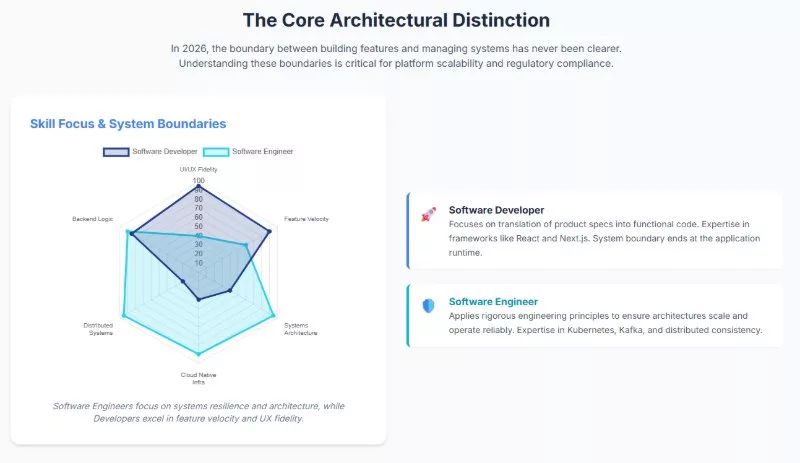
Understanding the difference between a software developer and an engineer starts with system boundaries. Industry usage varies, and some employers use the two titles interchangeably. For hiring purposes, the distinction that matters is the one between hands-on application coding and system design, and between shipping the next feature and owning the architecture that carries every feature.
Who is a Software Developer?
A software developer is an application-focused builder whose craft is turning product specifications into working code quickly and accurately. The focus is the feature layer: visual components, user journeys, form validation, and application-level business logic. Developers bring deep framework expertise across languages and tools such as React, Next.js, Node.js, Python, Java, C++, and Django, and they are strongest where a product needs polished interfaces and well-built workflows.
The developer’s system boundary is the application runtime. They integrate with external APIs and databases, and they treat networks, container orchestration, and hardware as utilities managed by other teams. Their performance indicators are feature delivery speed, testing and debugging accuracy, and UI/UX quality.
Who is a Software Engineer?
A software engineer is a systems-focused practitioner who applies engineering discipline so that architectures scale, stay reliable, remain secure under heavy load, and keep long-term operating costs down. The boundary extends past the application runtime to the full system lifecycle: network topologies, distributed message queues, database partitioning strategies, automated deployment environments, container orchestration, and cloud infrastructure.
An engineer evaluates every change against non-functional constraints: horizontal scalability, latency under load, threat-modeled security, and operational resilience. If nobody is accountable for latency under load, the first person to measure it is a customer. A failure at this level exposes the enterprise to financial, reputational, and regulatory consequences that a developer-only team cannot resolve alone.
Developer vs Engineer at a Glance
| Parameter | Software developer | Software engineer |
| Primary objective | Building consumer-facing features, client application flows, and functional business layers | Developing distributed system architectures, ensuring platform uptime, and optimizing horizontal scalability |
| Scope of impact | Localized: application modules, feature states, pages, and workflows | Systemic: API contracts, database scaling, cross-service communication, and deployment environments |
| Core analytical focus | UI/UX fidelity, frontend framework lifecycles, and application state correctness | Algorithmic efficiency, distributed consistency patterns, load profiling, and failure-mode analysis |
| Tech stack depth | Framework-heavy specialization: React, Node.js, Next.js, Tailwind CSS | Systems-heavy competence: Kubernetes, Kafka, Terraform, gRPC, distributed caching |
| Architecture ownership | Integrates with existing databases, schemas, and pre-defined API endpoints | Designs microservices architectures, defines caching topologies, and implements zero-trust security postures |
| Impact on total cost of ownership | Medium: tied to functional requirements, feature delivery, and product milestones | High: significantly affects compute costs, resource utilization, and long-term platform debt |
In a ten-person startup, one person may carry both mandates. The distinction earns its keep as the platform grows, because that is when nobody owns the system by default.
The Rule: Define the role by the risk it carries, not by the title on the ad.
Software Developer vs Software Engineer Salary: 2026 Singapore Benchmarks
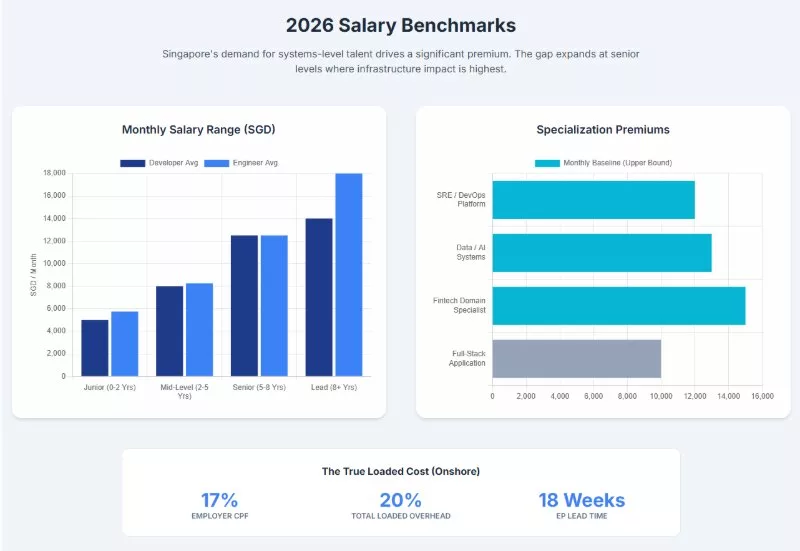
Singapore’s position as a regional technology and financial hub sustains strong demand for specialized technical talent. The software developer vs software engineer salary gap is narrow early in a career and widens at the lead and principal levels, where scope of responsibility and the impact on reliability, compute cost, and technical debt are greatest.
Indicative Monthly and Annual Base Salary by Seniority, Singapore 2026
| Seniority tier | Developer (monthly) | Developer (annual) | Engineer (monthly) | Engineer (annual) |
| Junior / entry (0 to 2 years) | SGD 4,000 to 6,000 | SGD 48,000 to 72,000 | SGD 4,500 to 7,000 | SGD 54,000 to 84,000 |
| Mid-level (2 to 5 years) | SGD 6,500 to 9,500 | SGD 78,000 to 114,000 | SGD 6,500 to 10,000 | SGD 78,000 to 120,000 |
| Senior specialist (5 to 8 years) | SGD 10,000 to 15,000 | SGD 120,000 to 180,000 | SGD 10,000 to 15,000 | SGD 120,000 to 180,000 |
| Lead / principal (8+ years) | SGD 12,000 to 16,000+ | SGD 144,000 to 192,000+ | SGD 14,000 to 22,000+ | SGD 168,000 to 264,000+ |
These are indicative base-salary ranges on a 12-month basis. They exclude the 13th-month Annual Wage Supplement, performance bonuses, and equity, which can add materially to total compensation. Published salary sources rarely separate the two titles cleanly, so read the gap as directional. For junior software developers and software engineers, the pay difference is small because entry-level responsibilities have not yet diverged.
The Takeaway: The pay gap is a lead-and-principal story. At junior and senior-specialist levels the ranges overlap heavily.
Employer tier premium
Total compensation depends heavily on the type of employer:
- Global technology platforms pay at the top of the market, and bonuses and equity lift total compensation well above the base ranges in the table.
- Regional banks and sovereign investors offer stable structures, with annual bonuses forming a large share of total pay for senior engineers.
- Local small and medium-sized enterprises (SMEs) and startups sit closer to the baseline and compensate with faster promotion cycles and equity.
Specialization premiums
Certain specializations command premiums over the developer-versus-engineer baseline:
Indicative Monthly Base Salary by Specialization, 2026
| Specialization | Monthly base salary (2026) | What drives the premium |
| Site Reliability Engineering (SRE) / DevOps platform engineer | SGD 8,000 to 12,000+ | Demand for cloud-native infrastructure automation |
| Data / AI systems engineer | SGD 8,500 to 13,000+ | Enterprise AI adoption and large-scale data pipeline engineering |
| Fintech domain specialist | SGD 9,000 to 15,000+ | Regulated financial systems, distributed ledger technologies, and high-throughput transaction engines |
| Full-stack application developer | SGD 6,500 to 10,000 | Market baseline: generalist application development and framework-level integration |
The true loaded cost of onshore hiring
When budgeting an onshore technical hire, finance and HR leaders need the full loaded cost. For Singapore Citizens and Permanent Residents (PRs), employers contribute 17% of ordinary wages to CPF, but only up to the SGD 8,000 monthly ordinary wage ceiling in 2026. That caps employer CPF at SGD 1,360 a month, so its weight falls as salaries rise. Employment Pass holders do not attract employer CPF. Bonuses attract CPF up to the annual wage ceiling of SGD 102,000.
Employer CPF at 17% With the SGD 8,000 Ordinary Wage Ceiling (Citizens and PRs)
| Monthly base salary | Employer CPF per month | CPF as a share of base |
| SGD 6,000 | SGD 1,020 | 17.0% |
| SGD 8,000 | SGD 1,360 | 17.0% |
| SGD 13,000 | SGD 1,360 | 10.5% |
| SGD 20,000 | SGD 1,360 | 6.8% |
Newer PRs contribute at graduated rates in their first two years. Add recruitment fees, benefits, equipment, and the weeks a senior systems role sits vacant, and the largest cost of an onshore hire is usually time, not the CPF line.
Daily Responsibilities: How the Roles Differ in Practice
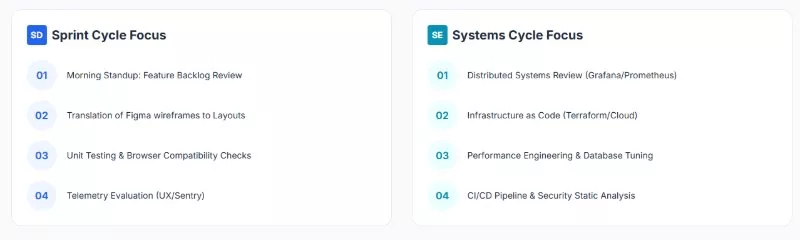
Beyond salary tables and COMPASS points, the difference between the two roles becomes clearest in the daily workflow. The two roles use different tools, collaborate differently, and define success differently. One focuses on delivering applications quickly, and the other on keeping the architecture scalable and reliable. The two cycles below show the contrast, and they set out the core software engineer job responsibilities at enterprise scale.
A Software Developer’s sprint cycle
At Vinova, the difference is felt daily in standups, sprint reviews, and deployment pipelines. A developer’s day follows the sprint backlog and localized feature requests:
- Morning standup: reviewing the Jira and GitHub backlog, with a focus on user-facing feature requests, layout bugs, and API integration tasks.
- Visual asset translation: converting Figma wireframes into responsive web layouts with modern frontend libraries.
- Application-level database work: writing migrations, configuring Object-Relational Mapping (ORM) frameworks, and building backend endpoints.
- Localized testing: unit tests in Jest, browser compatibility checks, and regression fixes from real-time feedback.
- Telemetry review: analyzing client-side dashboards (Sentry, LogRocket) to find layout shifts and slow interactions.
A Software Engineer’s systems cycle
An engineer’s day is structured around system telemetry, architectural integrity, and automated infrastructure delivery:
- Distributed systems review: Grafana and Prometheus dashboards that expose platform performance, database locks, and latency trends across server networks.
- Enterprise architecture design: working with principal architects to draft system blueprints using the C4 model.
- Infrastructure as Code (IaC): writing and deploying Terraform or CloudFormation templates for Amazon Web Services (AWS), Microsoft Azure, or Google Cloud Platform (GCP) environments.
- Performance engineering: analyzing query paths, implementing Redis caching hierarchies, and tuning service communication protocols such as gRPC and Apache Kafka.
- Continuous integration and continuous delivery (CI/CD) pipeline maintenance: optimizing release pipelines, enforcing SonarQube static analysis gates, and running performance regression tests under simulated load.
COMPASS Framework: How Role Definitions Affect EP Applications
MOM’s COMPASS scores EP applications out of a 40-point pass mark. Four foundational criteria (C1 to C4) are worth up to 20 points each, and two bonus criteria (C5 and C6) reward shortage skills and participation in Strategic Economic Priorities programs. Candidates must also meet the EP qualifying salary before COMPASS is applied. For enterprise hiring managers, the software developer vs engineer roles question matters in how duties are documented, because that is what MOM verifies.
COMPASS Criteria and Points
| Criterion | What it measures | Points |
| C1. Salary | Fixed monthly salary against local Professionals, Managers, Executives and Technicians (PMET) salaries in the sector, by age | 20 at the 90th percentile or above; 10 from the 65th to below the 90th; 0 below the 65th |
| C2. Qualifications | Degree-equivalent qualifications | 20 for a top-tier institution; 10 for other degree-equivalent qualifications; 0 for none |
| C3. Diversity | Share of the candidate’s nationality among the firm’s PMETs | 20 if under 5%; 10 if 5% to under 25%; 0 if 25% or more |
| C4. Support for local employment | The firm’s local PMET share relative to its sector | 20 at the 50th percentile or above; 10 from the 20th to below the 50th; 0 below the 20th |
| C5. Skills bonus | Job is on the Shortage Occupation List (SOL) | 20 if the nationality share among PMETs is under one third; 10 if it is one third or more |
| C6. Strategic Economic Priorities bonus | Participation in an eligible program, at the discretion of the supporting agency | 10 |
Salary benchmarks (C1) and the qualifying salary
Candidate salaries are compared against local PMET benchmarks by sector and age. Separately, every EP applicant must clear a minimum qualifying salary that rises with age, and that minimum steps up on 1 January 2027.
EP Qualifying Salary (Fixed Monthly), New Applications
| Sector | 2026 (age 23 and below, rising to age 45+) | From 1 January 2027 (age 23 and below, rising to age 45+) |
| All sectors except financial services | SGD 5,600 rising to SGD 10,700 | SGD 6,000 rising to SGD 11,500 |
| Financial services | SGD 6,200 rising to SGD 11,800 | SGD 6,600 rising to SGD 12,700 |
The C1 benchmarks themselves are refreshed for applications submitted from 1 January 2027. A senior systems role pitched at a mid-level salary can leave C1 points on the table, so align the salary offer with the seniority the job description claims. Candidates earning at least SGD 22,500 a month remain exempt from COMPASS.
Firm-level diversity and local support (C3 and C4)
C3 rewards a firm whose PMET workforce is not dominated by the candidate’s nationality, and C4 rewards a firm with a strong local PMET share relative to its sector. Firms with fewer than 25 PMETs score 10 points each for C3 and C4 by default.
Shortage Occupation List bonus (C5)
MOM’s Shortage Occupation List, released in November 2025 and applied to new and renewal EP applications from 1 January 2026, covers a range of technology occupations. It lists “Software developer” with “Software engineer” as an eligible job title, alongside occupations such as applications or systems programmer, web and mobile applications developer, cloud specialist, and cybersecurity architect. In practice, that means developer and engineer are not two separate COMPASS tracks.
What MOM checks is whether the candidate will perform the duties of the listed occupation. Where a candidate needs the C5 points to pass COMPASS, further job-requirement checks apply. A Software Engineer application whose job description describes only frontend feature changes is a mismatch waiting to be questioned, so a systems-level role should document systems-level duties: designing distributed services, managing Infrastructure as Code, or owning DevSecOps pipelines. MOM may add or remove occupations once a year, so confirm the current list before building a hiring plan around C5 points.
The 5-year Employment Pass for tech professionals in shortage
Experienced tech professionals in an SOL occupation can apply for a 5-year Employment Pass, which gives both the professional and the employer greater certainty than a standard renewal cycle. The candidate must pass COMPASS with at least 10 points on C3, meet a higher fixed monthly salary threshold, and clear further verification checks. This pass is separate from the Tech.Pass, which is an Economic Development Board (EDB) program for established tech entrepreneurs, leaders, and experts.
Minimum Fixed Monthly Salary for the 5-Year Tech EP
| Application date | Age 36 and below | Age 45 and above |
| New applications from 1 January 2025 | At least SGD 10,700 | SGD 14,270 |
| New applications from 1 January 2027 | At least SGD 11,500 | SGD 15,499 |
The required salary rises with age between those bands. For Principal Software Engineers and Staff Engineers whose pay already clears the threshold, this is a practical route to retain rare systems talent without annual renewal friction.making the tech pass a practical option for retaining rare systems talent without annual renewal friction.
The Singapore-Vietnam Corridor: Solving the Developer vs Engineer Talent Gap
Singapore’s local market struggles to supply enough senior software engineers to meet enterprise demand, and work-pass planning adds lead time for any foreign hire. Many Singapore enterprises, from established technology companies in Singapore to specialized AI companies in Singapore, close the gap with a hybrid execution model: strategic engineering leadership based in Singapore, and high-throughput delivery teams operating from Vietnam.
Why Vietnam
Vietnam has become a primary nearshore destination for Singapore-based enterprises for three structural reasons:
- Talent pipeline: a deep and growing pool of IT graduates and experienced software engineers across Hanoi, Da Nang, and Ho Chi Minh City.
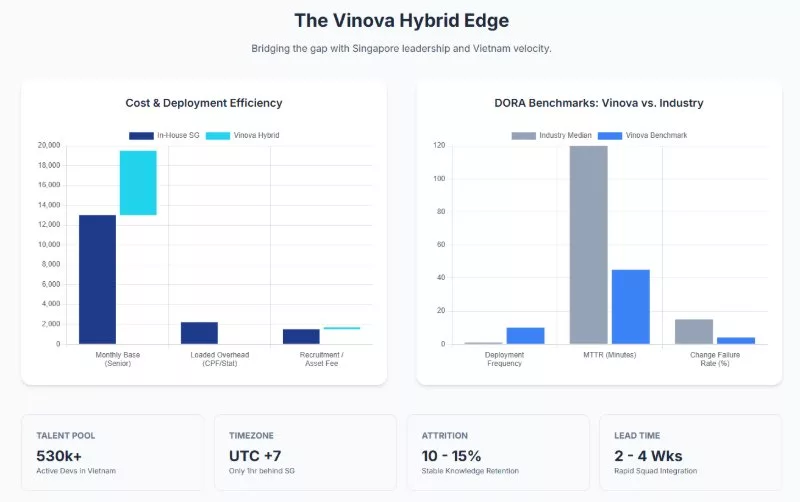
- Timezone alignment: UTC+7, one hour behind Singapore, which allows real-time daily standups across the full Singapore business day.
- Continuity: stable delivery teams, so system knowledge stays with the project. Vinova’s own delivery teams run at 8% to 12% annual voluntary attrition.
An enterprise that activates a Vietnam-based delivery partner can have a cross-functional engineering squad integrated into its sprint pipeline in 2 to 4 weeks. That is the structural answer to a senior engineering shortage that work-pass timelines cannot solve on their own.
The Vinova Engineering Ecosystem: Singapore Governance, Vietnam Velocity
Singapore’s tech talent shortage is a structural constraint, driven by local pipeline limits, work-pass timelines, and bidding wars that most SMEs and mid-market enterprises cannot win. Vinova’s Singapore-Vietnam hybrid model was built for exactly this: not as a staffing workaround, but as a precision corporate software development and custom software development Singapore delivery architecture that government agencies and regulated financial institutions in Singapore have relied on across 16 years of delivery.
Vinova is a Singapore-headquartered engineering consultancy established in 2010, recognized among Singapore’s Top 100 Fastest-Growing Companies in 2024, 2025, and 2026. It has built web and mobile applications for enterprises and agencies throughout that time, and you can see how it compares among the app development companies in Singapore.
Its work spans projects delivered as a trusted hybrid app development company, along with Android and iPhone application development. Vinova is certified to ISO 9001:2015 and ISO/IEC 27001:2022 and has been an International Software Testing Qualifications Board (ISTQB) Partner since 2023.
In December 2025, Vinova entered a strategic alliance with the Vietnamese IT firm Rikkeisoft, widening its delivery pipeline across Southeast Asia. Vinova is also an AWS Advanced Tier Partner with expertise in serverless architectures and microservices, a Microsoft Azure partner specializing in directory synchronization and enterprise security, and a GCP Registered Partner supporting GKE, BigQuery, and AI model training. The company also provides managed IT services Singapore enterprises rely on for ongoing platform management, maintenance, and support.
AI-augmented engineering delivery
Vinova’s Vietnam-based teams work under a proprietary AI-assisted delivery framework that brings GitHub Copilot, Cursor, and Claude into pair-programming workflows. The assistants take on boilerplate, and senior engineers keep their capacity for the work that needs judgment: systems design, review, and architectural decisions. It is a delivery precision model, and it happens to cost less than equivalent Singapore-only hiring.
DORA performance benchmarks
The DevOps Research and Assessment (DORA) program, run by Google Cloud, groups teams into performance clusters on four delivery metrics. The table sets the 2024 medium and elite clusters beside Vinova’s delivery benchmarks. DORA 2024 renamed the recovery metric from mean time to recover to failed deployment recovery time.
DORA Delivery Metrics: 2024 Clusters vs the Vinova Benchmark
| DORA metric | DORA 2024 medium cluster | DORA 2024 elite cluster | Vinova benchmark |
| Deployment frequency | Weekly to monthly | On demand | On demand; multiple times per day through Jenkins, GitHub Actions, and Bitbucket Pipelines |
| Lead time for changes | 1 week to 1 month | Under 1 day | Hours; automated infrastructure provisioning and trunk-based development |
| Failed deployment recovery time | Under 1 day | Under 1 hour | Under 1 hour; automated telemetry, rollbacks, and self-healing cloud containers |
| Change failure rate | 10% | 5% | Under 4%; SonarQube static analysis gates and automated regression test loops |
Enterprise Case Studies: Where Developers and Engineers Each Own the Outcome
The clearest proof of how Vinova applies engineering principles comes from client work. The four engagements below span government, education, finance, and shipping, and each shows how the developer vs engineer in tech accountability split plays out against a different architectural challenge. Client names are withheld, and details are available under NDA.
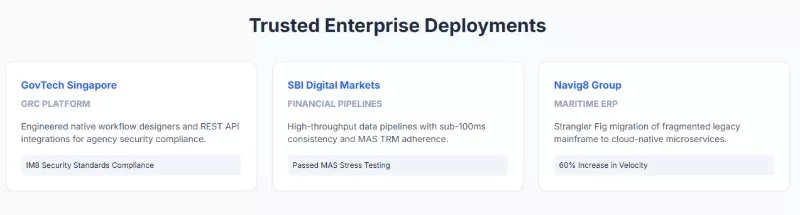
Singapore public sector: multi-agency governance, risk, and compliance platform
- Challenge: Build an automated, user-centric risk assessment engine across multiple government agencies under IM8 security controls and GeBIZ procurement guidelines.
- Architecture: Custom enterprise integration on ServiceNow Integrated Risk Management (IRM) modules. Vinova engineered native business rules, workflow designers, scripting frameworks, and REST API integrations so agencies could shift security compliance left into their development cycles.
Singapore university: personalized learning platform for the freshman cohort
- Challenge: Build a scalable personalized learning environment for university freshmen while maintaining campus network security.
- Architecture: Dynamic Bayesian Knowledge Tracing (BKT) over student diagnostic data in real time, personalizing content difficulty and pacing. Built through Design Thinking workshops and two-week Agile sprints.
Singapore financial markets operator: high-throughput data pipelines
- Challenge: Transaction immutability, sub-100ms processing consistency, and strict adherence to Monetary Authority of Singapore (MAS) Technology Risk Management (TRM) guidelines.
- Architecture: Dedicated engineering squads of 20 to 30+ specialists building custom high-throughput financial data pipelines on a single-tenant cloud architecture, with field-level encryption, non-bypassable audit logging, and automated security scanning.
Global maritime shipping group: Enterprise Resource Planning (ERP) modernization without downtime
- Challenge: Modernize a fragmented legacy shipping mainframe spanning 20+ logistics modules without interrupting active worldwide operations.
- Architecture: The Strangler Fig pattern: cloud-native microservices built progressively around the legacy monolith, with data routing shifted transparently through event-driven Kafka pipelines.
Reported Outcomes by Engagement
| Engagement | Reported outcome |
| Singapore public sector GRC platform | Multiple agencies moved from reactive, audit-driven compliance to automated risk assessment inside their development pipelines, delivered under public sector security standards |
| Singapore university learning platform | Measurable improvement in self-regulated learning behaviors and academic resilience; scaled to the full freshman cohort within campus IT security parameters, with zero compliance incidents |
| Singapore financial markets operator | Platform built to MAS TRM guidelines, with encryption, audit logging, and security scanning in the delivery pipeline |
| Global maritime shipping group | 60% higher development velocity and zero operational downtime during the migration |
Book a complimentary 2-hour technical consultation with Vinova’s Singapore-based engineering team. We will map your current talent gaps, recommend the right developer-to-engineer ratio for your architecture stage, and design a compliant, cost-effective delivery plan. No commitment required.
Schedule Your Free 2-Hour Engineering Team Consultation with Vinova →
Hiring Comparison: In-House Singapore vs. Vinova Hybrid Model
In-House Onshore Hiring vs the Vinova Hybrid Model
| Dimension | In-house onshore hiring (Singapore) | Vinova hybrid model (Singapore and Vietnam) |
| Sourcing and onboarding speed | Weeks to months for a senior hire, and longer when a work pass is needed | Pre-vetted cross-functional squads in your sprint pipeline in 2 to 4 weeks |
| Work pass and quota friction | Foreign hires must clear the EP qualifying salary and 40 COMPASS points | Offshore engineers sit outside Singapore work-pass requirements, while Singapore-based leads cover architecture and governance |
| Total cost of ownership | Base salary, employer CPF (up to SGD 1,360 a month for Citizens and PRs), benefits, recruitment fees, and workstation | Typically 40% to 60% below equivalent onshore engineering cost, depending on seniority mix |
| Team stability | Exposed to local bidding for senior talent, which puts system knowledge at risk | 8% to 12% annual voluntary attrition across Vinova delivery teams, keeping system knowledge in your project |
| Security and compliance | Varies with each employer’s training and controls | Built on ISO 9001 and ISO 27001 workflows, with MAS TRM and Personal Data Protection Act (PDPA) alignment and offshore delivery secured through virtual desktop infrastructure |
Software Developer vs Software Engineer FAQ
What is the difference between a software developer and a software engineer?
A software developer builds the application layer: features, interfaces, and business logic. A software engineer owns the system beneath it: architecture, scalability, reliability, security, and cost. Job titles overlap across employers, so the better test is the responsibilities a role is accountable for. If a role must answer for uptime, latency under load, and infrastructure cost, it is an engineering role whatever the title says.
Can a software developer transition into a software engineer role without a computer science degree?
Yes, provided the professional builds systems fundamentals deliberately. The move means going beyond framework-specific work to computational fundamentals: Big O complexity, memory management, distributed database replication, and microservices orchestration. SkillsFuture and the TechSkills Accelerator (TeSA) from the Infocomm Media Development Authority (IMDA) offer subsidized pathways to industry certifications such as AWS Certified Solutions Architect and Certified Kubernetes Administrator, which validate these competencies.
For HR leaders weighing upskilling against a delivery partner, an internal developer-to-engineer transition can take a year or more and does not guarantee retention. Vinova can integrate a production-ready Senior Software Engineer into a client’s sprint pipeline within 2 to 4 weeks.
How does Singapore’s COMPASS framework treat developer and engineer EP applications?
MOM lists “Software developer” as a single shortage occupation, with “Software engineer” as an eligible job title, so the two are not separate COMPASS tracks. MOM assesses whether the candidate will perform the listed duties, and where the C5 shortage points are needed to pass, further job-requirement checks apply.
A Software Engineer application whose job description is limited to frontend feature changes invites questions. Employers should document systems-level responsibilities explicitly: distributed services design, Infrastructure as Code, or DevSecOps pipeline ownership. Vinova assists clients with job description structuring as part of hybrid hiring engagements.
Why do software engineers command higher salaries than software developers in Singapore?
At junior and senior levels, the ranges overlap heavily. The premium shows most clearly at the lead and principal levels, where the scope of responsibility differs. A developer’s impact is localized to user stories and interfaces. An engineer manages systemic risk: the infrastructure handling high concurrent traffic, protecting sensitive data, and maintaining uptime. A failure at that level costs far more than the salary difference.
Software engineers also bring computer science fundamentals, site reliability expertise, and cloud architecture knowledge, skills that are scarce in Singapore’s market and that compound in value at the senior and principal levels.
What certifications accelerate a software engineer’s career in Singapore?
Cloud architecture: AWS Certified Solutions Architect (Professional) or Google Cloud Professional Cloud Architect.
Container orchestration and DevOps: Certified Kubernetes Administrator (CKA), the industry standard for managing containerized applications at scale.
Security and DevSecOps: CREST Practitioner Security Analyst or Certified Information Systems Security Professional (CISSP), both valued by financial institutions and government agencies in Singapore’s regulated sectors.
When should a Singapore startup hire its first Principal Software Engineer instead of scaling developers?
The trigger is infrastructure stress, not team size. Three signals matter: the application shows API performance bottlenecks or database latency spikes under concurrent traffic; the codebase needs to move from a monolith to microservices; or the platform must meet data protection and risk regulations (PDPA, MAS TRM) that require a systems architect to design and secure the core infrastructure from the foundation.
Hiring a Principal Engineer before these signals appear adds overhead without proportionate value. Waiting too long after they appear builds technical debt that is far more expensive to resolve.
How does Vinova’s hybrid model handle the developer versus engineer distinction across Singapore and Vietnam?
Vinova structures hybrid teams around a clear accountability split. Singapore-based Senior Solution Architects and Principal Engineers own system design, compliance mapping, and architectural decisions. Vietnam-based squads execute sprint delivery, feature builds, automated testing, and infrastructure configuration under those standards.
Senior systems judgment stays in-timezone and in-jurisdiction, while high-volume execution scales offshore without the employer CPF overhead, work-pass friction, or hiring lag of local senior engineering hires. Clients work with a Singapore-based Project Manager as their single point of accountability throughout.
Software Developer vs Software Engineer, Resolved: Define the Role by the Risk It Carries
Hiring decisions rarely fail because of the wrong title on a job ad. They fail when the responsibilities behind the title do not match the system risk being managed, whether that shows up as a work-pass query, a platform outage, or a senior hire who leaves within a year.
Enterprises that get the developer-versus-engineer call right treat it as an architectural decision first and a compensation decision second. They define system boundaries clearly, budget for the full cost of the role they genuinely need, and build a pipeline, onshore, offshore, or hybrid, that supplies both without waiting out a multi-month queue. Vinova’s Singapore-Vietnam model is built around that accountability:
- Fiduciary Governance & Regulatory Alignment: Delivery operations certified under ISO/IEC 27001:2022 (Information Security) and ISO 9001:2015 (Quality Management) and GovTech Category 1B approved, with architectures designed to align with MAS TRM and PDPA data protection requirements.
- Singapore Corporate Governance: Master Services Agreements governed under Singapore law with Singapore International Arbitration Centre (SIAC) arbitration, so intellectual property ownership and accountability are defined before the first commit.
- Software Engineering Practice: Application developers, systems engineers, and DevSecOps specialists working in one delivery structure, so feature velocity and platform reliability answer to the same governance.
- Engineering Depth: 300+ in-house engineers across Singapore and Vietnam delivery hubs in Ho Chi Minh City, Da Nang, and Hanoi, with 8% to 12% annual voluntary attrition, so the people who build your platform are still there to run it.
Ready to map the right mix of developers and engineers for your platform? Talk to a Vinova engineering lead or explore Vinova’s software development services.e with a Singapore-based Project Manager as their single point of accountability throughout.
Vinova: a Singaporean Government-Grade Digital Transformation Partner, Made Accessible. For 16 years, we have designed digital systems for 300+ companies and government agencies worldwide, backed by ISO 27001:2022 and ISO 9001:2015 certification and Singapore GovTech Category 1B approval.
300+ employees across offices in Singapore, Vietnam (Hanoi, Da Nang, Ho Chi Minh City), Norway (Oslo), and Thailand (Bangkok), scaling platforms and engineering capacity to serve clients across the globe. Financial Times Top 500 High-Growth Companies Asia-Pacific 2026. Recognized among Singapore’s Top 100 Fastest-Growing Companies in 2024, 2025, and 2026.