By Vinova’s AI and Enterprise Architecture Practice Group, 16+ years of IT consulting leadership in Singapore and Southeast Asia
| “In our direct engineering engagements across Singapore’s public sector and enterprise landscape, ranging from automated patent claim analysis for IPOS International to AI-assisted engineering panels for energy providers like SP Digital, the primary bottleneck in 2026 is no longer model capability. It’s integrating deterministic guardrails, AI-native QA, and strict data isolation into legacy enterprise systems.”— Vinova AI Practice Lead |
Is your organisation still treating neural networks like a sandbox experiment? That phase is over. Fuelled by Singapore’s National AI Strategy 2.0 (NAIS 2.0) and over S$1 billion in targeted government funding, AI in Singapore has matured into critical national and enterprise infrastructure across Southeast Asia, and what we’re building for clients on the ground reflects that shift directly. The broader AI industry Singapore has built is now one of the most closely watched in the region.
Custom enterprise AI development now commands a dominant share of Singapore’s technology service sector. As regional enterprises move from pilot projects to mission-critical operations, the executive agenda has pivoted decisively toward high-yield architecture, agentic orchestration, sovereign compute, and measurable ROI, the six trends in AI Singapore enterprises are actually acting on below. This AI transformation Singapore is undergoing didn’t happen by accident, it’s the direct result of coordinated government funding and enterprise demand arriving at the same time.
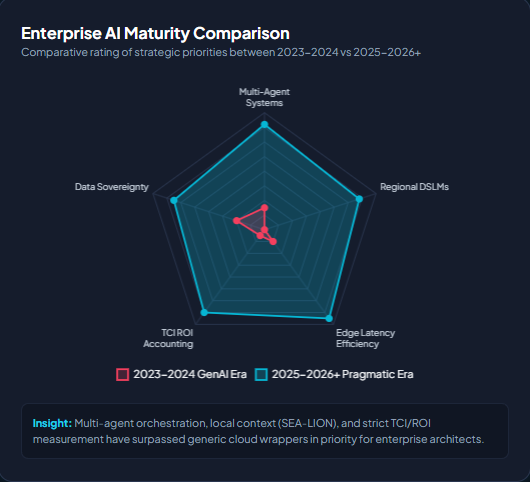
| Dimension | Experimental GenAI Era (2023-2024) | Pragmatic Execution Era (2025-2026+) |
| Interface | Single-turn chat interfaces | Multi-agent systems (MAS) |
| Models | Off-the-shelf cloud wrappers | Regional DSLMs (e.g. SEA-LION) |
| Latency | High-latency external APIs | On-device and edge intelligence |
| Proof | Unquantified proofs-of-concept | Rigorous TCI and ROI accounting |
Table of Contents
The Macro AI Shift: From Experimental Hype to Applied Execution
Among the trends in AI Singapore has seen since 2023, this shift from hype to execution is the one underpinning all the others below.
In 2024 and 2025, organisations across Asia-Pacific deployed lightweight wrappers built on third-party cloud models. Generic models failed to provide defensible moats, struggled with Southeast Asia’s linguistic diversity, and raised real data sovereignty concerns under the Personal Data Protection Act (PDPA). In 2026, Singapore’s enterprise landscape has shifted toward custom systems engineered for localised context, strict data security, and verifiable business yield.
The question we hear from clients has changed accordingly. It’s no longer “what can GenAI write for us,” it’s “what is our Total Cost of Intelligence relative to operational throughput.” That’s a genuinely different, harder question, and it’s the one this guide is built to help answer.
6 Core Technology Trends Defining the Future of AI in Singapore
These are the trends in AI Singapore enterprises are budgeting against right now, not theoretical roadmap items:
1. Multi-Agent Systems (MAS) and Agentic Workflows
Standalone AI assistants have evolved into collaborative multi-agent architectures tailored for complex enterprise processes like maritime trade routing, wealth management compliance, and automated document synthesis. Specialised agents break down instructions, interact with legacy ERPs and databases via APIs, and handle edge-case exceptions without manual intervention.
To satisfy MAS regulatory requirements, production systems combine probabilistic agentic logic with deterministic guardrail layers validated through Behaviour-Driven Development, and high-value decisions, cross-border trade financing, IP patent claims, clinical diagnostic validation, automatically flag a human expert for sign-off rather than executing unsupervised.
What we’re seeing directly: this guardrail-and-HITL pattern is exactly what we built into the automated patent claim analysis system for IPOS International, probabilistic AI doing the heavy lifting, with deterministic checkpoints before anything reaches a decision-maker. That structure is becoming the default we recommend for any agentic workflow touching a regulated or high-stakes decision, not just patent examination.
2. Domain-Specific Models (DSLMs) and Efficient Small Models (SLMs)
Among the trends in AI Singapore enterprises are prioritising, this one shows up first in actual budget line items.
Monolithic LLMs are giving way to specialised, localised architectures built for regional nuance. Initiatives like IMDA’s SEA-LION (Southeast Asian Languages in One Network) outperform generic models on local languages and cultural context at a fraction of the inference cost, and processing power is decentralising fast: small models running locally on edge hardware and mobile terminals cut inference latency from typical cloud averages of 200-500 milliseconds down to under 20 milliseconds on-device. Over 94% of Singapore-based enterprise CIOs have already put Edge AI and SLMs on their immediate technology roadmap.
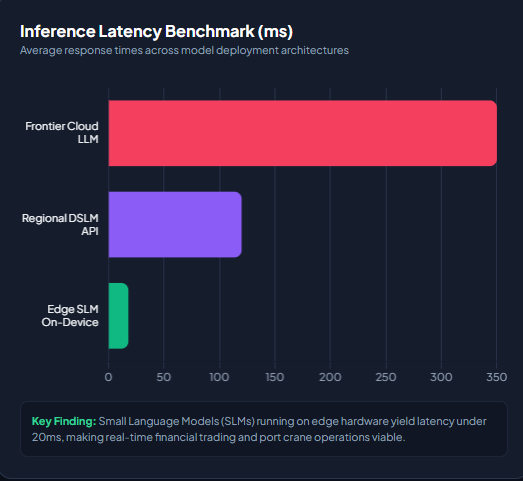
| Architectural Focus | Strategic Enterprise Advantage |
| Small Language Models (SLMs) | Under 20ms latency, on-premise privacy |
| Regional DSLMs (SEA-LION) | High precision in SEA languages and context |
| Frontier monolithic LLMs | Complex reasoning, global synthesis |
What we’re seeing directly: this is precisely why generic Western language models keep underperforming in Singapore specifically, they can’t reliably parse a patient or customer mixing English, Mandarin, Hokkien, and Malay in one sentence, which is completely normal here and completely unhandled by a model trained mostly on Western text. Building around regional and domain-specific models isn’t a nice-to-have for us, it’s the baseline for anything client-facing.
3. Sovereign Compute and Green Data Centre Architecture
Of all the trends in AI Singapore is navigating, this is the one least under any single enterprise’s control, and the most dependent on national infrastructure planning.
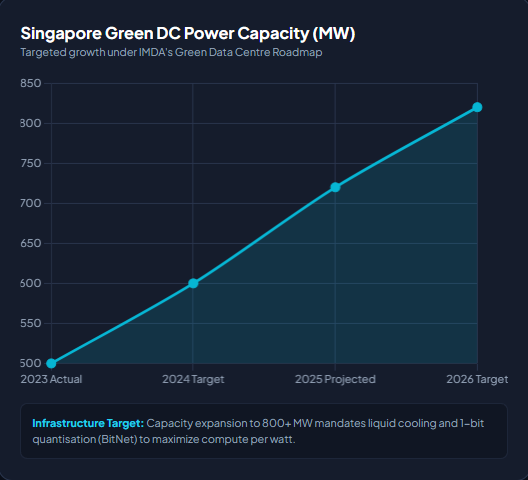
Land and power constraints have pushed Singapore to pioneer sustainable, high-density computing under IMDA’s Green Data Centre Roadmap, growing green-certified power capacity from roughly 500 MW in 2023 toward a targeted 800+ MW by 2026. Enterprise data centres are adopting tropical direct-to-chip liquid cooling and localised renewable integration to run high-density AI clusters within strict sustainability mandates, while local hubs lean on custom ASICs, optical interconnects, and 1-bit quantisation techniques like BitNet to maximise compute density per watt.
Where this affects what we build: we don’t build data centres, but application-layer efficiency is a real, controllable lever within our side of the stack, well-architected cloud deployments reduce unnecessary compute and data movement, which matters more every year as sustainability mandates tighten around the infrastructure our clients’ systems actually run on.
4. Overcoming Data Scarcity with Enterprise Knowledge Graphs
This is one of the trends in AI Singapore rarely gets credit for, since it’s unglamorous, invisible infrastructure work rather than a headline feature.
To avoid the limits of public web text and comply with strict data protection frameworks, enterprise AI engineering is centring on proprietary data curation. Privacy-compliant synthetic datasets let financial institutions and healthcare providers train models without exposing personally identifiable information, and structuring unstructured corporate data into unified knowledge graphs powers Retrieval-Augmented Generation engines rooted in verified enterprise truth rather than the open web.
What we’re seeing directly: this is the unglamorous work that actually determines whether a RAG system is useful or just confidently wrong, and it’s usually the single most underestimated line item in an AI project budget. Clients consistently plan for model selection and underestimate the data pipeline that has to exist underneath it.
5. Physical AI and Smart Nation Embodiment
In line with Singapore’s Smart Nation 2.0 vision, AI is expanding from digital software into physical systems. Embodied Vision-Language-Action (VLA) models now run autonomous harbour craft, automated port cranes at Tuas Port, and healthcare robotics, processing visual input and executing physical tasks in real time, while local research institutes and biotech firms apply AI to automated drug discovery, materials synthesis, and urban climate modelling.
6. AI Governance, Security Platforms, and Digital Provenance
The last of the six trends in AI Singapore enterprises now treat as a launch requirement, not a post-launch nicety.
As APAC’s leader in artificial intelligence Singapore governance, the city-state sets the regional benchmark for safe deployment, and it’s one of the reasons artificial intelligence companies in Singapore increasingly compete on compliance maturity, not just model quality. Enterprise systems align with the Model AI Governance Framework, MAS FEAT Principles (Fairness, Ethics, Accountability, Transparency), and IMDA’s AI Verify testing toolkit, with advanced defences increasingly built against prompt injection, model inversion, and multi-agent hijacking specifically. Cryptographic provenance tools like C2PA are also seeing real adoption to verify content authenticity and combat deepfakes.
What we’re seeing directly: this is where we spend a disproportionate amount of engineering effort relative to how little clients initially budget for it. Governance and security testing isn’t something we add before a compliance review, it’s built into the CI/CD pipeline from day one, which is the only way it actually holds up once a system is handling real production traffic.
Engineering Methodology: How We Actually Implement This
Tracking the trends in AI Singapore enterprises are adopting is one thing; actually engineering to them reliably is another.
Bridging AI strategy and production execution means grounding development in battle-tested software practice, not just a strong model.
- Design Thinking and Agile discovery: co-creating solutions through empathy-driven workshops so AI use cases align with real operational user journeys, the same process we ran in enterprise prototyping work with the Singapore Institute of Technology
- Shift-Left V-Model testing: applying the traditional software V-Model to AI systems so automated validation happens at every stage, test scenarios and BDD user stories defined early to catch bugs before they escape into production
- AI-native QA automation: evolving traditional QA into AI-assisted testing engineering, so edge cases, prompt responses, and security vulnerabilities get tested continuously inside automated CI/CD pipelines, not just before launch
Economic and Societal Transformations
Singapore’s investment in workforce transformation through SkillsFuture and AI apprenticeship initiatives is reshaping the local labour landscape. Industry labour analytics point to tech professionals with validated AI engineering and agentic architecture skills commanding a significant wage premium over standard software development roles, and AI integration is projected to add substantial economic value to Singapore’s GDP by 2030, driven by productivity gains in financial services, logistics, and advanced manufacturing. In logistics and maritime specifically, smart scheduling and autonomous port operations are already reducing vessel turnaround times by up to 25%.
The Executive Playbook: Capitalising on These Trends
Acting on these trends in AI Singapore has laid out comes down to three concrete steps:
1. Audit internal data maturity and PDPA compliance
Clean, structure, and govern internal data assets before deploying models. Ensure strict data segregation to comply with regional privacy mandates, this is the step most commonly skipped and most commonly regretted.
2. Choose open-source versus sovereign API models deliberately
Proprietary commercial APIs suit quick experiments and non-sensitive multi-modal tasks. Self-hosted open-weight and regional models become essential once core IP, data sovereignty, low-latency edge deployment, or localised multi-language context are actually on the line.
3. Optimise Total Cost of Intelligence via a secure dual-shore model
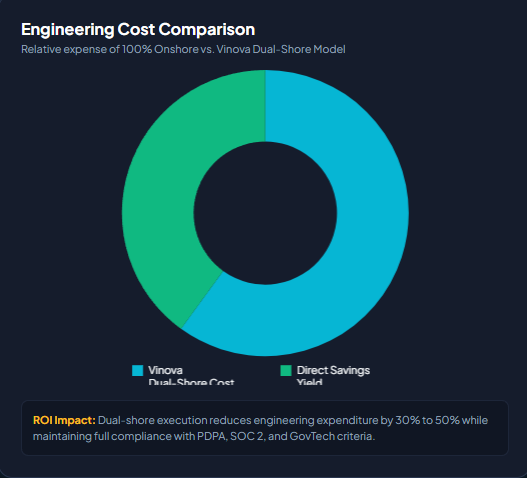
Balancing high domestic engineering costs against production demands is where a dual-shore delivery model earns its place: pairing Singapore-based strategy, architecture, and project leadership with dedicated development capacity in Vietnam. Vinova’s version of this typically reduces engineering costs by 30% to 50% while maintaining enterprise standards, security included, not traded away for the savings.
- Multi-layered ODC security architecture: ISO 27001 and ISO 9001 certified Dedicated Offshore Development Centres with physically and logically segregated project networks behind enterprise firewalls
- Data leak prevention: strict network policies blocking personal webmail and cloud storage on project devices
- Regulatory alignment: built to Singapore’s PDPA, SOC 2, GovTech supplier criteria (GovTech24014), and AI Verify standards
- A track record behind it: 16+ years delivering 300+ enterprise projects, including work for Abbott, IPOS International’s Patent Search and Examination Workbench, and energy leaders like SP Digital
Why Singapore Experience Is a Head Start for Scaling Into Australia
The same trends in AI Singapore is executing on today are the ones Australia’s own AI governance push is starting to demand.
Vinova doesn’t have an Australian office or an Australian AI client roster yet, and it would be dishonest to pretend otherwise. What Vinova does have is exactly the discipline Australia’s own AI governance push is now demanding: deterministic guardrails around agentic systems, MAS FEAT-aligned compliance work, and ISO 27001-certified delivery, all proven inside one of the region’s strictest regulatory environments.
Singapore’s AI Verify testing toolkit and Australia’s own emerging AI governance framework are converging on similar ground: transparency, human oversight for high-stakes decisions, and auditable model behaviour. The engineering discipline built for Singapore’s regulators isn’t a different skill set for Australia, it’s a considerably shorter learning curve than starting from zero, backed by a Singapore timezone that overlaps far more workably with Australia’s eastern states than a US or European AI vendor ever will.
| Ready to Engineer Production-Grade AI? Book a free consultation with Vinova’s AI Practice Group in Singapore. We’ll assess your data maturity, model strategy, and PDPA readiness. No commitment required. Schedule Your Free AI Strategy Consultation with Vinova |
Frequently Asked Questions
How does Singapore’s NAIS 2.0 impact enterprise AI adoption?
NAIS 2.0 provides national infrastructure support, government co-funding programmes, and clear governance frameworks like AI Verify. That combination is what lets enterprises move safely from initial prototypes to scalable production deployments, rather than stalling indefinitely in pilot purgatory.
What’s the difference between Generative AI and Agentic AI?
Generative AI creates text, images, or code in response to an immediate human prompt. Agentic AI adds autonomous reasoning, workflow planning, tool use, and execution, letting a system complete multi-step business processes with minimal manual intervention rather than waiting on the next prompt.
Why are Small Language Models and regional models like SEA-LION gaining ground in Singapore?
SLMs can run locally or on-premise, offering latency under 20 milliseconds, complete data privacy under PDPA, lower operational cost, and meaningfully better understanding of local Southeast Asian languages and business context than a general-purpose frontier model trained mostly on Western text.
How do Singapore enterprises ensure compliance with AI governance frameworks?
Organisations use tools like IMDA’s AI Verify to test models for fairness, transparency, and security, while adhering to MAS FEAT Principles for any financial-services deployment specifically.
What is Vinova’s dual-shore model, and how does it cut cost without cutting security?
Vinova pairs Singapore-headquartered project management and solution architecture with dedicated development teams in Vietnam. Security runs through an ISO 27001 and ISO 9001 certified Multi-Layered ODC Security Framework, network isolation, strict data leak prevention, and alignment with PDPA and MAS standards, while cutting engineering costs by roughly 30% to 50% compared to a fully onshore team.
What are the latest AI trends and top AI trends beyond Singapore specifically?
The current trends in AI globally track closely with what’s happening here, agentic workflows, smaller specialised models over ever-larger general ones, and governance moving from afterthought to architecture requirement, but Singapore is unusually far along on execution because NAIS 2.0 and AI Verify gave enterprises a clear regulatory path years before most markets had one. The trending AI technologies elsewhere are frequently what Singapore enterprises already shipped to production a cycle earlier.
Why do searches for “AI Singpore” and similar misspellings keep turning up results about Singapore’s AI industry?
It’s simply a common typo for “AI Singapore,” not a separate term, autocorrect and fast typing account for most of it. The underlying interest is the same: people tracking AI technology trends, AI research trends, and broader artificial intelligence trending topics specifically tied to Singapore’s regulatory and enterprise landscape, which is exactly what this guide covers regardless of how the search was typed.
| Vinova: Singapore’s AI and enterprise engineering partner since 2010. ISO 27001:2022 and ISO 9001:2015 certified, PDPA and AI Verify aligned. 300+ projects delivered for clients including Abbott, IPOS International, and SP Digital. Dual-shore delivery pairing Singapore strategy with dedicated Vietnam engineering capacity. Financial Times Top 500 High-Growth Companies Asia-Pacific 2026. The Straits Times Singapore’s Fastest-Growing Companies 2024, 2025, and 2026. Contact Vinova Singapore to build your AI roadmap. |