Learning how to build an AI app requires more than building a demo. It demands enterprise-grade architecture, compliance with Singapore’s PDPA and IMDA requirements, and a structured nine-step development lifecycle. This guide walks you through Vinova’s proven approach, from selecting the right technology stack to implementing production-ready security guardrails for Singapore businesses.
Key Takeaways:
- The cost to build an AI app at full enterprise grade in Singapore typically exceeds SGD 700,000 across a 6 to 10 month build, while a focused MVP can validate the architecture for SGD 40,000 to SGD 190,000 in just 8 to 12 weeks.
- Vinova’s Seamless Hybrid Delivery Model lowers development costs by 40% to 60% by pairing Singapore-based strategy and compliance with offshore engineering execution.
- A language-based data-leakage exploit that took 1.09 hours to negotiate in English succeeded instantly in Khmer, exposing how safety guardrails trained mainly in English fail on low-resource languages.
- IMDA’s Agentic AI Framework (Version 1.5, May 2026) requires a tiered autonomy model with 3 severity levels, restricting high-risk actions (e.g. bulk financial transactions) to human-only execution.
Table of Contents
Traditional App vs. AI App Architecture: The Structural Difference
Before you can create an AI app, your architecture team needs to understand what changes when you introduce a non-deterministic, probabilistic system into an enterprise stack. Traditional application design relies on strict, predictable control flows: a request arrives, hard-coded procedural logic processes it, a relational database returns a structured result, and a deterministic response is generated.
AI-powered agentic applications, especially those built on multi-agent systems, follow a fundamentally different execution model. Instead of relying on hard-coded control flows, the model dynamically plans tasks, selects tools, and determines execution paths based on real-time semantic context, making LLM integration a core part of the system architecture. Data retrieval also evolves from exact keyword matching to high-dimensional vector search, while error handling shifts from deterministic exception handling to iterative self-correction and schema validation.
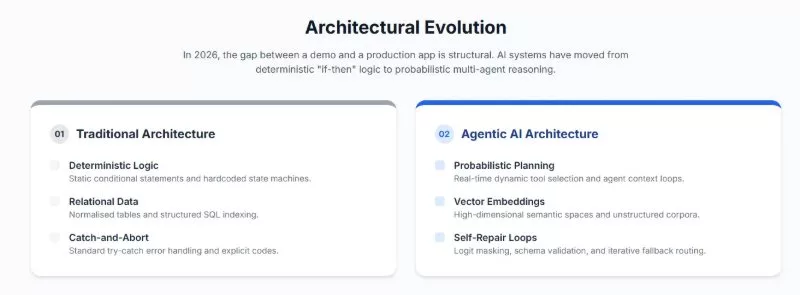
Architectural Axis | Traditional App Architectures | AI-Powered Agentic Applications (2026) |
Control flow logic | Deterministic: governed by static conditional statements and compiled state machine paths | Probabilistic: governed by real-time AI agents planning, dynamic prompt contexts, and model-directed tool selection |
Data ingestion | Relational schemas, transactional normalised tables, structured inputs, and predictable API payloads | Unstructured document corpora, dense vector embeddings, real-time semantic indices, and variable token windows |
Latency volatility | Predictable and bounded under consistent resource provisioning | Highly volatile: dependent on autoregressive token generation, multi-step tool loops, and agent handoffs |
Error handling | Catch-and-abort patterns: static exception handling, transaction rollbacks, and explicit error codes | Self-check and repair loops, logit masking, schema validation, and fallback model routing |
Infrastructure | Standard virtual machines, CPU-bound web servers, and standard cloud database instances | GPU-native processing clusters, tensor cores, specialised vector database layers, and edge cache networks |
Long-term TCO | Low to moderate: focused on software dependency patches, API version updates, and storage scaling | High: driven by continuous prompt optimisation, model drift tracking, vector indexing updates, and model retraining cycles |
These architectural differences influence every engineering decision that follows. This is why Vinova, one of the established technology companies in Singapore, adopts a risk-managed approach to legacy modernization using the Strangler Fig Pattern instead of high-risk, all-at-once migrations. Cloud-native microservices and AI capability layers are introduced around the existing monolith, allowing individual modules to be replaced incrementally while maintaining uninterrupted service for end users.
Vinova has successfully applied this approach to projects such as Navig8 Group’s Marine Shipping ERP and SP Digital (SP Group). It has become the preferred strategy for enterprises introducing AI capabilities into live operational systems without disrupting business operations, reflecting the level of corporate software development discipline expected in enterprise environments.
Choosing Your Tech Stack to Build an AI App
To build an AI app with an enterprise-grade backend, you need a cohesive stack across several computational layers. The foundational choice is between custom native development and managed enterprise builders.
Native framework development (Python and TypeScript SDKs)
Custom backends built with Python (FastAPI paired with LangGraph or CrewAI) or TypeScript (Node.js/Bun paired with Mastra) provide maximum control over performance tuning, database integrations, and security implementation to meet PDPA requirements. This is the technology stack Vinova uses to build AI application systems for healthcare, education, and financial services clients, reflecting the engineering practices adopted by leading app development companies in Singapore.
LangGraph (Python) is the standard for deep state management and cyclic agent paths requiring persistent thread memory and human-in-the-loop validation. Mastra (TypeScript) is the standard for full-stack TypeScript applications with built-in observability. Both integrate directly with Pydantic or Zod schema validation libraries to enforce structured output formats that prevent non-deterministic text from breaking downstream systems.
Managed enterprise builders (Retool, Bubble, OutSystems)
Managed low-code and no-code AI development platforms can significantly accelerate early prototyping, and they are often the fastest way for teams exploring how to create an AI app with no code. However, for highly regulated enterprise environments in Singapore, these platforms introduce four structural limitations that become critical in production:
- Data isolation gaps: these platforms typically cannot implement database-level Row-Level Security (RLS) across multi-tenant environments.
- Compliance bottlenecks: managed infrastructure makes it difficult to verify physical data residency or enforce Singapore sovereign-boundary network routing under PDPA Section 26.
- Latency overhead: multi-tier wrapper systems introduce additional routing hops that degrade conversational or real-time workflow performance.
- Platform lock-in: migrating complex business logic off a low-code architecture can require a complete rebuild.
Vinova has migrated multiple enterprise systems off restrictive low-code platforms to custom native architectures, an approach we also recommend to teams researching build AI apps for beginners who plan to scale beyond a first prototype. In every case, the replatforming returned the client’s full capital investment within two years of launch while restoring complete IP ownership and platform performance. For clients like Navig8 Group and SP Digital, this migration was executed using the Strangler Fig Pattern: zero-downtime, incremental module replacement so live operations continued uninterrupted throughout the transition.
How to Create an AI App: Vinova’s 9-Step Implementation Lifecycle
Vinova structures every AI application development engagement across nine milestone-based phases, a process refined through years of enterprise delivery experience as one of the trusted AI companies in Singapore. No data is extracted or migrated until the discovery phase receives formal approval. No integrations go live until User Acceptance Testing is completed and validated.
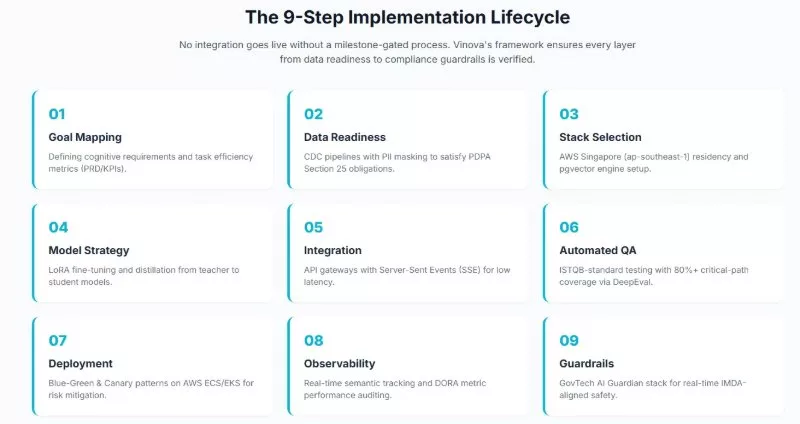
Step 1: Problem identification, goal setting, and success metric mapping
- Inputs: Business requirement drafts, user pain points, baseline operational costs, and legacy system bottleneck metrics.
- What happens: Define the exact cognitive requirements of the application (classification accuracy, entity extraction precision, planning step efficiency). Map success metrics to quantifiable targets: context retrieval precision thresholds, maximum response latency for transactional versus conversational tasks, and token budget limits.
- Deliverable: A formalised Product Requirements Document (PRD) with explicit KPIs, quantitative technical SLAs, and a structured system architecture topology.
Step 2: Data readiness assessment
- Inputs: Legacy databases, file servers, document repositories, and structural access governance policies.
- What happens: Audit all internal data sources against readiness criteria (completeness, timestamp validity, structural consistency). Deploy automated ingestion and extraction pipelines using Change Data Capture (CDC) to read, clean, and convert unstructured files into standardised Markdown or JSON without overloading production databases. Implement data-masking layers to scrub PII before model parsing, satisfying PDPA Section 25 retention and minimisation obligations.
- Deliverable: Mapped data lineage schemas, automated CDC pipeline configurations (Debezium to Apache Kafka), data sanitisation logs, and verified access-bounded raw data repositories.
Step 3: Tech stack and architecture selection
- Inputs: Performance requirements, expected request volume, query latency tolerances, and data residency restrictions.
- What happens: Evaluate trade-offs between pre-trained base APIs, custom RAG pipelines, and Supervised Fine-Tuning. Select hardware environments (AWS ap-southeast-1 Singapore region private VPC nodes) to prevent cross-border data residency violations under PDPA Section 26. Choose database engines (PostgreSQL with pgvector) that support high-performance vector retrieval and transactional security configurations.
- Deliverable: A finalised technology stack matrix specifying programming runtimes, vector storage layers, orchestration frameworks, and cloud hosting topologies.
Step 4: Model strategy execution
- What happens: Implement Supervised Fine-Tuning using Low-Rank Adaptation (LoRA) or run model distillation workflows where a large ‘teacher’ model generates synthetic training datasets that train a smaller, cost-effective ‘student’ model for specific domain tasks. Establish system prompts with strict context-anchoring and behavioural rules to prevent model drift. Define programmatic output validation schemas.
- Deliverable: Custom adapter configurations, validated model weight checkpoints, standardised system prompt templates, and active serialisation schemas.
Step 5: Model integration with mobile and web frontends
- What happens: Design and deploy secure API gateway wrappers around model inference nodes using streaming architectures (Server-Sent Events) to minimise perceived latency. Bind core model interfaces to specialised system tools with strict validation controls. Integrate model payloads with frontend consumer touchpoints: native iOS (SwiftUI/UIKit) or Android architectures, React/Next.js web applications.
- Deliverable: Production-ready API gateways, authenticated endpoints, interactive mobile and web client integration templates, and documented tool-calling interfaces for LLM integration.
Step 6: Automated testing, validation, and QA
- What happens: Construct offline and online automated testing pipelines using DeepEval. Deploy evaluation runners to programmatically measure target performance parameters including TaskCompletionMetric and StepEfficiencyMetric. Integrate evaluations into the CI/CD loop to automatically block prompt or code regressions. Vinova is an official ISTQB Partner since 2023, enforcing minimum 80% critical-path test coverage on every engagement.
- Deliverable: Automated QA workflows integrated into Git pipelines, comprehensive benchmark reports, and documented evaluation datasets.
Step 7: Production deployment and scale
- What happens: Package all application layers into secure Docker containers. Deploy across target clusters (AWS ECS or EKS) using Blue-Green or canary release patterns to minimise risk during production updates. Route 5% of traffic to the new deployment and monitor latency, output token distribution, and validation error rates in real time before full cutover. Connect endpoints to enterprise platforms (Odoo ERP, Salesforce, HRIS systems) for downstream workflow automation.
- Deliverable: Live production environments, automated container orchestration scripts, verified load balancer configurations, and canary routing schedules.
Step 8: Continuous real-time monitoring and observability
- What happens: Track tail latency profiles, token-level spending, operational error rates, and model output accuracy in real time. Use semantic tracking via LangSmith or Confident AI to identify data drift early. Configure automated alert thresholds for performance degradation or anomalies. Measure engineering delivery against DORA metrics (Deployment Frequency, Lead Time for Changes, MTTR, Change Failure Rate).
- Deliverable: Interactive operations dashboards, automated alerting configurations, centralised performance logs, and scheduled system health checks.
Step 9: Compliance, ethics, and security guardrails
- What happens: Deploy real-time input moderation intercepts (GovTech’s AI Guardian stack) to identify and block injection attempts, role-switching tricks, and prompt extraction patterns. Implement translation loops to secure regional multi-linguistic queries. Configure tiered human-in-the-loop validation checkpoints for sensitive, irreversible operations, aligned with the IMDA Model AI Governance Framework for Agentic AI (Version 1.5, May 2026).
- Deliverable: Live runtime guardrail filters, verified multi-language security configurations, documented regulatory audit trails, and human-in-the-loop workflow logs. After this step, the AI app has a defensible compliance posture that can survive a PDPC audit, satisfy MAS TRM notification requirements, and pass GovTech IM8 security review. That is what ‘production-ready’ means for a Singapore AI app.
Phase 1: Knowledge Augmentation via Retrieval-Augmented Generation (RAG)
RAG is the default architecture when you build an AI app on a knowledge base that is dynamic, access-controlled, and too large for a single model context window. It combines factual consistency, real-time data updates, and secure context-level access control without requiring model retraining every time the underlying data changes.
For enterprise systems operating under PDPA, data segregation across multi-tenant environments must be enforced at the database layer, not the application layer. Application-level filtering is a security risk: if a developer omits a tenant filtering condition in code, database queries can inadvertently expose data across tenant boundaries. Database-level Row-Level Security (RLS) enforces isolation structurally, so even if application code is wrong, the database engine still filters correctly.
Vinova implements high-throughput, event-driven, hybrid-cloud data pipelines to feed RAG architectures. Debezium handles Change Data Capture (CDC), streaming updates from legacy databases directly into Apache Kafka. Apache Airflow manages ETL orchestration. dbt unifies schemas across disparate data sources. A pgvector-enabled PostgreSQL database acts as the secure, multi-tenant vector store with HNSW indexing for fast similarity search. Each API query extracts the user’s tenant identifier from their validated session token before running vector searches, ensuring all retrieval is bounded by the requesting user’s access permissions.
Phase 2: Orchestrating Autonomous Multi-Agent AI App Systems
Complex enterprise AI apps require multi-agent orchestration: networks of autonomous AI agents that plan tasks, call tools, maintain state across sessions, and coordinate handoffs. A single agent is a starting point. Production enterprise systems that automate multi-step workflows (compliance monitoring, document processing, operational routing) require a supervisor-worker architecture where a coordinator agent decomposes tasks and delegates execution to specialised agents.
Vinova builds these workflows using LangGraph for Python stacks requiring deep state management, cyclic execution paths, and persistent thread memory. For TypeScript full-stack applications, Vinova uses Mastra with built-in observability and Zod schema validation for structured tool-calling interfaces. Both frameworks enforce the same principle: tool access is restricted to the minimum required for each agent’s role, with hardcoded permission boundaries rather than prompt-layer constraints.
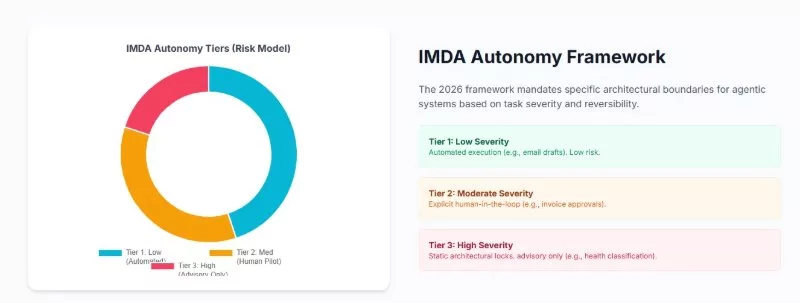
When multiple agents interact, systemic risks emerge: agent sprawl, miscoordination, and emergent behaviours outside the intended design boundaries. Singapore’s IMDA Agentic AI Framework (Version 1.5, May 2026) requires a tiered autonomy model:
- Tier 1 (Low Severity, Reversible): automated actions (email draft generation, password resets) run without direct human oversight but are logged for regular audit cycles.
- Tier 2 (Moderate Severity, Partially Reversible): business-critical operations (invoice approval processing, localised policy recommendations) require explicit human-in-the-loop review before execution.
- Tier 3 (High Severity, Limited Reversibility): highly sensitive actions (database permission changes, bulk financial transactions, health-risk classifications) are restricted to manual execution; the model serves as an advisory resource only.
Phase 3: Security, Privacy, and Guardrail Design for Your AI App
Deploying AI apps in Singapore’s regulated market introduces security challenges that standard web application firewalls alone cannot fully address. Unlike traditional software, AI systems operate probabilistically and may fail in unpredictable or difficult-to-detect ways. Effective guardrails must be designed into the architecture rather than added through configuration, which is where managed IT services in Singapore and specialised AI providers offer capabilities beyond generic development teams.
1. Input moderation layering
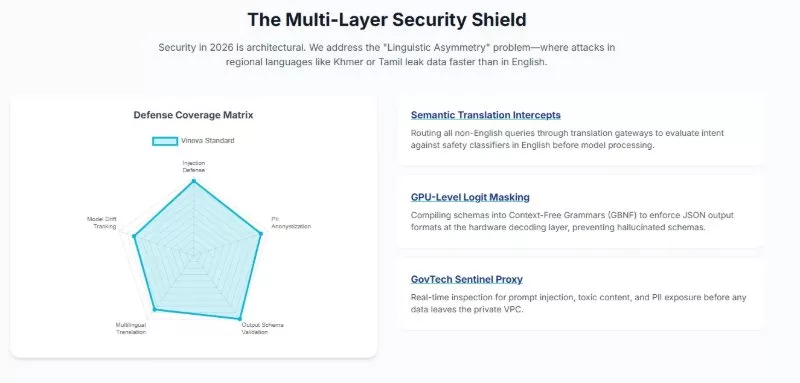
Before sending user inputs to the core model, the system inspects text for injection vectors, adversarial prompt structures, and regional language variations. Vinova routes all prompts and outputs through GovTech’s AI Guardian stack: Sentinel operates as a real-time proxy checking for system prompt leakage, toxic content, and PII before any query reaches the model. This is the same defensive middleware Vinova deploys for MAS, GovTech, OCBC Bank, and Prudential engagements.
2. Output structure validation
Production AI apps must prevent models from returning unstructured text to application services. Vinova enforces strict output schemas using Pydantic (Python) or Zod (TypeScript) validation libraries. For locally hosted models, JSON schemas are compiled directly into Context-Free Grammars (GBNF) to enforce output constraints at the GPU decoding layer via logit masking. This makes schema compliance a native infrastructure guarantee, not a post-processing check that fails when the model produces unexpected text.
3. Multilingual security: the Khmer exploit and linguistic asymmetry
Findings from the Singapore AI Safety Red Teaming Challenge 2026 identified a specific vulnerability that most AI app security configurations miss. Safety guardrails trained primarily on English datasets degrade or fail when inputs arrive in low-resource regional languages. The most striking case: an identical data-leakage attack took 1.09 hours of logical negotiation to extract information in English. The same attack pattern in Khmer leaked data instantly, because the model had insufficient safety-aligned training tokens for that language.
The mitigation: Translate non-English queries to English at the API gateway layer before evaluating intent against safety classifiers. Vinova implements translation intercepts as standard for any team that needs to build an AI app for a Singapore user base including Malay, Tamil, Tagalog, Vietnamese, or Khmer speakers. The same linguistic asymmetry applies to all of them.
4. Bounding autonomous action under IMDA Agentic AI Framework
Compliance with IMDA’s May 2026 framework requires implementing the tiered autonomy risk model described in Phase 2. The key architectural distinction: Tier 3 restrictions must be enforced through static system architecture (hardcoded API permission scopes, network isolation, database write-privilege locks), not through natural-language instructions telling the model not to take certain actions. A well-crafted adversarial prompt can override a system instruction. It cannot override a hardcoded permission boundary.
Phase 4: Scalability, Cost Optimisation, and Delivery Engineering
Once an AI-powered solutions stack is live, the priority shifts from building features to controlling cost, latency, and delivery speed at scale. This phase explains how Vinova reduces inference costs through model distillation and how our hybrid delivery model gives clients access to senior engineering talent while complying with Singapore’s strict workforce regulations.
Model distillation to manage production costs
Under sustained workloads, large frontier models (GPT-4o, Claude) become expensive and introduce operational latency. Vinova implements model distillation pipelines: a large, highly capable ‘teacher’ model generates synthetic training datasets during production runs, which are then used to train a smaller, cost-effective ‘student’ model (Llama-3-8B or Mistral-7B) for specific domain tasks. The distilled model handles high-volume repetitive inference at a fraction of the frontier model cost, while the frontier model handles complex edge cases. Batch API processing for non-interactive backend operations (overnight billing runs, large-scale document parsing) reduces total API costs by up to 50% versus real-time synchronous inference.
Hybrid delivery model for Singapore AI app development
Building custom AI apps in Singapore requires managing strict talent constraints. Under COMPASS, EP applications must score at least 40 points across salary benchmarks (C1), qualification criteria (C2), and shortage occupation bonuses (C5). The 10 to 18 week processing timeline means a team that needs a senior AI engineer today cannot wait.
Vinova’s Seamless Hybrid Delivery Model, one of the reasons we are considered among the leading hybrid app development companies in the region, resolves this without compromising quality or compliance. Singapore headquarters (Toa Payoh) retains local AI strategy, risk assessment, architecture design, regulatory alignment (PDPA, MAS TRM, GovTech IM8), and client accountability. High-volume engineering, data pipeline construction, model integration, and automated testing execute through Vinova’s ISO 9001 and ISO/IEC 27001:2022 certified ODCs in Hanoi, Da Nang, and Ho Chi Minh City, at UTC+7 (one hour behind Singapore). This lowers development costs by 40% to 60% and accelerates sprint velocity without triggering COMPASS quotas, EP salary floors, or CPF obligations.
All offshore engineers access client systems exclusively through VDI hosted in Singapore cloud zones. Zero source code or customer data resides on local devices in Vietnam. PDPA Section 26 Transfer Limitation Obligation is satisfied structurally, not through policy documents. This is how Vinova has delivered for GovTech Singapore, MAS, SBI Digital Markets, and OCBC Bank under Singapore’s strictest regulatory standards. It is the delivery model we bring to every AI app engagement.
| Build Your AI App with Vinova Book a complimentary 2-hour AI architecture consultation with Vinova’s Singapore-based team. We’ll help define your requirements, explore how to build intelligent application systems, select the right model strategy, and design a PDPA-compliant, production-grade delivery plan. No commitment required. Schedule Your Free 2-Hour AI App Development Consultation with Vinova |
How to Create an AI App: Frequently Asked Questions
The questions below cover the practical decisions teams face most often when planning to build an AI app in Singapore, from realistic budgets and timelines to the technical stack and security architecture required for AI applications that pass regulatory review.
What is the realistic cost and timeline to build an AI app for a Singapore enterprise?
A full enterprise-grade AI app taken from concept to production in Singapore typically requires SGD 700,000+ in capital across a 6 to 10 month development timeline. That figure reflects the real cost of custom integration (unifying disparate database silos into event-driven pipelines), enterprise security (row-level security, local hosting for PDPA compliance), and engineering standards (MAS TRM and IM8 compliance). Focused MVPs that validate a single platform or core AI feature can be delivered by Vinova in 8 to 12 weeks for SGD 40,000 to SGD 190,000, validating the architecture against real enterprise data before the full programme budget is committed.
How does the IMDA Agentic AI Framework (Version 1.5, May 2026) change QA requirements for Singapore AI app developers?
The May 2026 update introduces three specific QA requirements that most standard testing pipelines don’t address.
First, boundary and constraint verification: testing suites must prove that agents operate within predefined design limits and cannot call unauthorized external systems or exceed human-level permissions.
Second, traceability auditing: every planning decision, tool call, and agent handoff must be programmatically logged and evaluated using frameworks like DeepEval to verify the agent follows its intended execution paths.
Third, automation bias monitoring: QA processes must track and log human override rates to ensure reviewers are critically evaluating model outputs, not rubber-stamping approvals. A 100% human approval rate is a red flag, not a quality indicator.
How do you secure an AI app against regional language exploits and prompt injection?
A multi-layer security architecture is required:
- Semantic translation intercepts: route all incoming queries through a translation gateway to evaluate intent in English before processing, addressing the linguistic asymmetry gap where safety alignment is sparse for low-resource languages.
- GovTech AI Guardian proxy (Sentinel): wrap model calls inside the defensive API proxy to check for toxic content, PII exposure, and system prompt extraction attempts before the request reaches the model.
- GPU-level logit masking: for locally hosted models, compile output schemas into Context-Free Grammars (GBNF) to constrain the next-token probability distribution directly at the GPU decoding layer, making output schema compliance a hardware-enforced guarantee.
- Tiered autonomy controls: restrict high-severity agent actions through static system architecture (hardcoded permission scopes, network isolation), not natural-language instructions that adversarial prompts can override.
When should an AI app architect choose supervised fine-tuning (SFT) over retrieval-augmented generation (RAG)?
Choose RAG when the application requires access to dynamic factual knowledge, real-time database updates, and strict document-level permissions. RAG fetches relevant information and provides source citations without model retraining and supports role-based access controls at the retrieval layer.
Choose SFT when the model needs to learn specific output formatting schemas, adhere to a particular tone or instruction set, or execute complex domain-specific classifications. SFT modifies the model’s behavioural patterns rather than expanding its factual memory.
For complex enterprise AI apps, Vinova recommends a hybrid architecture: SFT to lock down output formatting and stylistic requirements, RAG to retrieve factual context safely with document-level access controls enforced at the database layer.
What stack is recommended to build an AI app securely under Singapore’s PDPA?
- Programming languages: Python (FastAPI and LangGraph) for data processing and multi-agent orchestration; TypeScript (Bun/Node.js and Mastra) for full-stack API integration and type-safe tool execution with Zod schema validation
- Database: PostgreSQL with pgvector for transactional data and vector embeddings in a single database, with Row-Level Security enforced at the database level (not application level) for strict multi-tenant isolation
- Cloud architecture: private VPC environments on AWS ap-southeast-1 (Singapore region); AWS PrivateLink for connecting to LLM APIs without public internet transit; envelope encryption with Customer-Managed Keys for sensitive data at rest and in transit
- Security middleware: GovTech AI Guardian (Sentinel) as the real-time proxy for input moderation; Microsoft Presidio or custom regex engines for PII anonymisation upstream of all external model calls; immutable audit logging within Singapore cloud zones for PDPC auditability.
Learning how to create an AI app that survives production and regulatory scrutiny comes down to discipline, not just tooling. Vinova’s 9-step lifecycle from problem framing and data readiness through model strategy, testing, deployment, and compliance guardrails turns a working demo into a system that can pass a PDPC audit or a GovTech IM8 review. If your team is still deciding on architecture, tech stack, or a compliance roadmap, Vinova’s Singapore-based engineers can walk through it with you.
| Vinova: Singapore’s AI app development and enterprise engineering partner since 2010. ISO 27001:2022 and ISO 9001:2015 certified. PDPA, IMDA AI Verify, MAS TRM, and GovTech IM8 compliant. 300+ in-house engineers across Singapore, Hanoi, Da Nang, and Ho Chi Minh City. AI clients include GovTech Singapore, MAS, SBI Digital Markets, OCBC Bank, Prudential, Navig8 Group, and SP Digital. Financial Times Top 500 High-Growth Companies Asia-Pacific 2026. The Straits Times Singapore’s Fastest-Growing Companies 2024, 2025, and 2026. |